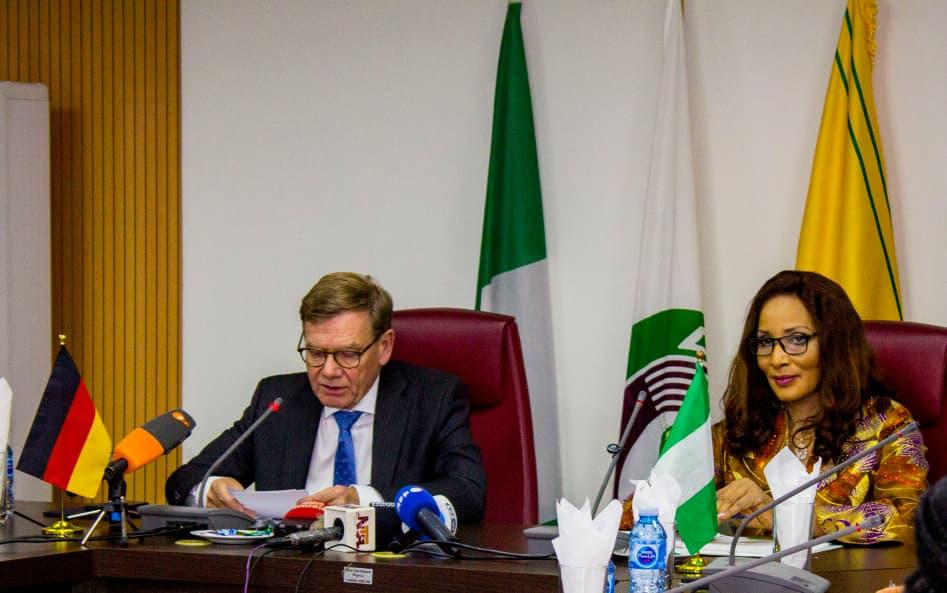
Nigeria and Germany on Wednesday strengthened their longstanding bilateral relationship, committing to expanded cooperation in trade, investment, energy, technology, security and human capital development, as Berlin pledged to encourage greater German investment in Africa’s largest economy.
The renewed commitment emerged during a high-level bilateral meeting in Abuja between Nigeria’s Minister of Foreign Affairs, Ambassador Bianca Odumegwu-Ojukwu, and Germany’s Federal Minister for Foreign Affairs, Johann Wadephul.
The talks underscored both countries’ determination to build on more than six decades of diplomatic relations by transforming their partnership into a stronger platform for economic growth, regional stability and sustainable development.
Welcoming the German delegation, Odumegwu-Ojukwu described Germany as one of Nigeria’s most strategic partners in Europe, noting that bilateral relations had evolved beyond diplomacy to embrace trade, investment, renewable energy, education, science and technology, migration, culture and security.
She said the increasingly complex global landscape—shaped by geopolitical tensions, terrorism, climate change, food insecurity and economic uncertainty—required stronger international partnerships capable of delivering tangible benefits.
According to the minister, Nigeria remains committed to deepening cooperation with Germany in ways that promote economic prosperity, strengthen regional security and contribute to global stability.
She identified renewable energy, digital innovation, artificial intelligence, critical minerals, manufacturing, agriculture, healthcare, infrastructure and the green economy as priority sectors offering significant opportunities for enhanced collaboration.
Odumegwu-Ojukwu also highlighted the Nigeria-Germany Bi-National Commission as a key pillar of bilateral engagement, describing it as an effective mechanism for advancing cooperation across strategic sectors.
She noted that the Federal Government had continued implementing economic reforms aimed at improving the investment climate, strengthening governance and expanding opportunities for private sector participation.
The minister consequently urged Germany to increase investments in Nigeria’s priority sectors, particularly renewable energy, industrialisation, transport infrastructure, agriculture and digital technology.
Responding, Wadephul described Nigeria and Germany as longstanding strategic partners, recalling that Germany established its embassy in Lagos just three days after Nigeria attained independence in 1960.
He said the relationship had continued to flourish, with Germany emerging as Nigeria’s largest bilateral trading partner in Europe.
The German foreign minister disclosed that trade between both countries grew by 10 per cent over the past year, reflecting expanding commercial engagement and stronger economic ties.
He said the Nigeria-Germany Business Forum would continue to serve as a vital platform for promoting trade, facilitating investment and attracting more German companies to Nigeria.
“With my visit, many more German investors will be investing in Nigeria,” Wadephul said, expressing Germany’s strong interest in Nigeria’s energy sector and other industries capable of driving economic transformation and sustainable growth.
He also commended the Nigeria-Germany Bi-National Commission for providing a practical framework for delivering concrete outcomes in bilateral relations.
Beyond economic cooperation, both ministers reaffirmed their commitment to strengthening collaboration on regional security amid growing threats posed by terrorism, violent extremism and organised crime across West Africa.
Odumegwu-Ojukwu praised Germany’s continued support for the Economic Community of West African States (ECOWAS), particularly its contributions to peacebuilding, democratic governance, conflict prevention and institutional development.
Wadephul reaffirmed Germany’s readiness to support ECOWAS efforts to address insecurity in the region, especially the escalating security challenges in the Sahel, while pledging closer collaboration with Nigeria to advance peace and stability.
The renewed commitments signal a significant push by Abuja and Berlin to convert more than 65 years of diplomatic friendship into stronger economic cooperation, increased investment flows and enhanced collaboration in addressing regional and global challenges.