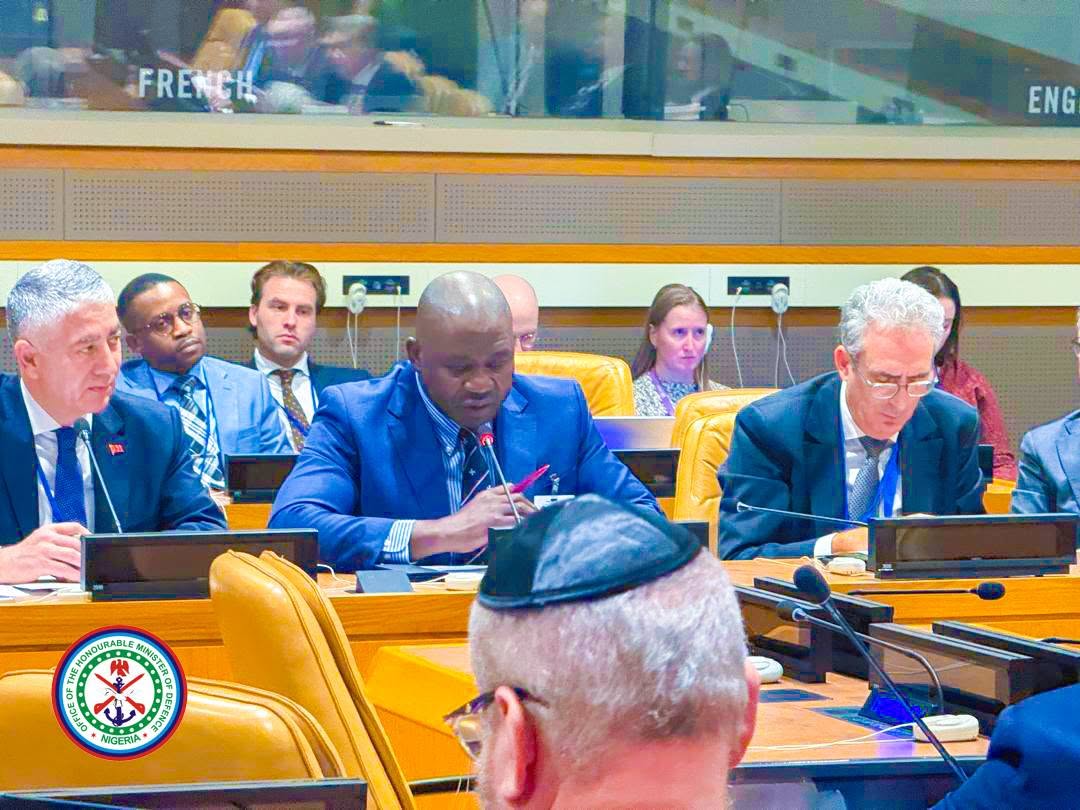
Nigeria has called for a sustained, survivor-centred global response to terrorism, urging the international community to move beyond short-term humanitarian assistance and establish long-term support systems for victims of violent extremism.
The Minister of Defence, General Christopher Gwabin Musa (rtd), made the call at the Ministerial Meeting of the Group of Friends of Victims of Terrorism at the United Nations Headquarters in New York.
The meeting was co-convened by Spain and Iraq and brought together international delegates to deliberate on strengthening support for victims and survivors of terrorism.
Musa said the disproportionate burden of terrorism on Africa required stronger international attention, noting that Sub-Saharan Africa accounted for approximately 60 per cent of global terrorism deaths in 2025.
“Behind these figures are families displaced, livelihoods destroyed, communities fractured, and lives permanently changed,” he said.
The minister stressed that the priorities and needs of victims must translate into sustained programmes capable of supporting survivors beyond the immediate aftermath of attacks.
Highlighting Nigeria’s counter-terrorism and justice efforts, Musa disclosed that the country recorded 865 terrorism-related convictions in 2026, describing the figure as evidence of Nigeria’s commitment to accountability.
He said Nigeria continued to prioritise the rescue and liberation of captives while providing post-rescue support, including medical treatment, psychosocial rehabilitation, economic assistance and community reintegration.
Drawing on Nigeria’s experience in combating violent extremism, the Defence Minister proposed a three-point framework for strengthening international cooperation: enhanced peer learning, inclusive partnerships and targeted United Nations support.
On peer learning, Musa called for institutional mechanisms through which countries could exchange operational models, referral systems and lessons from counter-terrorism interventions, including approaches that failed to deliver their intended outcomes.
He also advocated stronger feedback channels and partnerships among government authorities, civil society organisations and victims’ associations to ensure that survivors have a meaningful role in justice, rehabilitation and reintegration efforts.
The minister further called for expanded UN technical assistance, capacity building and resource mobilisation tailored to countries carrying the heaviest burden of terrorism.
Musa commended UN initiatives supporting victims of terrorism, including the UN Office of Counter-Terrorism’s Global Victims of Terrorism Support Programme and the Victims of Terrorism Associations Network.
He also acknowledged Germany’s support for the development of the Toolkit for Technology-Enabled Support to Victims of Terrorism, describing such initiatives as important components of a stronger international support architecture.
Reaffirming Nigeria’s willingness to share its experience and collaborate with international partners, Musa expressed optimism about the forthcoming International Conference on Victims of Terrorism, scheduled to hold in Baghdad, Iraq, in the fourth quarter of 2026.
He said sustained international cooperation remained essential to ensuring that victims and survivors of terrorism receive not only immediate assistance but also the long-term support required to rebuild their lives and communities.