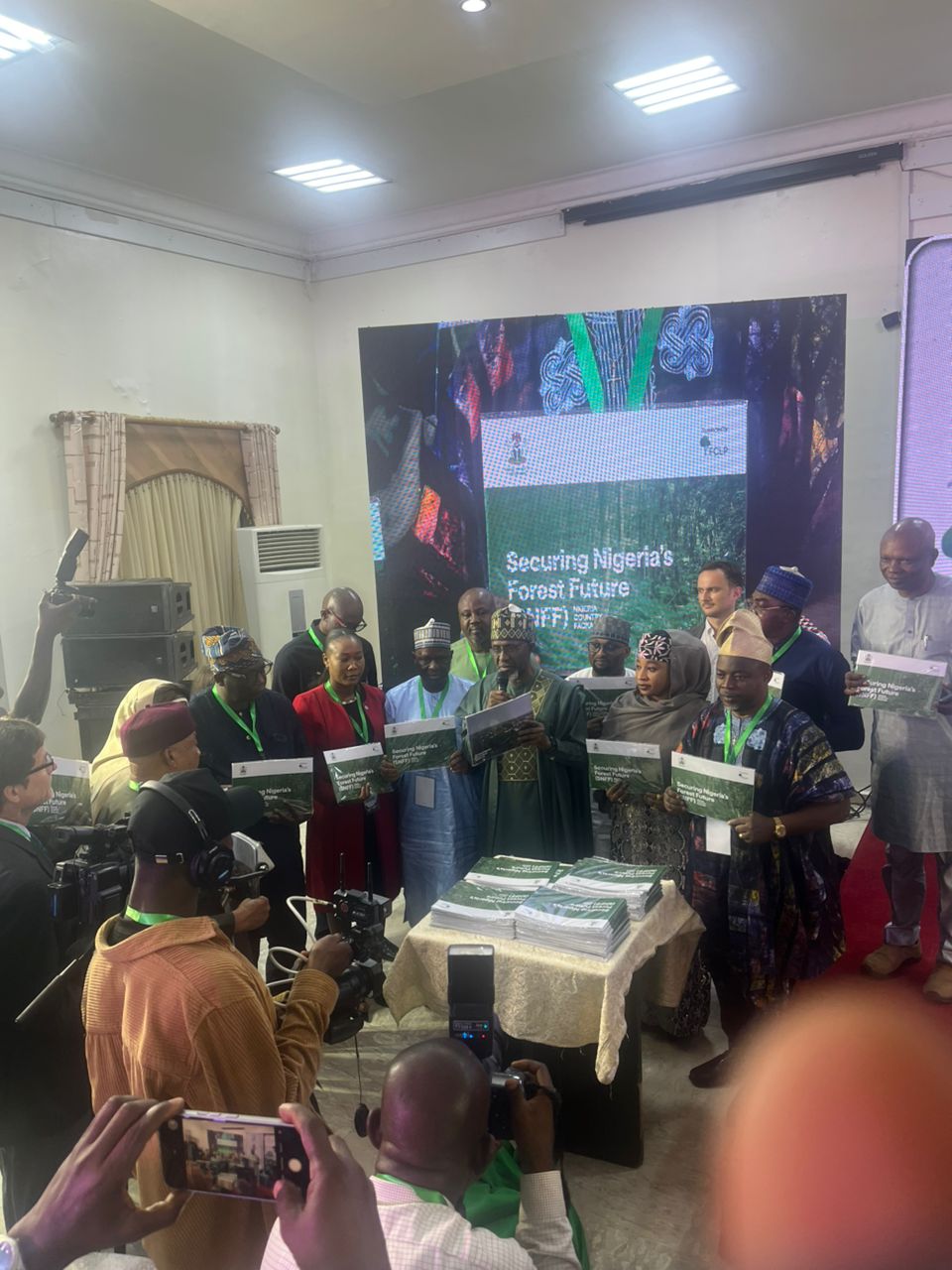
Nigeria has unveiled an ambitious 10-year strategy to transform forest conservation into a major economic and climate investment agenda, targeting about $1 billion in blended finance, the restoration of two million hectares of degraded land and the creation of 1.5 million green jobs.
The initiative, known as the Securing Nigeria’s Forest Future (SNFF) Country Package, was launched on Tuesday in Abuja by the Minister of Environment, Balarabe Lawal, with support from the European Union, Germany and the Food and Agriculture Organisation of the United Nations (FAO).
Under the framework, Nigeria aims to reduce deforestation by 20 per cent, restore two million hectares of degraded forests and landscapes, create 1.5 million green jobs and strengthen climate resilience for more than five million Nigerians.
Lawal said the strategy represented a shift from fragmented forest interventions towards a coordinated investment framework designed to bring together government, private investors, development partners and local communities.
He said Nigeria’s forests remained critical to livelihoods, agriculture, biodiversity, water security and climate resilience but were facing increasing pressure from agricultural expansion, unsustainable exploitation of natural resources and rapid urbanisation.
The Minister stressed that government funding alone would not be sufficient to deliver the scale of intervention required, making private capital, blended finance and carbon finance central to the success of the programme.
He urged financial institutions and private-sector investors to identify commercially viable opportunities in sustainable forest management and forest-based value chains, while emphasising that investments must deliver measurable benefits to local communities.
Lawal also said women and young people must have meaningful opportunities in the emerging green economy.
The European Union, meanwhile, said Nigeria’s forest agenda must be integrated with agriculture, trade and wider economic development, warning that commodity production and land-use practices would increasingly shape the country’s future access to international markets.
Speaking at the launch, the EU Head of Partnerships, Massimo De Luca, said experiences from the Amazon, Congo Basin, Southeast Asia and the Sahel had demonstrated the consequences of weak forest governance and unsustainable land use.
However, he said those regions had also shown that environmental degradation could be reversed through strong institutions, community participation, sustainable agriculture, landscape restoration and international cooperation.
De Luca highlighted EU support for the protection of Nigeria’s natural assets, including Gashaka Gumti National Park and Cross River National Park, as part of broader efforts to conserve biodiversity and protect the economic and ecological value of forests.
He also pointed to the European Union’s €700 million commitment to the Great Green Wall Initiative, aimed at combating desertification, restoring degraded landscapes and strengthening climate resilience across the Sahel.
For Nigeria, one of the most immediate economic implications of improved forest governance could be its agricultural export sector.
De Luca said the European Union Deforestation Regulation presents both challenges and opportunities for Nigeria, particularly for the cocoa industry.
He noted that stronger forest governance, improved land-use planning, farm-level traceability and reliable geospatial data could help ensure that Nigerian cocoa production is not associated with deforestation or forest degradation.
Such measures, he said, could help farmers and businesses maintain access to the European market while encouraging more sustainable agricultural production.
Germany also called for stronger institutions and increased private-sector participation in Nigeria’s transition towards sustainable forest and land management.
The German representative said private investors could provide the capital, technology, innovation and market access needed to accelerate the transition.
However, the representative said investors would require predictable policies, secure land rights, reliable data, access to finance and appropriate incentives.
Germany also stressed that environmental protection would only be sustainable if it created tangible economic opportunities for people living around forest communities.
Local communities, particularly women and young people, must be able to benefit directly from forest conservation and restoration, the German government said, pledging continued support for Nigerian-led solutions and efforts to mobilise additional public and private financing.
The FAO, in its intervention, said Nigeria’s forests could not be separated from the country’s food and agricultural systems.
In a goodwill message delivered on behalf of the FAO Representative in Nigeria and to ECOWAS, Dr Hussein Gadain, the organisation said forests were directly linked to food production, water resources, household incomes and climate resilience for millions of Nigerians, particularly forest-dependent communities.
FAO welcomed the SNFF’s effort to combine forest conservation with sustainable land management, climate action, biodiversity protection, investment and livelihoods.
It stressed that agricultural production and forest protection must advance together through sustainable commodity production, deforestation-free supply chains, agroforestry and landscape restoration.
The organisation also called for communities, women and young people to become active participants in the management and restoration of forest resources.
FAO said it was ready to support Nigeria in developing investment-ready programmes and accessing international environmental and climate financing, including resources available through the Global Environment Facility, Green Climate Fund and Adaptation Fund.
Despite the strong international backing, Lawal acknowledged that the most difficult phase would be implementation.
He said the SNFF would ultimately be judged not by the quality of its policy document but by measurable results delivered on the ground.
The Minister identified clear institutional responsibilities, bankable investment pipelines, resource mobilisation, technical capacity, reliable monitoring systems and strong accountability mechanisms as critical to the success of the strategy.
He urged Ministries, Departments and Agencies to treat the initiative as a cross-cutting economic and climate priority rather than merely a forestry programme.
State governments and local communities, he added, would play a decisive role, as much of the implementation would take place at the subnational level.
Lawal also called on development partners to move beyond fragmented, project-based interventions towards coordinated, scalable and investment-driven programmes.
The Federal Ministry of Environment, through its Department of Forestry, is expected to strengthen forest monitoring systems to track deforestation, degradation and restoration, while supporting Nigeria’s climate and sustainable development reporting obligations.
With the country now facing the challenge of converting ambitious targets into bankable projects and mobilised investments, the success of the strategy will depend on whether financing reaches communities, degraded landscapes are restored and sustainable production becomes economically competitive.
The launch of the SNFF Country Package therefore places Nigeria’s forests at the centre of a broader development and economic agenda—linking environmental protection with job creation, food security, climate resilience, investment mobilisation and the competitiveness of Nigeria’s agricultural exports in a rapidly changing global market.