The Federal Government has unveiled a new digital governance blueprint aimed at integrating government operations, eliminating fragmented public services and improving citizens’ access to government institutions through a unified digital infrastructure.
The initiative follows the handover of Nigeria’s e-Government Master Plan 2.0 (e-GMP 2.0) by the Korea International Cooperation Agency (KOICA) to the Federal Ministry of Communications, Innovation and Digital Economy in Abuja on Thursday, marking the completion of a five-year digital governance partnership between Nigeria and South Korea.
The master plan, covering 2026 to 2030, is designed to transform public administration by connecting government Ministries, Departments and Agencies (MDAs) through common digital infrastructure, shared information systems and coordinated service delivery platforms.
The initiative seeks to move Nigeria away from isolated digital platforms towards an integrated, citizen-centred system that will reduce administrative bottlenecks, improve institutional coordination and strengthen transparency and accountability.
Speaking at the handover ceremony, KOICA Country Director, Mr Kim Eunsup, described digital governance as an increasingly important pillar of Nigeria-South Korea cooperation, noting that the partnership represented a long-term investment in Nigeria’s institutional capacity and human resources.
He said the intervention was designed to establish sustainable digital governance structures rather than deliver isolated technology projects.
The new master plan consolidates the 25 initiatives contained in Nigeria’s first e-Government Master Plan into 10 strategic initiatives built around five pillars: Integrated Digital Infrastructure; Sustainable Digital Government; Citizen-Centric Digital Service Transformation; Digital Governance and Institutional Reform; and Innovations, Partnerships and Digital Capacity.
Developed between May 2022 and 2026 through consultations with relevant government institutions and technical support from South Korea, the framework is expected to provide common standards and direction for digital transformation across the public sector.
Presenting the document, Prof. Hung Kook Park, Project Manager from Sangmyung University, South Korea, highlighted the project’s implementation process, achievements, critical success factors and roadmap for the next phase.
A major achievement of the partnership was the soft launch of Nigeria’s first single-window Government Service Portal (GSP) in July 2026. The platform is designed to provide citizens with a central access point for government digital services, reducing the need to navigate multiple institutional websites.
The project also developed Enterprise Architecture frameworks for the National Information Technology Development Agency (NITDA), Nigeria Customs Service, Nigeria Immigration Service and National Identity Management Commission (NIMC).
An Enterprise Architecture Portal was equally handed over to NITDA in March 2026 to promote standardisation and coordination of digital systems across government institutions.
In another significant intervention, KOICA donated 572 mobile National Identification Number (NIN) registration devices to NIMC and the Nigerian Postal Service (NIPOST) to strengthen digital identity infrastructure and expand registration capacity.
Beyond infrastructure development, the partnership recorded significant investments in human capacity development, with 2,276 public-sector officials and information technology professionals benefiting from various training programmes.
These included 630 state government officials from six states trained to develop their respective e-Government Master Plans, while 69 instructors were prepared for the Nigerian e-Government Training Centre.
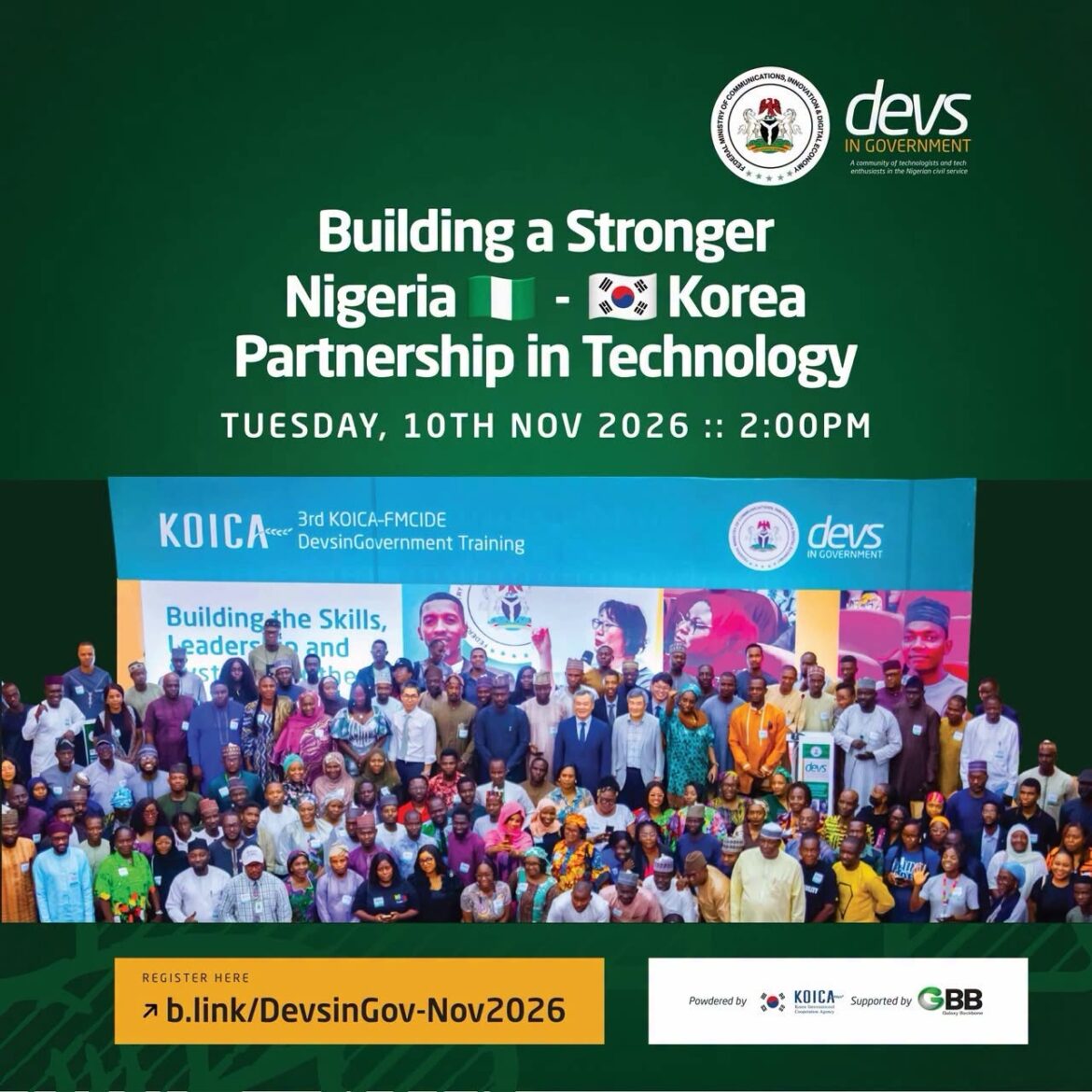
Additionally, 1,646 public-sector information technology professionals participated in four KOICA-supported DevsinGov training sessions.
The earlier phase of the partnership also facilitated the development of Nigeria’s first e-Government Master Plan and the establishment of the Nigerian e-Government Training Centre.
The interventions are expected to strengthen the technical expertise required to manage, maintain and expand digital governance systems across the country.
However, the successful implementation of the new master plan will depend on sustained government investment, effective coordination among MDAs, institutional commitment and adequate maintenance of the digital infrastructure beyond the lifespan of donor-supported projects.
Kim emphasised that the completion of the project should be regarded as the beginning of nationwide implementation rather than the end of the partnership.
He stressed that Nigerian ownership, sustained investment and effective coordination across government institutions would determine the long-term success of the initiative.
He said the systems, institutional frameworks and technical skills developed through the partnership now belonged to Nigeria, adding that KOICA remained committed to supporting the country’s digital transformation efforts.
KOICA, the grant assistance agency of the Government of the Republic of Korea, has partnered with Nigerian institutions since 2008, supporting initiatives in e-government, governance reforms, digital capacity development and national ICT infrastructure.
With the handover of e-GMP 2.0, the Federal Government faces the task of translating the blueprint into practical digital services that will improve administrative efficiency, promote transparency and make public services more accessible to millions of Nigerians.