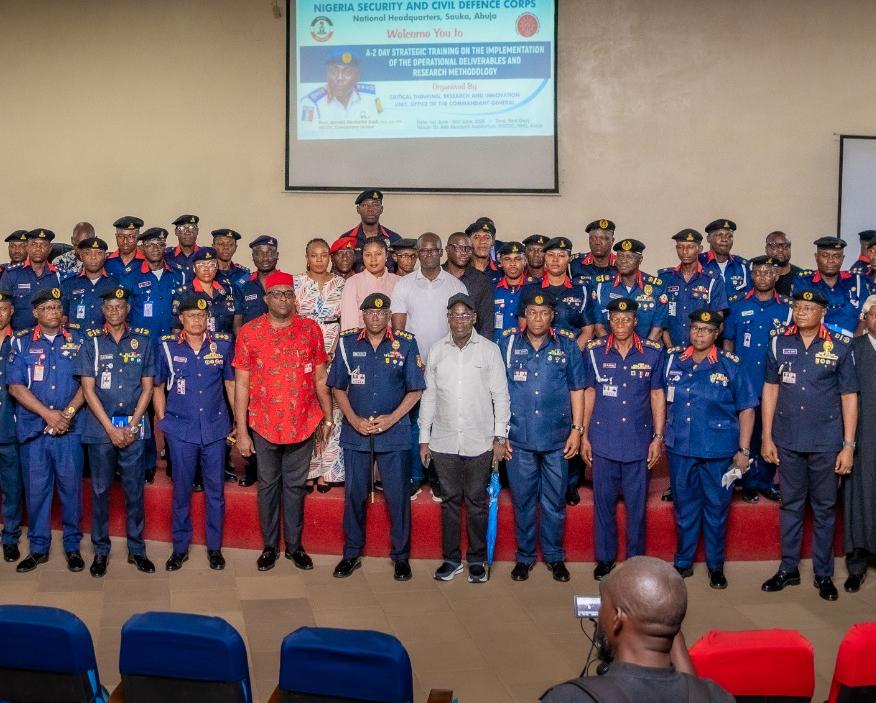
The Nigeria Security and Civil Defence Corps (NSCDC) has intensified efforts to strengthen operational efficiency and institutional performance with the commencement of a strategic capacity-building programme focused on research methodology, operational deliverables, and digital transformation.
Speaking at the opening of a two-day training workshop in Abuja, the Commandant General of the Corps, Prof. Ahmed Audi, described the NSCDC as a critical component of Nigeria’s security architecture, highlighting its responsibilities in the protection of critical national assets and infrastructure, disaster management, intelligence gathering, and community engagement.
Audi said the training was designed to enhance the Corps’ operational effectiveness through the adoption of research-based approaches and digital technologies, in line with the priorities of the administration of President Bola Ahmed Tinubu.
He noted that the evolving nature of security threats requires personnel to move beyond traditional operational methods and embrace analytical thinking, innovation, and technology-driven solutions.
According to him, modern security challenges demand evidence-based strategies and practical problem-solving skills capable of improving service delivery and strengthening national security outcomes.
“Modern security challenges demand evidence-based approaches and innovative problem-solving skills. Personnel must be equipped to identify emerging threats, conduct relevant research, and develop practical solutions that can improve service delivery,” he said.
The Commandant General urged participants to apply the knowledge gained during the training to achieve measurable improvements across commands and formations nationwide.
Earlier, the Commandant in charge of Planning, Research and Statistics, Commandant Peter Okloho, emphasized the importance of effective service delivery, noting that the Federal Government assesses the Corps based on its ability to fulfill its statutory responsibilities.
He called on officers to maintain professionalism and accuracy in reporting processes, stressing that accountability and quality documentation remain essential to institutional success.
Also speaking, the Head of the Critical Thinking, Research and Innovation Unit, Dr. Ogunshola Folashade, underscored the need to integrate field experience with critical thinking and research in addressing contemporary security challenges.
She explained that the workshop would cover implementation strategies for operational deliverables, research methodology, strategic communication, advanced report writing, and institutional best practices.
A major highlight of the programme was the induction and administration of the Oath of Allegiance to newly appointed Critical Thinking, Research and Innovation Desk Officers. The ceremony was conducted by the Corps’ Head of Legal Services, Commandant Bamiyo Akomolafe.
Participants at the training were drawn from the 36 state commands and the Federal Capital Territory, as well as various directorates, departments, and units at the NSCDC National Headquarters.
The programme is expected to enhance institutional capacity, strengthen operational outcomes, and support the Corps’ transition toward a more innovative, research-driven, and technology-enabled security institution capable of responding effectively to emerging security threats across the country.