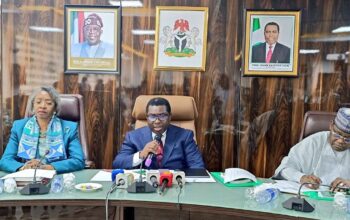
The Honourable Minister of State for Environment, Dr. Iziag Adekunle Salako, delivered a compelling address at the ECOWAS Marine Biodiversity of Areas Beyond National Jurisdiction (BBNJ) Coordination Meeting in Abuja on the urgent need to address the escalating crisis affecting our oceans and climate.
Dr. Salako opened the meeting by highlighting the interconnectedness of biodiversity loss and climate change, emphasizing that both issues are part of the same crisis demanding simultaneous attention. He pointed to the alarming state of the world’s oceans, besieged by threats such as sea level rise, temperature increases, pollution, and unsustainable exploitation of marine resources.
In response to this critical situation, Nigeria and other ECOWAS member nations have issued an “Appeal for an Ambitious Global Response to the Biodiversity Crisis.” The appeal underscores the necessity of designating 30% of land and ocean areas as protected by 2030 and calls for a robust new high-seas treaty.
Currently, only 7% of the world’s oceans are protected, leaving vast international areas without comprehensive legal mechanisms for conservation. Dr. Salako stressed the importance of a new treaty for the conservation and management of marine life in the high seas, with provisions to prevent significant adverse impacts and establish fully protected marine protected areas (MPAs).
Celebrating the adoption of the high-seas treaty in June, Dr. Salako urged prompt ratification to make it enforceable. Nigeria, alongside 22 other nations, symbolically signed a commitment to ratify the BBNJ treaty in September, signaling progress.
Notably, Nigeria’s efforts have garnered support from the 55 member states of the African Union. The Addis Ababa Declaration, adopted at the 19th ordinary session of the Africa Ministerial Conference on the Environment, reflects consensus on ratifying the high-seas treaty. Dr. Salako urged a shift from vague timelines to a specific period for Africa’s ratification, with ECOWAS leading the way.
The meeting, attended by representatives from ECOWAS countries, aims to provide a pathway for prompt ratification and effective engagement in implementing the high-seas treaty. Dr. Salako emphasized the shared responsibility to protect oceans, considering the economic and food security implications for local communities and multinational businesses.
In his closing remarks, Dr. Salako called for collective action, stating, “We must act to protect our oceans now, and we must be bold if we have any hope of preserving our planet for our people and our future generation.” He reiterated the Federal Government of Nigeria’s commitment to ratifying the BBNJ treaty in alignment with President Bola Ahmed Tinubu’s sustainable development agenda.
The Minister expressed gratitude to all attendees for their attention, concluding with a heartfelt wish for blessings upon ECOWAS countries and the Federal Republic of Nigeria in their shared endeavor to safeguard marine biodiversity.