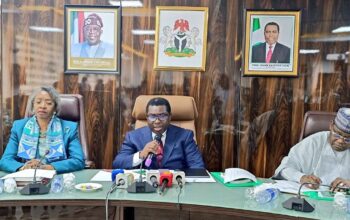
The United Kingdom has expressed strong support for Nigeria’s ongoing economic reforms under President Bola Tinubu, describing them as tough but essential for long-term growth and stability.
Speaking at a press conference on UK-Nigeria trade relations in Abuja on Wednesday, the British High Commissioner to Nigeria, Dr. Richard Montgomery, commended the Nigerian government’s reform agenda, noting its positive impact on investor confidence.
“President Tinubu’s economic reforms are working, and they have made Nigeria more investible,” Montgomery stated. “The naira is now more stable and predictable, and in the last quarter, the Nigerian economy recorded a 4% growth.”
While acknowledging the inflationary pressures and economic hardship resulting from the reforms, Montgomery emphasized that such measures are necessary to stabilize Nigeria’s economy and create a more conducive environment for investment.
He also highlighted the UK’s own economic reforms, which aim to simplify regulations and make international business, including with Nigeria, more predictable.
Princess Zahrah Mustapha Audu, Director General of the Presidential Enabling Business Environment Council (PEBEC), echoed these sentiments, emphasizing that stability and predictability in the exchange rate are critical to attracting investment.
“In the past, investors were deterred by the unpredictability of the naira,” she said. “Now, with the market reforms, those artificial trade windows are gone, and we’ve brought back confidence. Predictability is key.”
She also noted that new government policies must now pass through stakeholder engagement and rigorous assessment processes to ensure they support rather than hinder business growth.
“We’ve stopped the practice where ministries or agencies could unilaterally introduce new policies. Now, everything must go through proper channels to assess the impact on businesses,” she added.
Also speaking at the event, Mark Smithson, the UK’s Country Director for the Department of Business and Trade, revealed that trade between the UK and Nigeria now stands at £7.2 billion. He noted that the UK has granted zero tariffs on 3,000 Nigerian export items, including cocoa, cashew nuts, and tomatoes.