The Federal Government has intensified efforts to integrate artificial intelligence into public sector governance, unveiling a comprehensive reform agenda aimed at enhancing service delivery, transparency, and operational efficiency across the civil service.
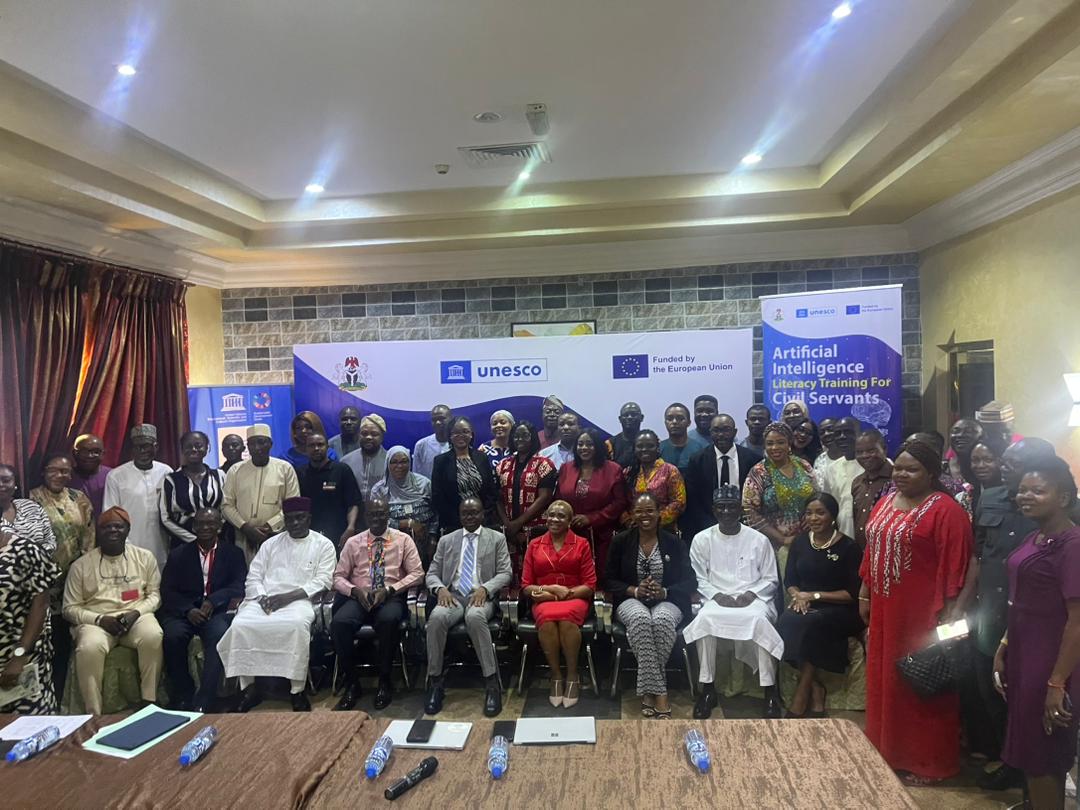
The initiative gained traction on Wednesday in Abuja with the launch of a three-day Artificial Intelligence Literacy Training Programme for senior civil servants. The programme was organised by the Office of the Head of the Civil Service of the Federation (OHCSF) in partnership with the United Nations Educational, Scientific and Cultural Organisation (UNESCO), with support from the European Union.
Declaring the training open, the Head of the Civil Service of the Federation, Mrs Didi Esther Walson-Jack, said the government would accelerate AI-driven reforms to reposition the civil service for modern, technology-enabled governance. Represented by Dr Gideon Adogbo, she noted that artificial intelligence is reshaping governance globally, influencing policymaking, service delivery, and institutional responsiveness.
“The Nigerian Federal Civil Service cannot afford to stand on the sidelines of this transformation,” she said, adding that the initiative aligns with President Bola Ahmed Tinubu’s Renewed Hope Agenda, which prioritises digitalisation, transparency, and improved performance.
Walson-Jack disclosed that the civil service has made notable progress in deploying digital tools to improve coordination across Ministries, Departments and Agencies (MDAs), strengthen knowledge management, and boost efficiency.
She highlighted the introduction of “Service Wise GPT,” an AI-powered platform designed to help public servants navigate Public Service Rules, financial regulations, procurement guidelines, and official circulars with greater speed and accuracy. She clarified that the tool is intended to support decision-making rather than replace human judgment.
However, the Head of Service warned against the unregulated adoption of artificial intelligence, stressing that weak governance frameworks could expose public institutions to risks such as algorithmic bias, misinformation, data misuse, privacy breaches, and diminished accountability.
“Artificial intelligence must support openness, not secrecy. It must strengthen accountability, not reduce it,” she said, emphasising that all deployments must comply with existing procurement and transparency regulations.
She further underscored the role of top civil servants, including Permanent Secretaries, Directors, and Heads of ICT, as critical drivers of implementation responsible for ensuring that AI systems are secure, auditable, and aligned with national priorities.

In his remarks, the Acting Head of Education Sector at UNESCO Abuja, Mr Oladeji Adeyemi, described the initiative as a milestone in Nigeria’s journey towards building a responsible, inclusive, and human-centred AI ecosystem.
He noted that artificial intelligence is a defining force in the global digital economy, with AI competencies increasingly essential for workforce readiness and national competitiveness. According to him, Nigeria’s National AI Strategy and Digital Economy Plan demonstrate a deliberate effort to leverage emerging technologies to boost productivity, enhance security, and improve service delivery across key sectors.
Adeyemi added that Nigeria’s approach is consistent with UNESCO’s Recommendation on the Ethics of Artificial Intelligence, a global framework adopted by over 190 member states to ensure that AI systems are ethical, rights-based, and development-oriented.
Also speaking, Mrs Joy Baderin, Director overseeing the Office of the Permanent Secretary, Special Duties Office in the OHCSF, described the training as timely, noting that digital transformation has become imperative for effective governance.
She explained that the programme adopts a “train-the-trainers” model to ensure knowledge transfer across MDAs, thereby promoting sustainability and long-term institutional impact.
UNESCO officials further noted that, with support from the European Union, the organisation had previously introduced the AI Readiness Assessment Methodology in Nigeria to strengthen national preparedness and guide policy development.
The training, anchored on UNESCO’s global ethical framework, is designed to build both technical capacity and ethical discipline among participants, equipping them with practical strategies to deploy AI tools, strengthen oversight, and improve service delivery outcomes.
Walson-Jack reaffirmed that the overarching objective of the reform is to improve citizens’ welfare through more responsive and transparent governance.
“The future of the Nigerian Civil Service will be shaped by our ability to combine innovation with integrity, technology with accountability, and efficiency with service to the people,” she said.
The initiative marks a significant step in Nigeria’s ambition to emerge as a regional leader in responsible artificial intelligence, while ensuring that digital transformation delivers measurable benefits to citizens.