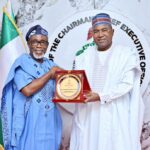
The Minister of Solid Minerals Development, Dr. Dele Alake, has said the South-West region remains at the forefront of Nigeria’s mining revolution, driving record revenues and demonstrating the success of President Bola Tinubu’s Renewed Hope Agenda through comprehensive sector reforms.
Speaking at the South-West Leaders Conference in Akure, Ondo State, on Wednesday, October 29, 2025, Dr. Alake described the ongoing transformation of the mining industry as “progressive and, in several cases, revolutionary,” crediting the achievements to disciplined reforms anchored on transparency, security, and the Yoruba Omoluabi values of integrity and fairness.
He revealed that federal revenues from mining rose sharply from ₦8.6 billion in 2022 to ₦14.9 billion in 2023, ₦38 billion in 2024, and over ₦30 billion already recorded between January and September 2025. The South-West, he added, contributed ₦7.2 billion, making it the highest regional contributor to national mining earnings.
“The South-West region is home to Nigeria’s most successful gold project — the Segilola/Thor Mine — which posted $193 million in turnover last year and employs over 2,000 workers, 80 percent of whom are youths,” Alake said. He also highlighted the region’s rich endowment in minerals such as gold, lithium, limestone, feldspar, and gemstones, with South-West firms holding 1,801 of the 9,592 mineral titles nationwide.
Addressing past challenges, Alake said the creation of the Mining Marshals under the Nigerian Security and Civil Defence Corps had reclaimed over 90 mining sites from illegal occupiers, leading to the prosecution of more than 300 offenders. The improved security, he noted, prompted President Tinubu to lift the five-year ban on mining in Zamfara State.
To strengthen monitoring and accountability, the minister disclosed that the Federal Executive Council approved ₦2.5 billion for the Mines Satellite Monitoring Project, which tracks licensed sites and mineral transportation to curb illegal operations.
He further noted that 46 licensed private mineral buying centres and 369 cooperatives with 5,734 members are currently registered in the South-West, with Osun State leading in community participation. “Establishing cooperatives is our non-kinetic approach to reducing illegal mining,” Alake stated.
The minister emphasized that all mining companies must sign Community Development Agreements (CDAs) with host communities before operations begin. “In the South-West alone, 99 CDAs have been signed, with 45 completed in just the last two years — doubling the total number recorded in over 15 years,” he disclosed.
Alake also announced the establishment of the Nigerian Solid Minerals Company, structured under the Ministry of Finance Incorporated, to operate with a private-sector orientation and engage in joint ventures with global investors.
The reforms, he added, have also boosted revenues from the Mining Cadastral Office, which grew from ₦6 billion in 2023 to ₦12.5 billion in 2024 and ₦26.7 billion so far in 2025.
Internationally, Nigeria’s advocacy for mineral value addition has gained traction, with the country leading the newly formed Africa Minerals Strategy Group (AMSG), chaired by Alake. The initiative, he said, is attracting major processing investments, including a $400 million rare earth plant and lithium projects worth $1.7 billion.
According to data from the National Bureau of Statistics (NBS), the mining sector’s growth rose from 2.84 percent in 2023 to 4.85 percent in 2024, with its GDP contribution increasing from 5.56 to 5.64 percent.
Dr. Alake concluded by urging traditional and local authorities to support the campaign against illegal mining and promote community participation through cooperatives and value addition. “Our past is a story already told,” he declared. “Our future shall be written in gold.”