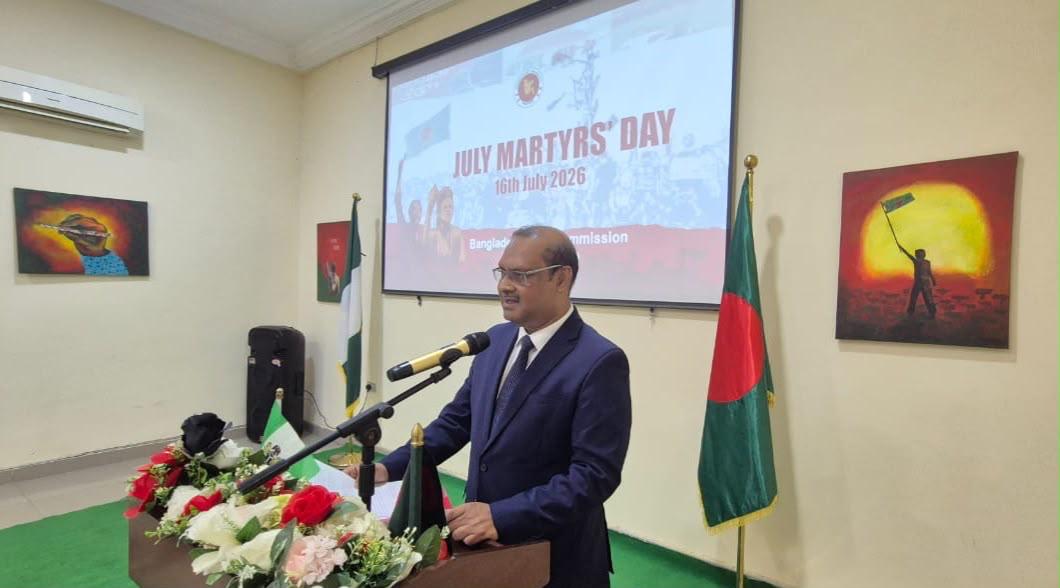
Bangladesh has commemorated the martyrs of its July 2024 Mass Uprising in Abuja, paying tribute to students and citizens whose sacrifices transformed protests against a controversial public service quota system into a nationwide movement that culminated in the collapse of the Awami League government on August 5, 2024.
The solemn ceremony brought together senior Nigerian government officials, diplomats, members of the Bangladeshi community, civil society representatives and friends of Bangladesh to honour those who lost their lives and reaffirm the democratic values for which they fought.
Among the dignitaries in attendance were the Chief of Protocol at Nigeria’s Ministry of Foreign Affairs, Ambassador Babagana Wakil, and the Deputy Director of the Institute for Peace and Conflict Resolution (IPCR), Dr. Patrick Okoro, who delivered the guest lecture.
Addressing the gathering, the Bangladesh representative described the July uprising as a defining chapter in the country’s history, saying it reflected the courage, resilience and unity of the Bangladeshi people.

He said students, youths, workers, professionals and citizens from diverse backgrounds united in pursuit of justice, democracy and accountable governance, adding that the sacrifices of those who died had become a permanent symbol of Bangladesh’s democratic journey.
The commemoration focused particularly on the events of July 16, 2024, described as a turning point in the uprising when unarmed students and ordinary citizens confronted state repression, the use of lethal force and what speakers characterised as politics driven by fear.

Among those honoured was Abu Sayeed, a student leader and coordinator of the movement in Rangpur, whose death became one of the defining moments of the protests.
According to accounts presented at the event, Sayeed stood peacefully with his arms outstretched before he was fatally shot by police. Footage of his final moments quickly spread across Bangladesh, galvanising public support for the movement.
Speakers said at least six people were killed that day, with the fatalities transforming what began as student demonstrations against the quota system into a nationwide uprising that united citizens across social and professional divides and eventually led to the fall of the Awami League administration.
The ceremony also paid tribute to the families of those killed and expressed solidarity with victims who sustained injuries during the protests.
Speakers stressed that the most enduring tribute to the July Martyrs would be the preservation of the principles they died defending, including justice, democracy, equality, the rule of law, human rights, tolerance and national unity.
The event highlighted the commitment of the government of Prime Minister Tarique Rahman to provide recognition, rehabilitation and long-term support for the families of those killed and injured during the uprising.

According to the organisers, the government is also committed to preserving the legacy of the movement while advancing efforts to build a more democratic, just and equitable Bangladesh.
The commemoration assumed broader diplomatic significance as speakers drew parallels between Bangladesh and Nigeria, noting that both nations share youthful populations, vibrant cultural heritage and histories shaped by struggles for democracy, national unity, peace and development.
They observed that Bangladesh’s remembrance of the July Martyrs also provided an opportunity to acknowledge Nigeria’s own sacrifices in the pursuit of democratic governance, national cohesion and lasting peace.
According to the speakers, these shared historical experiences continue to strengthen the longstanding friendship and mutual understanding between both countries.
The ceremony concluded with prayers for the souls of the fallen, comfort for their families, and lasting peace, democracy, stability and prosperity for Bangladesh.
Participants said the commemoration served not only as a tribute to those who lost their lives but also as a renewed call to uphold justice, equality, accountability and human dignity as enduring pillars of democratic governance.