The Economic Community of West African States (ECOWAS) has acknowledged mounting political, security and economic pressures confronting the region, with member states calling for sweeping reforms, stronger unity and people-centred governance to restore public confidence in the regional bloc.
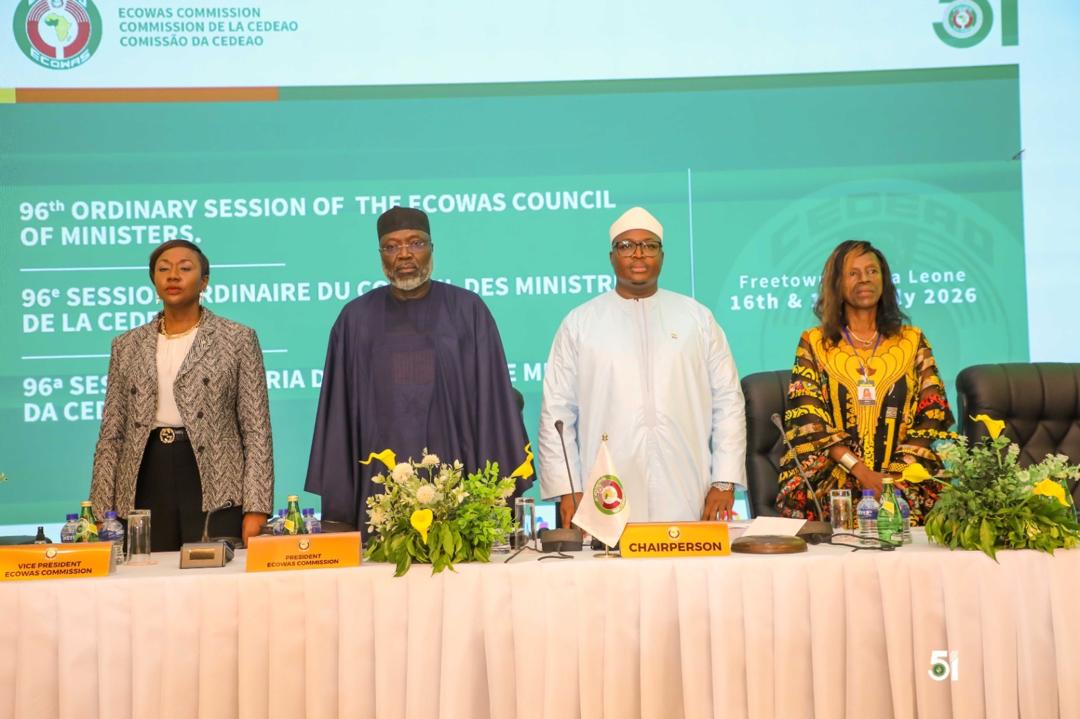
The call came at the opening of the 96th Ordinary Session of the ECOWAS Council of Ministers in Freetown, Sierra Leone, where ministers began two days of deliberations ahead of the 69th Ordinary Session of the ECOWAS Authority of Heads of State and Government.
Opening the meeting, Chairperson of the ECOWAS Council of Ministers and Sierra Leone’s Minister of Foreign Affairs and International Cooperation, Alhaji Musa Timothy Kabba, said the organisation had reached a defining moment in its history and could no longer allow internal divisions and emerging challenges to undermine decades of regional integration.
He said ECOWAS must become more responsive, united and innovative in delivering peace, security, economic opportunities and social progress to the people of West Africa.
“Our citizens’ expectations have never been higher,” Kabba said, urging member states and ECOWAS institutions to ensure that regional integration translates into tangible improvements in the lives of ordinary citizens.
According to him, the region’s growing political and security challenges require renewed commitment to dialogue, solidarity and mutual respect, principles he described as indispensable for lasting peace and sustainable development.
Drawing from Sierra Leone’s experience of post-conflict recovery, Kabba said cooperation and dialogue remained the surest path to regional stability and prosperity.
He urged leaders to remain faithful to the vision of the founding fathers of ECOWAS, stressing that the destinies of West African nations were inseparably linked.
“As we work together over the coming days, let us remain guided by our common purpose and inspired by the vision of the founding fathers of ECOWAS, who understood that our individual destinies are inextricably linked to our collective future,” he said.
Echoing the call for reform, President of the ECOWAS Commission, Dr. Omar Alieu Touray, said the regional body must now move beyond celebrating its achievements and focus on translating its shared vision into practical actions capable of addressing the changing realities of West Africa.
He noted that ECOWAS had navigated one of the most difficult periods in its five-decade history, marked by political transitions, worsening insecurity, economic uncertainty, global instability and the withdrawal of Burkina Faso, Mali and Niger from the bloc.
“Together, we have steered our community through one of the most challenging periods in its history,” Touray said.
Despite the challenges, he said the Commission had continued to implement decisions of the Authority of Heads of State and Government, preserve institutional stability, maintain dialogue among member states and sustain Community programmes.
Touray stressed that the organisation’s future depended not merely on preserving its institutions but on strengthening them to respond more effectively to the aspirations of West Africans.
“Following the commemoration of the fiftieth anniversary of ECOWAS last year, our focus must now be on translating our shared vision into concrete actions that respond to the changing realities of our region,” he said.
Highlighting recent achievements, Touray cited the operationalisation of the Permanent Representatives Committee as an advisory body to the Council of Ministers, the completion and commissioning of the Mfum-Ekok Bridge and Joint Border Post linking ECOWAS and the Economic Community of Central African States (ECCAS), and the inauguration of the ECOWAS Business Council under the chairmanship of Nigerian industrialist Aliko Dangote.
He also listed the relocation of the ECOWAS Commission to its new headquarters in Abuja in May 2026 as a major institutional milestone.
“These milestones reflect our collective determination to build stronger institutions capable of serving the people of West Africa more effectively,” he said.
The Council of Ministers is expected to review the 2026 Interim Report on the State of the Community, assess the organisation’s financial position and evaluate the implementation of previous decisions.
Ministers will also consider reports from key statutory bodies, including the Administration and Finance Committee, Audit Committee, Judicial Council and the ad hoc ministerial committee on the selection and evaluation of statutory appointees.
Other issues on the agenda include digital transformation, regional investment promotion, trade, agriculture, telecommunications, science and innovation, gender equality and cultural cooperation.
The Council is also expected to deliberate on relations between ECOWAS and the Alliance of Sahel States (AES)—Burkina Faso, Mali and Niger—which withdrew from the regional bloc.
Recommendations from the ministerial meeting will be presented to the ECOWAS Authority of Heads of State and Government during its 69th Ordinary Session.
Kabba urged delegates to conduct the deliberations with wisdom, mutual respect and a shared commitment to advancing the interests of the Community, saying the meeting must strengthen ECOWAS’ capacity to address the region’s complex political, security and socio-economic challenges.
The session also marked Touray’s final Ordinary Council meeting as President of the ECOWAS Commission after four years in office.
He expressed appreciation to the Authority of Heads of State and Government, the Council of Ministers, member states, development partners and ECOWAS staff for their support, professionalism and resilience throughout his tenure.
Touray maintained that the progress recorded by the Commission was the result of collective commitment rather than individual effort.
“I leave office with confidence in the future of our Community,” he said, expressing optimism that ECOWAS possesses the resilience, institutional capacity and political will to deepen regional integration, strengthen peace and security, and promote sustainable development across West Africa.
The Freetown meeting is widely seen as a pivotal moment for the 15-member regional bloc as it seeks to restore confidence in its institutions, reinforce regional unity and demonstrate that integration can deliver meaningful economic and social benefits for the people of West Africa.