The Federal Government has raised concerns over a worsening mental health crisis among children displaced by conflict, revealing that 79.7 per cent suffer post-traumatic stress disorder (PTSD), while 84.8 per cent experience depression.
The government also disclosed that 90.7 per cent of displaced children suffer functional impairments affecting their learning, relationships and sleep, warning that untreated childhood trauma could have far-reaching consequences for Nigeria’s education, healthcare and national security systems.
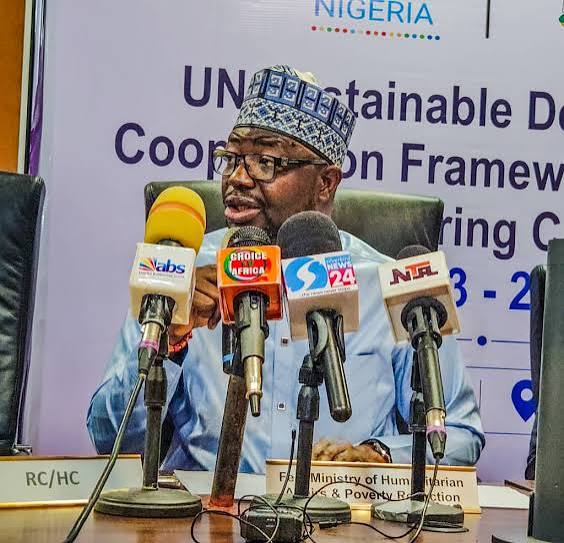
The Minister of Humanitarian Affairs and Poverty Reduction, Dr Bernard Doro, disclosed this on Wednesday in Maiduguri, Borno State, at the National Dialogue on the Psychosocial Impact of Conflict on Children in Nigeria.
Doro said the figures offered measurable evidence of the hidden human cost of years of insurgency, terrorism and displacement, stressing that humanitarian interventions could no longer focus solely on food, shelter and physical protection.
“A child who has been fed, but not healed in mind, has not truly been rescued,” the minister said.
He warned that children who carry untreated trauma into adulthood could impose a significant long-term burden on Nigeria’s schools, hospitals and security institutions.
“None of this is a charity; it is an investment. Untreated trauma in a generation of children is a cost that returns to our schools, our clinics, and our security architecture for decades,” Doro said.
The minister cited evidence from Borno State, including a study in Chibok which found that 41.5 per cent of children exposed to Boko Haram insurgency met the clinical threshold for PTSD.
He also referenced a continent-wide analysis which estimated conflict-related PTSD among African children at about 36 per cent.
Doro said mental health had historically received less attention than physical health because psychological symptoms were often less visible, but stressed that Nigeria could no longer afford to treat mental wellbeing as a secondary concern.
“Globally, there is a bias towards physical health compared to mental health. Because mental health manifests with subtle symptoms, healthcare professionals and policymakers do most times ignore mental health. This narrative needs to change,” he said.
According to the minister, more than one million children in the North-East have been uprooted from their homes by conflict, while more than 7,000 women and girls have been held by Boko Haram.
He said the psychological consequences of prolonged conflict were evident among children from communities including Bama, Konduga, Gwoza and Chibok.
“These are the children of Bama, Konduga, Gwoza, Chibok. Children we have all met, I’m sure, in our interactions. And they go quiet in mid-sentences, manifesting the very symptoms of mental illness,” he said.
To address the crisis, Doro said the ministry would collaborate with the Office of the Special Adviser to the President on Health and other partners to establish stronger community referral systems to ensure that distressed children identified in schools and displacement camps receive appropriate care.
He also announced plans to incorporate trauma exposure into the National Social Registry alongside economic vulnerability, enabling government to identify households and communities with significant psychosocial needs.
The ministry, he added, would support the training of teachers and frontline humanitarian workers to recognise early warning signs among children affected by conflict.
“A child spends more hours with a teacher than a therapist,” Doro said.
Earlier, the Special Adviser to the President on Health, Dr Salma Ibrahim Anas, said Maiduguri was deliberately chosen as the venue because of Borno’s prolonged exposure to insurgency.
Anas said the dialogue was aimed at moving the conversation from isolated interventions to a coordinated national policy response anchored on research and evidence.
She recalled the case of a woman who fled Bama with seven children but arrived at the Dalori Internally Displaced Persons camp with only one, without knowing the fate of the others.
Such experiences, she said, demonstrate that displacement does not necessarily end when victims reach a camp or another place of safety.
“Some have been born only in this crisis,” Anas said, warning that children who spend their formative years surrounded by violence could carry its consequences into adulthood and transmit unresolved trauma to another generation.
The humanitarian scale of the crisis was further highlighted by the United Nations Office for the Coordination of Humanitarian Affairs (OCHA).
Representing OCHA, Ballama Mustapha said 7.8 million people required humanitarian assistance across Borno, Adamawa and Yobe under the 2025 Humanitarian Response Plan, including about 1.8 million children.
He said the 2026 plan identified 5.9 million people for humanitarian assistance, but funding remained inadequate to meet the scale of the needs.
“The wounds we cannot see must not become the reason we fail to act,” Mustapha said.
The UNICEF representative, Francis Otuochi, said an estimated 270,864 children across Borno, Adamawa and Yobe required mental health and psychosocial support under the 2026 humanitarian needs and response plan.
He added that more than 161,000 adults and over 23,000 persons living with disabilities also required psychosocial support.
Otuochi urged the government to move mental health and psychosocial services from the margins of humanitarian interventions into mainstream child protection, education, healthcare and social welfare systems.
“Conflict continues to cause profound harm on children, including fear, anxiety, family separation, disrupted learning, and exposure to violence and trauma,” he said.
The North East Development Commission (NEDC) also stressed that psychological recovery must accompany the physical reconstruction of communities devastated by conflict.
Representing the commission’s Managing Director, Mohammed Goni Alkali, the Borno State Coordinator, Engineer Muhammadu Umaru Maska, said the rebuilding of schools, hospitals, roads, markets, water systems and homes should form part of a broader peacebuilding strategy.
He said youth empowerment, livelihood restoration, support for internally displaced persons and social cohesion were equally essential to prevent communities from relapsing into violence.
“Development should be regarded not as a mere economic activity, but as a powerful instrument of conflict prevention and peacebuilding,” Maska said.
The representative of the National Council of Traditional Rulers of Nigeria, Zanna Lawan Maina, District Head of Damboa, emphasised the role of traditional institutions in rebuilding trust, mobilising communities and supporting reconciliation.
The dialogue was convened by the Office of the Special Adviser to the President on Health in partnership with the NEDC and the Borno State Government.
Stakeholders agreed that Nigeria’s recovery from years of conflict must extend beyond physical reconstruction, warning that failure to invest deliberately in the mental wellbeing of children raised amid violence could create a second crisis—one defined not by destroyed infrastructure, but by a generation burdened by trauma, disrupted development and reduced capacity to build peaceful communities.