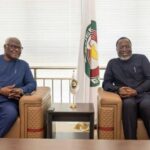
The Executive Chairman of Nigeria’s Economic and Financial Crimes Commission (EFCC), Ola Olukoyede, reaffirmed his commitment to intensifying the fight against economic crimes and corruption as he marked his first year in office.
At a media conference in Abuja on October 31, 2024, Olukoyede—represented by EFCC’s Director of Public Affairs, Wilson Uwujaren—highlighted significant achievements over the past year.
Olukoyede’s tenure has seen over 3,455 convictions in various corruption cases and the recovery of billions in assets. Notable cases include the prosecution of four former governors: Yahaya Bello, Abdulfatah Ahmed, Willie Obiano, and Darius Dickson Ishaku, charged with corruption and money laundering in cases amounting to billions of naira.
In the crackdown on abuse of the naira, the EFCC’s Special Task Force achieved 35 convictions, including high-profile offenders like popular figures Bobrisky and Oluwadarasimi Omoseyin. This initiative is part of a broader campaign against currency misuse and economic destabilization.
Internationally, the EFCC facilitated the repatriation of assets recovered from Nigerian fraudsters, handing over $180,300 and 53 vehicles to Canada, and €5,100 to Spain. The EFCC also advanced its global reach, strengthening ties with agencies such as the FBI, whose Director, Christopher Wray, recently visited Nigeria to bolster collaboration on cyber and financial crimes.
Domestically, the EFCC launched the Fraud Risk Assessment Prevention program, aimed at reducing fraud within government departments. A new department, Fraud Risk Assessment and Control (FRAC), was established to examine systemic vulnerabilities. The EFCC further launched a Cybercrime and Rapid Response Centre for real-time reporting of cyber-related offenses, alongside a collaboration with Flutterwave to establish a Cybercrime Research Centre at the EFCC Academy.
Olukoyede has made strides in reforming EFCC’s operations and expanding public outreach with the introduction of EFCC Radio 97.3 FM to promote anti-corruption messaging. New directorates are also set to open in Ekiti, Katsina, and Anambra, reinforcing the agency’s commitment to fighting corruption across Nigeria.