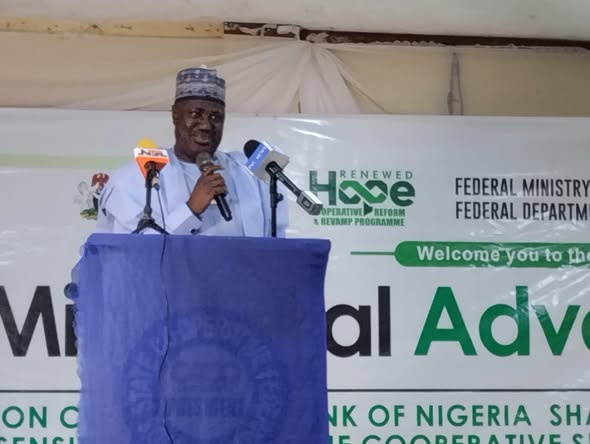
The Federal Government has flagged off the South-West zonal engagement of the ministerial advocacy tour on the Cooperative Bank of Nigeria share capital mobilisation and cooperative sector digitalisation drive as part of efforts to reposition cooperatives as catalysts for inclusive economic growth and financial inclusion.
The initiative was launched on Monday at the LASCOFED Multipurpose Hall in Ikeja, Lagos, by the Minister of State for Agriculture and Food Security and Supervising Minister of Cooperative Affairs, Aliyu Sabi Abdullahi.
According to the minister, the programme forms part of the Renewed Hope Cooperative Reform and Revamp Programme (RH-CRRP) 2025–2030 approved during the eighth regular meeting of the National Council on Cooperative Affairs held in March 2026.
Abdullahi said the initiative aligns with the administration of Bola Ahmed Tinubu and its Renewed Hope Agenda aimed at driving food security, enterprise development, job creation and poverty reduction while supporting Nigeria’s aspiration of building a one-trillion-dollar economy.
He described the South-West launch as symbolic, noting that the region marked the origin of the cooperative movement in Nigeria with the establishment of Gbedun Cooperative in 1937.
The minister announced the commencement of nationwide sensitisation for the proposed Cooperative Bank of Nigeria, which he said would provide accessible and affordable financial services to cooperators, farmers, artisans, traders, small and medium-scale enterprises, youths, women and persons with special needs.
To safeguard the bank’s cooperative identity, Abdullahi disclosed that 65 per cent controlling equity would be reserved for cooperative societies, unions, federations and individual cooperators, while 30 per cent non-controlling equity would be open to private institutional investors, development finance institutions and qualified individuals.
He added that the remaining five per cent equity participation would be allocated to employees of the bank and affiliated cooperative enterprises to ensure institutional commitment.
The minister stressed that the initiative was government-enabled but not government-funded, noting that no Treasury Single Account funds would be utilised.
“The Federal Ministry of Agriculture and Food Security will provide policy support, stakeholder coordination and regulatory facilitation only,” he said.
As part of the digitalisation drive, Abdullahi unveiled two digital identity systems for the cooperative sector — the Cooperative Verification Number (CVN) for registered cooperative societies and the Cooperative Members Identification Number (CoopID) for individual cooperators nationwide.
According to him, both systems would be integrated with the National Identity Number architecture to improve transparency, eliminate ghost cooperatives, strengthen investor confidence and serve as the data backbone for the proposed cooperative bank.
The minister outlined seven pillars of the RH-CRRP 2025–2030, including cooperative governance reforms, financing and establishment of the Cooperative Bank of Nigeria, sector digitalisation, capacity building, enterprise development, inclusion of women and youths, and strategic partnerships for global competitiveness.
He further disclosed plans for the establishment of the proposed Cooperative Trust and Investment Society of Nigeria, known as CoopTrust, to expand investments into housing, transport, agro-processing, retail and digital platforms.
“Under RH-CRRP 2025–2030, we are ending the era of dormant cooperatives. We are building a movement that creates wealth, jobs and dignity for millions of Nigerians,” Abdullahi stated.
In her remarks, Lagos State Commissioner for Commerce, Cooperatives, Trade and Investment, Folashade Ambrose-Medebem, described cooperatives as strategic institutions for future economic development rather than relics of the past.
She noted that more than one billion people globally belong to cooperatives, while the world’s top 300 cooperatives generate over two trillion dollars annually through agriculture, housing finance, retail distribution and community banking.
Ambrose-Medebem emphasised the need for a coordinated national cooperative data architecture capable of generating reliable statistics on GDP growth, employment and agricultural productivity.
She also advocated stronger digital interoperability between cooperative registries, financial institutions and regulatory agencies to improve transparency, reduce fraud and enhance access to financing.
The commissioner warned that access to finance without strong governance structures could undermine sustainability and called for intensive capacity-building for cooperative leaders in financial management, internal controls, audit compliance and strategic planning.
Earlier in his vote of thanks, the Federal Director of the Cooperatives Department, Mohammed Bashir Abdulkadir, said the discussions reaffirmed the bright future of the cooperative movement in Nigeria.
He commended Abdullahi for his commitment to repositioning the cooperative sector under the RH-CRRP and appreciated the Lagos State Government and other stakeholders for supporting the successful launch of the South-West ministerial tour.