The Federal Government has unveiled a renewed strategy to combat human trafficking, warning that criminal syndicates are increasingly exploiting digital platforms, cybercrime and transnational networks to recruit, control and exploit victims.
Attorney-General of the Federation and Minister of Justice, Chief Lateef Fagbemi (SAN), said Nigeria must strengthen its legal framework, institutional capacity and international partnerships to effectively confront traffickers who have shifted from conventional methods to sophisticated online recruitment and cyber-enabled forced criminality.
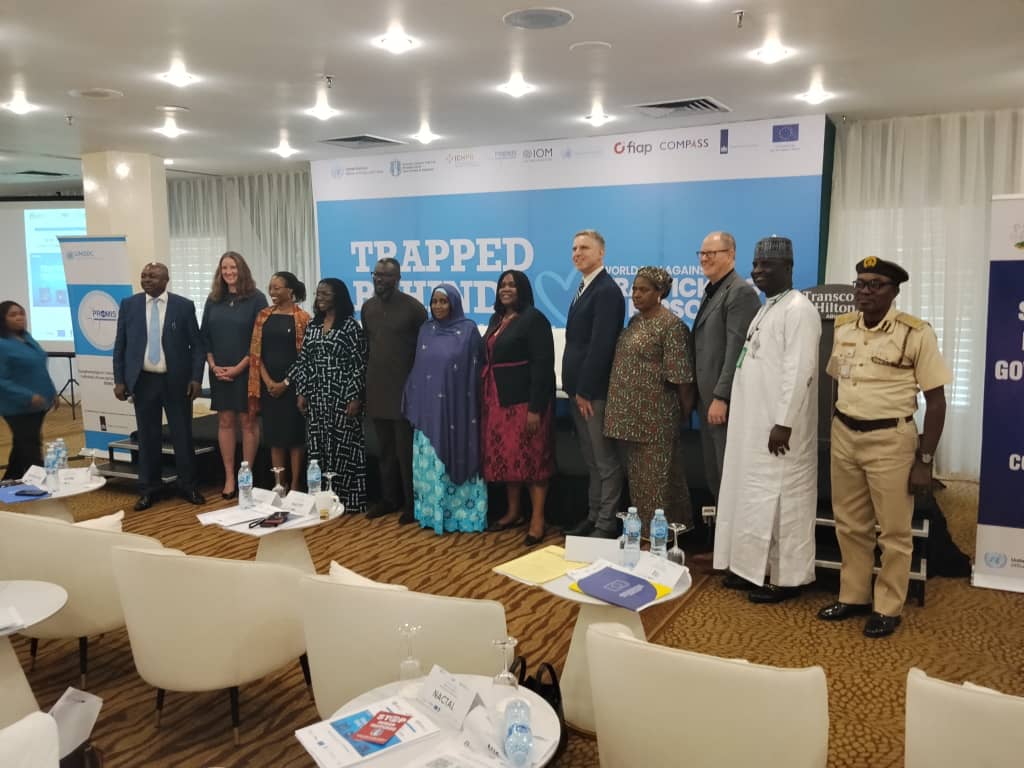
Fagbemi, represented by the Director of Research, Planning and Statistics in the Federal Ministry of Justice, Mrs. Victoria Ojogbane, spoke at the national commemoration of the 2026 World Day Against Trafficking in Persons in Abuja, themed “Trapped Behind the Scam.”
He said the Federal Government was committed to reinforcing Nigeria’s legal and institutional response to emerging trafficking trends linked to online scams, cybercrime and organised transnational criminal activities.
According to him, traffickers are increasingly exploiting technological advancements to evade detection, recruit victims and transfer illicit proceeds, making stronger intelligence sharing, enhanced law enforcement coordination, effective prosecution and improved victim protection imperative.
“The changing dynamics of human trafficking require stronger laws, closer inter-agency collaboration and deeper international cooperation to ensure traffickers no longer exploit technological advances and cross-border criminal networks to evade justice,” he said.
The Attorney-General assured that the government would continue to support intelligence-led operations, strengthen partnerships with security agencies, neighbouring countries and development partners, while ensuring that victims receive adequate protection and rehabilitation.
He noted that traffickers now commonly use fake job offers, scholarship opportunities, business proposals and migration promises circulated through social media and messaging platforms to lure unsuspecting victims into exploitation.
The renewed government offensive comes amid growing concerns over the increasing convergence of human trafficking, cybercrime, money laundering and organised criminal enterprises.
Director-General of the National Agency for the Prohibition of Trafficking in Persons (NAPTIP), Binta Bello, described the digital transformation of trafficking as one of the most serious challenges facing anti-trafficking agencies worldwide.
She warned that traffickers are capitalising on unemployment, poverty and the aspirations of young Nigerians by deploying sophisticated online deception to recruit victims before subjecting them to forced labour, cyber fraud, sexual exploitation and other forms of modern slavery.
Bello said this year’s theme reflects the reality that many victims are first manipulated online before becoming trapped in criminal exploitation.
She called for stronger collaboration among government institutions, technology companies, financial institutions, security agencies and civil society organisations to dismantle trafficking networks.
Delivering the keynote address, the Country Representative of the United Nations Office on Drugs and Crime (UNODC), Cheikh Touré, warned that trafficking in persons, cybercrime, money laundering and financial fraud are increasingly merging into a single transnational criminal enterprise.
He explained that victims are frequently deceived through fake online advertisements and social media posts offering employment, educational opportunities and migration pathways, only to end up in scam compounds where their identity documents are confiscated and they are forced to perpetrate online fraud.
Touré disclosed that many victims are compelled to operate romance scams, investment fraud and cryptocurrency-related schemes targeting victims across the world.
He added that UNODC research conducted across 21 Nigerian states found increasing evidence of traffickers exploiting digital platforms for recruitment, with many survivors identifying fraudulent employment and migration opportunities as the primary tactics used by criminal networks.
According to him, Nigerians are increasingly being trafficked into overseas cyber scam compounds, while similar patterns of forced online criminality are beginning to emerge within the country.
To strengthen enforcement, UNODC announced the establishment of a Joint Operational Task Force involving NAPTIP and the Nigeria Immigration Service under the European Union-funded Partnership Against Cybercrime and Trafficking in Persons (PACTS) Project.
The task force will focus on intelligence gathering, digital evidence preservation, financial investigations and cross-border operations against trafficking syndicates.
The Head of Office of the International Centre for Migration Policy Development (ICMPD) Nigeria, Isabelle Wolfsgruber, said traffickers have shifted recruitment from physical locations to digital spaces, where deceptive messages offering jobs, scholarships and migration opportunities are increasingly targeting vulnerable individuals.
She noted that ICMPD is supporting Nigeria’s anti-trafficking efforts through the European Union-funded Free Movement of Persons and Migration in West Africa (FMM II) Project, the Netherlands-supported School Anti-Trafficking Education and Advocacy Project (STEAP), and the Trafficking in Persons Victim Assistance Programme (TIPVAP) implemented with NAPTIP.
Wolfsgruber stressed that no single country or organisation can defeat trafficking alone, given the speed with which criminal networks share tactics and operate across international borders.
Also speaking, the Chief of Mission of the International Organisation for Migration (IOM) in Nigeria, Sharon Dimanche, emphasised the importance of a survivor-centred response, noting that traffickers often lure victims with promises of education, employment and a better future rather than threats of violence.
She recounted the experience of children rescued by NAPTIP in Lagos after being deceived with promises of education, as well as a Nigerian trafficked to Southeast Asia under the guise of legitimate employment before being forced into cyber fraud after his passport was confiscated.
Dimanche said the victim was eventually repatriated through coordinated efforts involving the Federal Government, NAPTIP, IOM and other partners, describing the case as evidence of the growing sophistication of modern trafficking networks.
According to her, IOM has assisted more than 7,700 trafficking survivors since 2017, with nearly 90 per cent of them being women and girls, mostly young adults seeking improved economic opportunities.
She stressed that rehabilitation extends beyond rescue operations and requires sustained psychosocial support, education, skills acquisition and livelihood opportunities to prevent survivors from being re-trafficked.
Stakeholders at the event agreed that human trafficking has evolved into a complex security, justice and development challenge requiring technology-driven law enforcement, stronger regional cooperation, robust public awareness campaigns and sustained investment in victim support.
They maintained that Nigeria’s success in combating trafficking will depend on its ability to respond with the same speed, coordination and technological sophistication now employed by organised criminal networks.