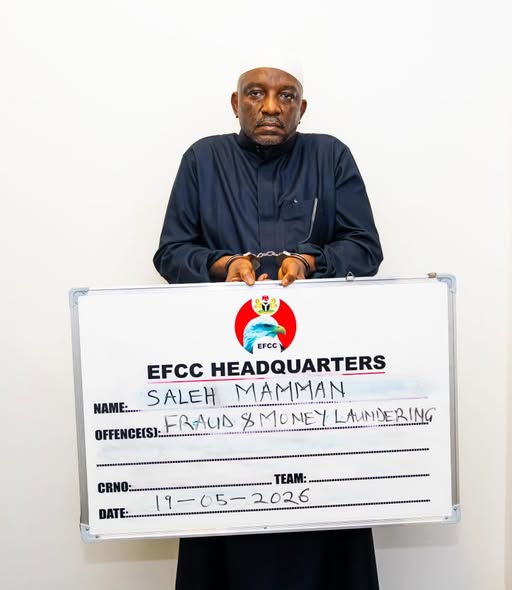
The arrest of former Minister of Power, Saleh Mamman, in Kaduna by the Economic and Financial Crimes Commission (EFCC) marks a significant turn in one of Nigeria’s most closely watched corruption prosecutions in the energy sector, underscoring both the persistence of anti-graft enforcement and the widening legal consequences of high-level financial misconduct.
Mamman was picked up in the Rigasa area of Kaduna State in the early hours of Tuesday, 19 May 2026, after weeks of surveillance and intelligence-led tracking, according to the EFCC. His arrest follows his decision to go underground after being convicted by the Federal High Court in Abuja on corruption-related charges.
EFCC Chairman, Ola Olukoyede, said Mamman had been declared a fugitive after failing to appear for sentencing proceedings. The court had earlier convicted him in absentia on 7 May 2026 on 12 counts relating to the diversion of funds earmarked for major national power projects.
At the centre of the case are allegations that billions of naira intended for the Zungeru and Mambilla hydroelectric power projects were siphoned through proxy companies and associates. The court found that at least N22 billion was diverted, describing the transactions as a “gross abuse of public trust” involving critical national infrastructure.
Justice James Omotosho held that the prosecution had proved its case beyond reasonable doubt, noting that the defence failed to provide credible evidence to counter the EFCC’s allegations. The judgment also detailed how funds were allegedly routed through layered corporate structures to obscure their origin and beneficiaries.
The sentencing phase of the trial had been scheduled for 13 May 2026, but Mamman failed to appear in court, prompting a bench warrant and his subsequent classification as a wanted convict. The court later proceeded to impose a cumulative sentence of 75 years’ imprisonment, structured across multiple counts, with some terms to run consecutively and others concurrently, alongside limited options of fine on select counts.
Mamman, who served as Minister of Power between 2019 and 2021 under former President Muhammadu Buhari, oversaw a sector long burdened by infrastructure deficits and stalled hydropower ambitions, including flagship projects such as Mambilla and Zungeru. His conviction therefore carries symbolic weight in a sector repeatedly flagged as central to Nigeria’s development challenges.
Beyond the concluded case, Mamman remains entangled in a separate corruption trial before the Federal Capital Territory High Court involving an alleged N31 billion fraud. In that matter, Justice Maryanne Anenih issued a bench warrant on 11 May 2026 after he again failed to appear in court.
From a broader governance perspective, the development highlights an increasingly assertive posture by anti-corruption institutions, particularly in pursuing post-conviction enforcement. It also raises institutional questions about the ease with which high-profile defendants evade judicial processes, even after conviction.
The EFCC has indicated that Mamman will now be processed for transfer to the Correctional Centre to commence service of his sentence, signalling the close of one phase of a protracted legal battle, even as others remain ongoing.
In practical terms, the case reflects a tightening enforcement environment, but also the enduring structural challenge: ensuring that high-value corruption prosecutions translate into uninterrupted execution of judicial outcomes, particularly when politically exposed persons are involved.