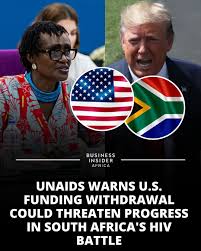
The global campaign against HIV/AIDS is facing a dangerous setback as deep cuts in international funding threaten to reverse decades of progress, the Joint United Nations Programme on HIV/AIDS (UNAIDS) has warned.
In a special report unveiled on Monday at the 26th International AIDS Conference in Rio de Janeiro, Brazil, UNAIDS revealed that an estimated 1.2 million people contracted HIV in 2025, while 570,000 died from AIDS-related illnesses, highlighting growing concerns that the epidemic could regain momentum if urgent action is not taken.
The agency warned that unless the world accelerates efforts to meet the 2030 global targets, more than three million additional people could become infected with HIV in the coming years.
Although new HIV infections and AIDS-related deaths have fallen to their lowest levels in more than 30 years, UNAIDS cautioned that the gains are increasingly fragile as financial support declines and prevention programmes come under pressure.
According to the report, about nine million of the estimated 41 million people living with HIV were not receiving life-saving antiretroviral therapy in 2025, while nearly half of all children living with the virus lacked access to treatment.
Progress has also become uneven across regions. While Benin, Eswatini, Kenya, Lesotho, Nepal, Rwanda and Zimbabwe have reduced new HIV infections by nearly 80 per cent since 2010, infections rose across three regions and in 21 countries during 2025.
UNAIDS Executive Director, Winnie Byanyima, said scientific breakthroughs have revolutionised HIV prevention, with long-acting injectable medicines offering protection levels approaching those of vaccines. However, she stressed that access, affordability and equity remain the greatest barriers.
“Scientific breakthroughs are giving us tools that previous generations could only dream of,” Byanyima said. “However, innovation without access is not innovation—it is injustice. The real measure of success is whether people who need these medicines can obtain them at prices they can afford.”
She noted that countries including Brazil, Ethiopia, Uganda and South Africa have expanded access to HIV prevention medicines through domestic investment and price negotiations. Nevertheless, global access to promising innovations such as the twice-yearly injectable drug lenacapavir remains limited.
While UNITAID, the Global Fund to Fight AIDS, Tuberculosis and Malaria and development partners aim to provide lenacapavir to three million people by 2028, UNAIDS estimates that at least 20 million people require access to antiretroviral-based prevention to significantly reduce new infections worldwide.
The report identified shrinking international funding as one of the greatest threats to the global HIV response.
Global official development assistance declined by 23 per cent in 2025—the sharpest annual drop ever recorded—while international HIV financing fell by more than $1.5 billion, from $8.8 billion in 2024 to $7.3 billion in 2025, its lowest level in almost two decades.
Low-income African countries have been particularly affected, with many relying on international donors for more than 90 per cent of their HIV programmes.
“The era of relying on international aid is over,” Byanyima said, urging governments to strengthen domestic financing while calling for reforms to the global financial system and faster debt restructuring to enable greater investment in healthcare.
UNAIDS warned that HIV prevention initiatives, which have historically depended heavily on donor funding, are especially vulnerable. In sub-Saharan Africa, approximately 80 per cent of prevention funding has traditionally come from international assistance.
Community-led organisations providing critical HIV prevention and treatment services are also facing severe financial strain. The agency reported that some countries have experienced funding cuts of up to 50 per cent for community-led HIV services, 85 per cent for programmes serving gay men and other men who have sex with men, 82 per cent for sex workers, and 72 per cent for survivors of gender-based violence.
Condom distribution has also declined by more than 90 per cent in some countries, raising fears of increased HIV transmission.
Beyond funding constraints, UNAIDS said shrinking civic space and expanding criminalisation of vulnerable populations continue to undermine the global response. For the first time since it began tracking legal trends, the number of countries criminalising key populations has increased.
In 2025, Burkina Faso and Niger enacted laws criminalising same-sex sexual activity, while Senegal strengthened related penalties in 2026. Globally, 66 countries criminalise same-sex sexual relations, 168 criminalise sex work, 152 criminalise possession of small quantities of drugs and 14 criminalise transgender people.
Byanyima warned that criminalisation fuels fear, discrimination and violence, discouraging vulnerable groups from accessing HIV testing, prevention and treatment services.
Despite the challenges, UNAIDS welcomed the adoption in June 2026 of a new Political Declaration on HIV and AIDS by 149 United Nations member states, aligning global efforts with the Global AIDS Strategy 2026–2031.
The declaration targets placing 40 million people on treatment, expanding antiretroviral-based prevention to 20 million people, and significantly reducing stigma, discrimination, gender inequality and punitive laws by 2030.
UNAIDS estimates that achieving these commitments could avert an additional 3.2 million HIV infections and save 1.3 million lives before the end of the decade.
The agency called on governments, international partners and donors to urgently renew investments in HIV prevention, treatment, innovation and human rights, warning that failure to act could trigger a resurgence of one of the world’s deadliest epidemics.
“Despite enormous challenges, ending AIDS is still within reach,” Byanyima said. “The choice before us is clear: retreat and risk resurgence, or rethink, rebuild and rise to end AIDS as a public health threat by 2030.”