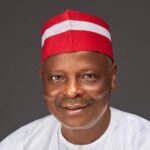
The Chairman of the Code of Conduct Tribunal, Mainasara Ibrahim Kogo Umar, has warned that any public officer who declares assets beyond three months after assumption of office is already in breach of constitutional provisions.
Justice Umar made the assertion in an interview with select journalists, where he outlined his reform agenda for the Tribunal and emphasised strict enforcement of ethical standards in public service.
Appointed on July 13, 2024, the Katsina State-born jurist returned to the Tribunal 23 years after previously serving as a young lawyer and later as Chief Registrar. His appointment followed the removal of the former chairman by the National Assembly in November 2024 over allegations of misconduct. He was formally inaugurated and sworn in on October 7, 2025.
The Tribunal, established under the Fifth Schedule of the 1999 Constitution, is vested with jurisdiction over breaches of the Code of Conduct by public officers, including abuse of office, illicit enrichment and living beyond legitimate earnings.
Justice Umar stressed that asset declaration is mandatory within three months of assuming office and subsequently every four years, whether by appointment, election or employment. He explained that the requirement provides a benchmark for assessing whether a public officer’s acquisitions correspond with lawful income.
He further clarified that public officers are prohibited from engaging in private business or trade while in office, except farming, and must resign before contesting political office.
The chairman noted that removal from office, disqualification from holding public office for up to 10 years, and forfeiture of illicit assets are among the constitutional penalties available to the Tribunal, without prejudice to additional criminal sanctions under other laws.
On the state of the institution upon his resumption, Justice Umar described it as “moribund,” citing low staff morale, dilapidated infrastructure, and lack of electricity and water supply. He said immediate steps were taken to restore basic utilities, rehabilitate facilities, and secure technical support and equipment through outreach to international partners.
He also disclosed that the Tribunal has been restructured from three to 13 departments to enhance operational efficiency.
As part of a broader reform agenda, Justice Umar revealed plans to transform the Tribunal into a Code of Conduct and Anti-Corruption Court, in line with Section 15(5) of the Constitution, which mandates the abolition of corrupt practices and abuse of office. A bill to that effect, he said, has passed second reading at the National Assembly.
He explained that under the proposed framework, anti-corruption cases involving public officers—currently prosecuted by agencies such as the Economic and Financial Crimes Commission and the Independent Corrupt Practices Commission in regular courts—could be prosecuted before the Tribunal.
Justice Umar emphasised that proceedings at the Tribunal operate under summary jurisdiction. Written submissions are required in advance, hearings focus on adoption and cross-examination, and judgments are delivered expeditiously, with a target timeline of no more than six weeks per case.
Addressing concerns about impartiality in high-profile matters, he maintained that the Tribunal does not initiate cases but adjudicates on matters investigated by the Code of Conduct Bureau and prosecuted by the Attorney General. Decisions, he said, are reached collectively by a three-member panel based strictly on facts, evidence and the law.
The chairman disclosed that he inherited thousands of pending cases, some dating back over two decades. However, following consultations with the Bureau, the Tribunal now prioritises cases within a reasonable timeframe—preferably within three years of occurrence—to enhance effectiveness. He added that between two and five cases are currently handled weekly.
Looking ahead, Justice Umar called for the Tribunal to be placed on first-line charge to guarantee financial autonomy and proposed expansion to at least 36 judges, with divisions across the six geopolitical zones and the Federal Capital Territory.
He said his long-term objective is to reposition the institution as a model of integrity and efficiency, adding that he intends to step aside once comprehensive reforms are achieved rather than remain in office until retirement age.