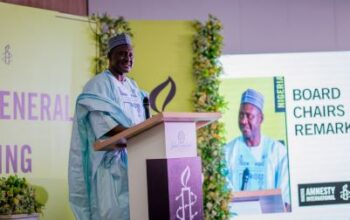
Chairman and Chief Executive Officer of the National Drug Law Enforcement Agency (NDLEA), Brigadier General Mohamed Buba Marwa (rtd), has called on Nigerians to recognise the nation’s diversity as a blessing and a trust that must be preserved.
According to Director, Media & Advocacy, NDLEA Headquarters, Abuja Femi Babafemi, Marwa made the remarks in Abuja on Saturday during the public presentation of Buni Boy, a book written by the late legal icon Niyi Ayoola-Daniels.
Delivering the keynote address, the NDLEA chief said the book’s narrative evoked memories of a Nigeria where mutual respect, unity and shared identity once defined daily life. He noted that the author’s life story was a reminder of the strength that lies in a united and diverse nation.
Marwa recounted his childhood across different regions—Zaria, Enugu, Abeokuta and Lagos—and his formative years at the Nigerian Military School, where students from various ethnic groups lived as one. This, he said, shaped his lifelong belief that “our diversity enriches us, sharpens our understanding of one another, and strengthens the fabric of our shared existence.”
He also reflected on his military career, saying the Nigerian Army embodied the ideal of unity in diversity through intermarriage, shared experiences and camaraderie beyond ethnic lines.

Speaking on his tenure as Military Administrator of Lagos State, Marwa recalled the overwhelming support he received from Lagosians despite political tensions at the federal level. He said this inspired him to conduct a free and fair election in 1999 that produced Senator Bola Ahmed Tinubu as governor.
According to Marwa, the military hierarchy had instructed him to block Tinubu’s victory due to his pro-democracy activism, but he insisted on allowing the will of the people to prevail.
“Even though the Head of State, General Abdulsalami Abubakar, did not interfere in the election, the military hierarchy did,” he said. “But I chose to conduct a free and fair election that produced the most popular candidate. The rest is history.”
Marwa acknowledged that Nigeria faces challenges rooted in the mismanagement of its diversity but stressed that such difficulties should motivate national healing and inclusion—not division.
On the book, he praised Mrs Leticia Ayoola-Daniels for sustaining her late husband’s legacy. He noted that the story resonates with him not only because he once governed the old Borno State, where Buni Yadi was located, but also because he knew the family of the judge whose sense of justice profoundly shaped the author’s life.
“Barrister Niyi Ayoola-Daniels is no longer with us, but his legacy lives on,” Marwa said. “The real-life story told in the book reflects the very heart of the Nigerian spirit.”