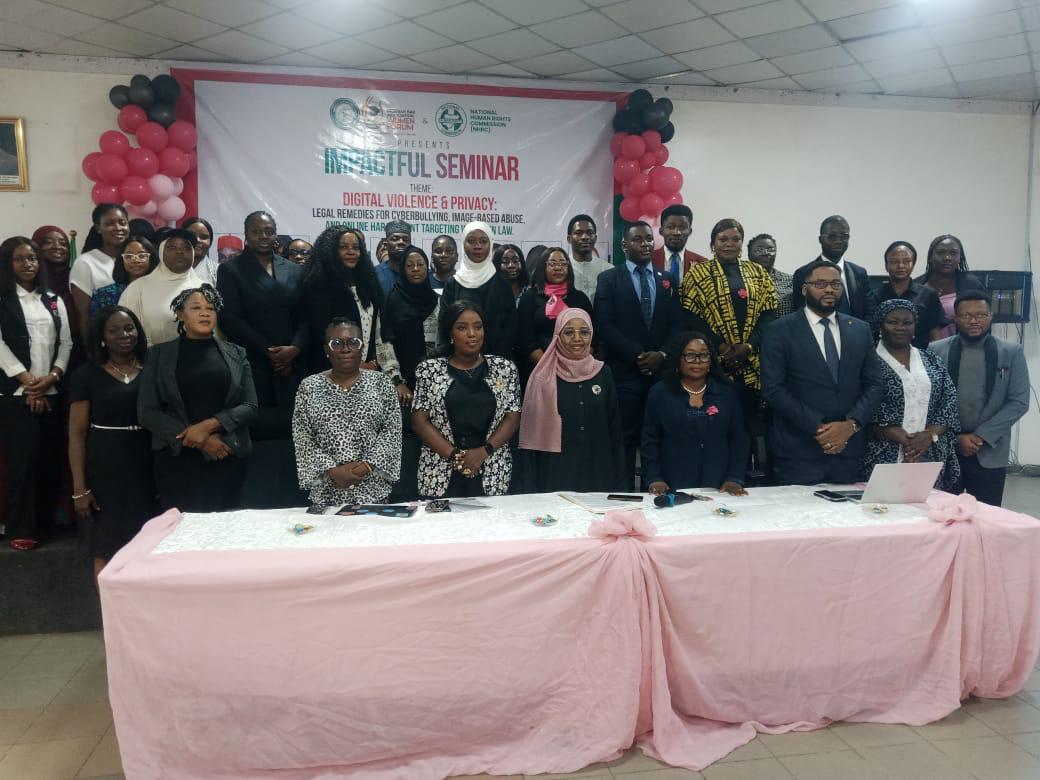
The National Human Rights Commission (NHRC) and the Nigerian Bar Association Women Forum (NBAWF) have intensified efforts to combat the rising tide of digital violence against women in the legal profession, warning that online abuse is increasingly being deployed to intimidate, silence and discourage women from active participation in public and professional life.
The renewed commitment was announced on Monday at a high-level seminar in Abuja, where legal practitioners, judicial officers, human rights advocates and digital rights experts called for stronger legal protection, improved reporting mechanisms, enhanced cybersecurity awareness and closer institutional collaboration to address technology-facilitated gender-based violence.
The seminar, themed “Digital Violence and Privacy: Legal Remedies for Cyberbullying, Image-Based Abuse and Online Harassment Targeting Women in Law,” examined the growing misuse of digital platforms to target women lawyers, judges, academics, law students and other female professionals within the justice sector.
Speaking on behalf of the Executive Secretary of the NHRC, Chief Tony Ojukwu (SAN), the Commission’s Director of Legal Services, Hajiya Rabi A. Anwar, said while digital technology had transformed communication and legal practice, it had also opened new avenues for human rights violations.
She noted that women in the legal profession increasingly face cyberbullying, cyberstalking, identity theft, doxxing, online intimidation and the non-consensual sharing of intimate images, describing such acts as grave violations of fundamental rights to dignity, privacy, equality and freedom from discrimination.
According to Anwar, persistent online harassment not only harms victims personally but also discourages women from seeking leadership positions, engaging in public discourse and maintaining a visible professional presence.
“Digital violence can silence women, restrict their participation in public life and undermine their professional advancement,” she said.
She stressed that the NHRC’s mandate extends to protecting human rights in both physical and digital spaces, adding that emerging online threats require stronger institutional collaboration and more adaptive strategies.
Anwar identified the Cybercrimes (Prohibition, Prevention, etc.) Act, the Violence Against Persons (Prohibition) Act, the Nigeria Data Protection Act 2023 and constitutional provisions safeguarding fundamental rights as key legal frameworks available to victims.
However, she observed that limited public awareness remained a major obstacle, as many victims were unaware of where to report incidents, how to preserve digital evidence or which agencies had responsibility for intervention.
She explained that the seminar was designed to provide practical guidance on litigation, digital evidence preservation, content takedown procedures, data protection complaints, cybersecurity and strategic advocacy, urging participants to apply the knowledge in supporting victims and strengthening Nigeria’s response to digital violence.
The NHRC also pledged to deepen its partnership with the NBA Women Forum to translate the seminar’s recommendations into concrete policy reforms and institutional action.

In her address, National Chairperson of the NBA Women Forum, Mrs. Agnes Fache-Omoya, described digital violence as a growing human rights and professional challenge confronting women in the legal profession.
She said although digital platforms have expanded opportunities for professional engagement and public advocacy, they have equally exposed women lawyers to increased risks of cyberbullying, online harassment, identity theft, image-based abuse and other forms of technology-enabled violence.
“The legal profession cannot claim to be advancing gender equality while women lawyers are forced to choose between professional visibility and personal safety,” she said.
“No female lawyer should have to choose between professional visibility and personal security.”
Fache-Omoya reaffirmed the Forum’s commitment to ensuring that women lawyers can practise their profession and participate fully in public life without fear of harassment, whether online or offline.
She said protecting women in digital spaces requires more than personal vigilance, stressing the need for effective laws, responsive institutions, accessible legal remedies and a professional community that rejects all forms of online abuse.
She also urged lawyers to promote responsible digital conduct, ethical online engagement and stronger solidarity within the profession.
Experts at the seminar reviewed existing legal and institutional mechanisms for addressing cyberbullying, privacy violations and image-based abuse, while highlighting the importance of cybersecurity awareness, responsible digital citizenship, evidence preservation and prompt reporting of online offences.
The seminar concluded with a call for sustained public education, stronger institutional response systems and more effective enforcement of existing laws to safeguard women in digital spaces.
Participants agreed that as Nigeria continues to expand its digital ecosystem, protecting women online must become a central component of the country’s human rights, gender equality and justice agenda, insisting that digital platforms should foster inclusion and equal participation rather than serve as tools of intimidation and discrimination.