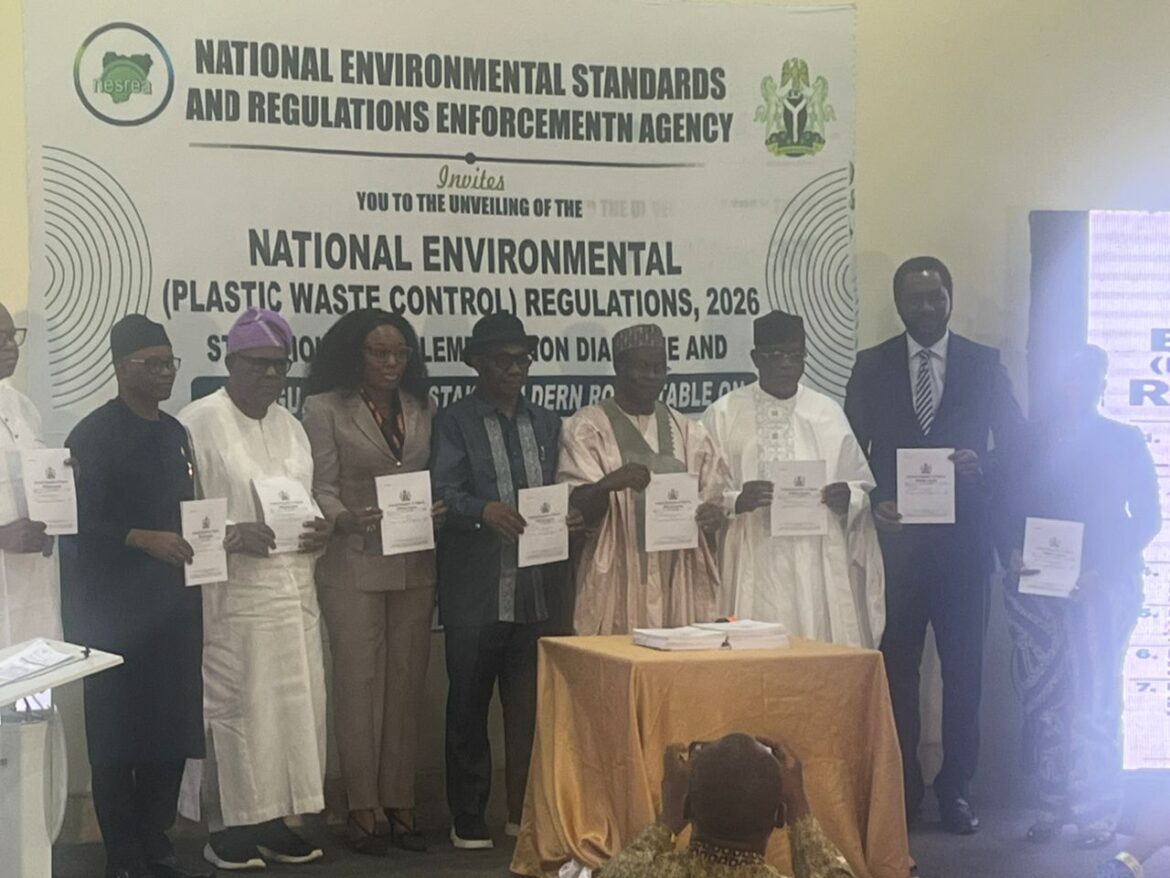
Nigeria generates an estimated 2.5 million tonnes of plastic waste annually, prompting the Federal Government to introduce new regulations that make producers, importers and other businesses responsible for managing their plastic products throughout their life cycle.
The National Environmental (Plastic Waste Control) Regulations, 2026, unveiled by the National Environmental Standards and Regulations Enforcement Agency (NESREA), are designed to shift Nigeria away from the traditional “make, use and throw away” model towards a circular economy driven by recovery, recycling and resource efficiency.
Speaking at the Stakeholder Implementation Dialogue and inaugural multi-stakeholder roundtable on “Less Plastic in Water,” NESREA Director-General, Prof. Innocent Barikor, said the new regulations represented a decisive transition from policy development to implementation.
“Today is significant because it marks a transition from policy intention to implementation,” Barikor said.
He said the effectiveness of the regulations would ultimately be measured by cleaner communities and waterways, increased plastic recovery, stronger recycling markets and greater accountability among producers.
At the heart of the new framework is the Extended Producer Responsibility (EPR) principle, which requires producers, importers and other businesses that place plastic products on the Nigerian market to assume responsibility for those products throughout their life cycle, including recovery and environmentally sound management after use.
The regulations apply to producers, importers, retailers, consumers, recyclers and waste managers, while establishing requirements covering plastic shopping bags, recycled content and recycling facilities.
Under the new framework, certain plastic shopping bags below 80 microns in thickness will be regulated, while PET packaging must contain at least 25 per cent recycled PET by January 2028, increasing to 50 per cent thereafter.
Recycling facilities will also be required to comply with prescribed environmental standards, while the production of plastics containing prohibited toxic substances will attract sanctions.
Businesses engaged in regulated activities are required to obtain relevant permits and registrations within the stipulated compliance period. Violations may attract financial penalties, imprisonment and personal liability, where applicable.
Chairman of the NESREA Governing Board, Hon. Garba Datti Muhammad, described plastic pollution as a major threat to waterways, livelihoods, communities and public health.
He stressed that successful implementation would require coordinated action by government agencies, industry players, Producer Responsibility Organisations, recyclers, subnational authorities, development partners and citizens.
Barikor identified the strengthening of the National Producer Registry as a critical component of the enforcement framework, saying reliable data would support producer accountability, investment planning and the measurement of environmental performance.
“Data should not be viewed merely as an administrative requirement; it is the foundation upon which producer accountability, investment decisions, recovery systems and credible environmental outcomes can be built,” he said.
The government, however, acknowledged the critical role of plastics in healthcare, food preservation, agriculture, manufacturing and other sectors, stressing that the objective of the regulations was not to eliminate plastics but to address irresponsible production, consumption and disposal.
Particular attention is being directed at single-use plastics and sachet water, which remain widely used because of their affordability. Officials said environmentally sustainable alternatives must also remain affordable and accessible, particularly to vulnerable populations.
The “Less Plastic in Water” initiative forms part of the Plastic Reboot Nigeria Project, a five-year programme supported by the Global Environment Facility and implemented by the United Nations Environment Programme.
The Minister of Environment, Balarabe Lawal, represented by the Permanent Secretary, Alhaji Salihu Aminu Usman, said stronger implementation of EPR could unlock investment in recycling, expand markets for recovered materials and generate employment.
He urged stakeholders to begin viewing discarded plastics not merely as waste but as potential raw materials for new industries.
Barikor emphasised that the scale of the challenge demanded collective responsibility.
“No ministry can solve the plastic problem, no agency can solve it, no company can solve it,” he said.
He warned that the regulations would have little impact without effective enforcement.
“A regulation without enforcement is merely a wish,” Barikor said.
The immediate focus is now on implementation, including producer registration, enforcement of EPR obligations, monitoring, improved waste recovery systems, investment in recycling infrastructure and the development of viable alternatives to avoidable single-use plastics.
If effectively enforced, the 2026 regulations could significantly reshape Nigeria’s approach to plastic pollution by placing greater responsibility on producers for the full life cycle of their products while creating opportunities to transform plastic waste into an economic resource.