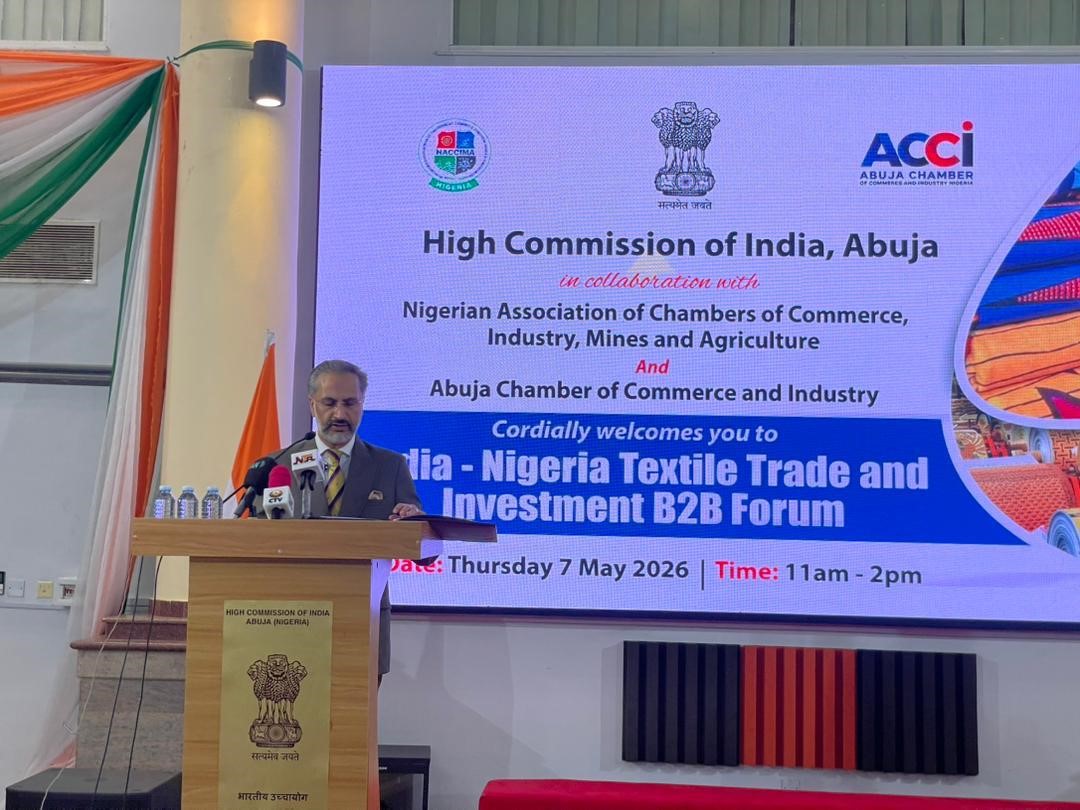
Stakeholders from Nigeria and India have intensified calls for the revival of Nigeria’s textile industry and expanded access to finance for women-owned businesses, as both countries explored new industrial and investment partnerships aimed at boosting manufacturing and job creation.
The renewed push emerged during a high-level Nigeria–India Textile Business-to-Business (B2B) engagement and policy roundtable held in Abuja, where business leaders, trade representatives, and development partners outlined strategies to reposition the textile sector as a major driver of economic growth, exports, and employment.
The discussions brought together the leadership of Nigeria’s organised private sector, including the President of the Nigerian Association of Chambers of Commerce, Industry, Mines and Agriculture (NACCIMA), Jani Ibrahim, and the President of the Abuja Chamber of Commerce and Industry (ACCI), Dr. Emeka Obegolu, SAN, alongside Indian trade and industrial partners.
Speaking at the event, Ibrahim warned that Nigeria’s once-thriving textile industry remains in sharp decline despite strong domestic demand, disclosing that the country imported textiles valued at over ₦1 trillion in 2025 while exports continued to fall.
He described the trend as a significant economic loss, noting that resources spent on imports could instead stimulate local cotton production, textile manufacturing, fashion design, and small-scale enterprises across the value chain.
According to him, Nigeria still possesses the key fundamentals required for industrial recovery, including a large consumer market, abundant cotton potential, a rapidly expanding fashion industry, and a vibrant entrepreneurial population.
A major focus of the engagement was the proposed industrial collaboration with India, which stakeholders identified as a strategic pathway for technology transfer, skills development, and value-chain expansion.
India, regarded as one of the world’s leading textile economies, was highlighted as a potential partner in machinery supply, textile technology, manufacturing investment, and technical training.
Participants proposed the establishment of textile processing clusters in major cotton-producing states such as Katsina and Zamfara, while also advocating technical partnerships with Indian industrial hubs including Surat, Tiruppur, and Coimbatore.
The roundtable further discussed plans for structured business-to-business matchmaking, virtual trade platforms, institutional cooperation, and specialised training programmes designed to connect Nigerian distributors and manufacturers with Indian partners.
NACCIMA also called for a transition from fragmented textile production to a fully integrated cotton-to-garment value chain encompassing farming, ginning, spinning, weaving, dyeing, garment production, and retail distribution.
Stakeholders identified outdated equipment, inadequate technical capacity, weak access to finance, and poor enforcement of local content policies as some of the major constraints facing the industry.
They urged government authorities and financial institutions to introduce targeted financing frameworks, strengthen industrial policies, and enforce procurement policies favouring locally produced textiles for uniforms, hospitality services, and public sector clothing needs.
In a separate but related policy dialogue, the Abuja Chamber of Commerce and Industry convened a roundtable focused on expanding non-interest financing opportunities for women-owned businesses.
Obegolu described financial inclusion as critical to Nigeria’s long-term economic transformation, stressing that women-led micro, small and medium enterprises (MSMEs) continue to face serious barriers in accessing credit.
He noted that high interest rates, stringent collateral requirements, and rigid lending systems have continued to limit the growth potential of women entrepreneurs despite their contributions to innovation and job creation.
The ACCI President advocated broader adoption of non-interest financing models, describing them as more inclusive, ethical, and suitable for emerging enterprises.
He added that the Chamber would collaborate with regulators, financial institutions, and development partners to increase awareness, build confidence in alternative financing structures, and connect women entrepreneurs with funding opportunities.
Across both engagements, stakeholders maintained that Nigeria’s economic transformation would depend largely on rebuilding its productive capacity while ensuring inclusive access to finance, technology, and industrial opportunities.
They stressed that the textile industry alone possesses the capacity to become a major employment generator if supported by coherent policies, strategic investments, and sustained international collaboration.
Participants also agreed that women and young entrepreneurs must play a central role in the country’s industrialisation agenda.
The meetings concluded with renewed commitments to move beyond policy discussions toward implementation through bankable projects, structured partnerships, and measurable economic outcomes.
Stakeholders expressed optimism that a fully implemented Nigeria–India textile partnership, combined with expanded financial inclusion initiatives, could significantly strengthen Nigeria’s manufacturing sector and improve its competitiveness in global trade.