The extradition of a Nigerian-linked cyber fraud suspect to the United States marks another significant step in Nigeria’s expanding cooperation with international law enforcement agencies in tackling transnational financial crime and cyber-enabled fraud.
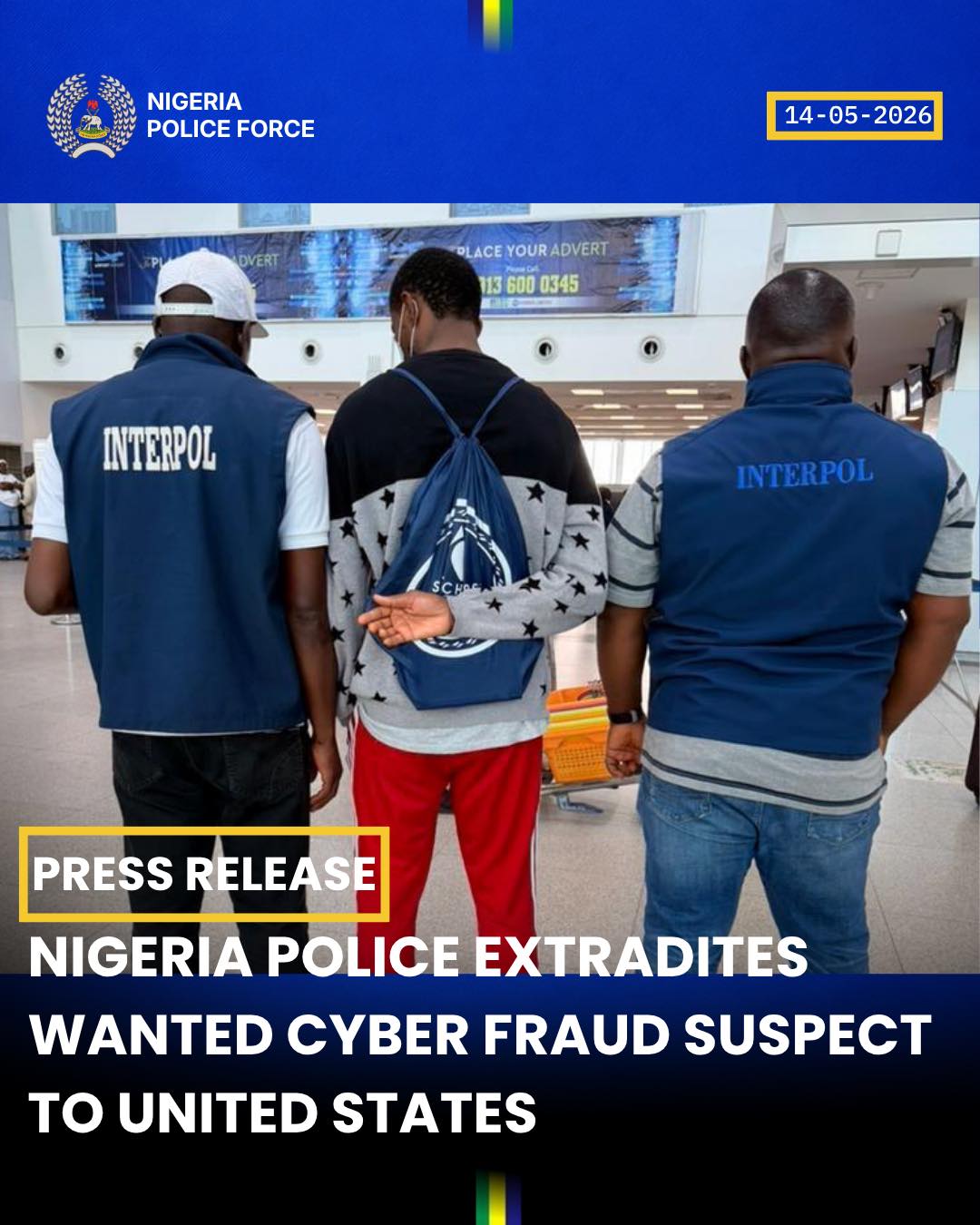
The Nigeria Police Force, through the INTERPOL National Central Bureau (NCB) Abuja, has extradited Samuel Ugberease—also known by aliases “Putsammy,” “Putput,” and “Sammy”—to the United States to stand trial for alleged involvement in online romance scams, wire fraud, and related financial offences.
Ugberease, previously based in South Africa, was transferred to U.S. custody on Wednesday, 14 May 2026, following the conclusion of extradition proceedings coordinated between Nigerian authorities and their U.S. counterparts. The case underscores the increasing operational reach of international policing frameworks in tracking and transferring fugitives across jurisdictions.
Investigators allege that between 2014 and 2018, the suspect operated within a wider criminal network that targeted victims in the United States, particularly within the Eastern District of North Carolina. The syndicate reportedly used fabricated online identities on dating platforms to establish romantic relationships with victims, a classic “romance scam” model designed to build emotional trust before soliciting funds under false pretences, including staged emergencies.
Authorities further allege that proceeds from the scheme were layered through multiple bank accounts to obscure their origin, a pattern consistent with structured money laundering operations used in cyber-enabled financial crimes. In one of the more prominent allegations, the network is linked to the defrauding of a victim of over $1.5 million.
The extradition follows a sequence of enforcement actions that began with Ugberease’s arrest at the Murtala Mohammed International Airport in Lagos on 14 December 2025. He was apprehended by INTERPOL NCB Abuja operatives upon arrival from South Africa, acting on a Red Notice issued by U.S. authorities.
Subsequent legal proceedings at the Federal High Court, Lagos Division, resulted in a judicial order granting extradition in line with Nigeria’s Extradition Act (CAP E25, Laws of the Federation of Nigeria, 2004). The ruling reflects the judiciary’s growing role in facilitating international criminal justice cooperation, particularly in cases involving cybercrime and cross-border fraud.
From a broader policy perspective, the case highlights Nigeria’s evolving posture on cybercrime enforcement. Increasing reliance on INTERPOL mechanisms, intelligence-sharing frameworks, and bilateral cooperation agreements signals a shift toward more assertive participation in global security architecture.
The Nigeria Police Force has consistently emphasized intelligence-led policing as a core strategy for combating cyber fraud, financial crimes, and other forms of organised transnational criminality. This extradition reinforces that stance, while also serving as a signal to international partners of Nigeria’s willingness to prosecute or transfer suspects in line with due legal process.
As cybercrime continues to expand in scale and sophistication, especially through social engineering schemes like romance fraud, the case illustrates both the vulnerabilities exploited by criminal networks and the growing capacity of enforcement institutions to respond across borders.
The development is likely to strengthen ongoing collaboration between Nigerian authorities and international partners, particularly in tracking digital financial crimes that increasingly blur jurisdictional boundaries.