Edo State Governor, Monday Okpebholo, and the Oba of Benin, Oba Ewuare II, have pledged support for the National Drug Law Enforcement Agency (NDLEA)’s campaign against substance abuse and illicit drug trafficking, as the agency plans to introduce alternative livelihoods for cannabis farmers in the state.
The two leaders gave the assurances on Wednesday in Benin City when the NDLEA Chairman and Chief Executive, Brig. Gen. Buba Marwa (retd.), led the agency’s War Against Drug Abuse (WADA) advocacy campaign to Edo State.
During separate meetings with the governor and the traditional ruler, Marwa called for stronger involvement of political, traditional and religious institutions in tackling drug abuse, stressing that the challenge required a coordinated, whole-of-society approach.
Receiving the NDLEA delegation at Government House, Okpebholo described illicit drugs as a major driver of criminality and urged Nigerians to take collective responsibility for combating the menace.
“At the root of virtually every crime is the issue of drugs. From our experience, even kidnappers first ask their victims for drugs before demanding ransom. That shows that illicit drug is our enemy,” the governor said.
He commended the Edo NDLEA command for its operations and assured the agency of his administration’s support.
“Your officers and men in Edo are doing excellent work. We are ready to work with you, we are ready to partner with you, and we are ready to support you with any request you bring before us,” he said.

The governor was subsequently decorated as a WADA Grand Ambassador in recognition of his commitment to the fight against drug abuse and trafficking.
Marwa commended the state government’s developmental efforts and commitment to drug control, noting that the visit was also aimed at securing support for the NDLEA’s Alternative Development Programme.
The initiative, launched last year, seeks to encourage cannabis farmers to abandon illicit cultivation and embrace legitimate agricultural activities that can provide sustainable livelihoods.
According to Marwa, the programme’s pilot phase, launched in Ondo State in January, has recorded encouraging results, prompting plans to extend it to Edo, one of Nigeria’s cannabis-producing states.
He appealed to the governor for support for the programme and additional logistics to strengthen the agency’s operations in the state.
At the palace of the Oba of Benin, Marwa described drug abuse as one of the three leading challenges confronting Nigeria, disclosing that more than 15 million Nigerians were involved in drug abuse, a prevalence rate he said was about three times the global average.
He warned that substance abuse had spread to schools and communities, including the Benin Kingdom, making the involvement of traditional institutions critical to reversing the trend.
Marwa disclosed that the NDLEA arrested more than 1,200 suspected drug traffickers and seized over 30 tonnes of illicit substances in Edo State last year.
He added that cannabis accounted for 75 per cent of the 16 million kilogrammes of assorted illicit substances seized nationwide by the agency in the last five years, noting that the plant was cultivated locally, with Edo among the major producing states.
“The job of the NDLEA is to enforce the law against drug trafficking, and as well help those who are addicted to drugs with counselling, treatment and rehabilitation. But this is an assignment that we cannot do alone. It is a whole-of-society approach,” he said.
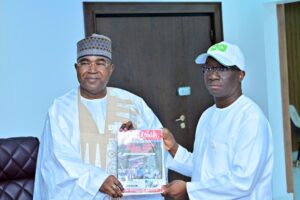
The NDLEA chairman identified traditional institutions, religious organisations, civil society groups, governments and the media as critical partners in the campaign, noting that traditional rulers wield considerable influence within their communities.
He also commended the Oba’s interventions against social problems, including kidnapping and human trafficking, saying the monarch’s efforts had contributed to reducing human trafficking in the kingdom.
Marwa appealed to the monarch to encourage communities under his domain to abandon cannabis cultivation and trading in favour of the Alternative Development Programme.
He said Nigeria was the first African country to adopt alternative development as a strategic pillar of drug control, adding that the approach had received the endorsement of the United Nations Office on Drugs and Crime (UNODC) and the Federal Government under the Renewed Hope Agenda.
Under the programme, cannabis farmers would be encouraged to cultivate legitimate crops such as cassava, yam and maize, with support from the federal and state governments and the NDLEA through farm inputs and community infrastructure, including roads, schools, clinics and water facilities.
Marwa said the initiative was designed to address the economic realities driving illicit cultivation by providing farmers with viable alternatives.
“The growers themselves have confided in us that they are grateful for this initiative. Even though there is more money in cannabis, they will at least have peace of mind when they cultivate licit crops. With cannabis, they are perpetually ill at ease in their homes with their families for fear of NDLEA,” he said.
In his response, the Oba thanked the NDLEA chairman for recognising the Benin Kingdom’s contributions to the campaign against drug abuse and disclosed plans to submit a written proposal to the agency on ways to improve its operations.
“I have a suggestion that I will make in writing to NDLEA. I would not want to state it here in public. I want to put it quietly as my own thinking on how to improve the work of NDLEA,” the monarch said.
As part of the advocacy campaign, Marwa also met with leaders of the National Union of Road Transport Workers (NURTW) in Edo State, led by Comrade Saturday Oamen, urging them to mobilise members against substance abuse and drug trafficking.
He called on transport operators to use their networks to sensitise drivers and other members, particularly at motor parks, and collaborate with the agency to keep roads and communities free of illicit drugs.
The NDLEA chairman was also scheduled to engage religious and civil society leaders as the advocacy campaign continued in the state.