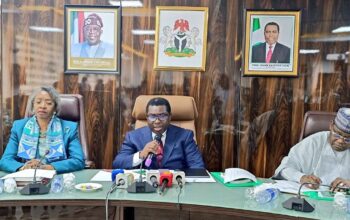
The Federal Ministry of Agriculture and Food Security, in collaboration with dairy industry stakeholders, has announced a plan to increase the country’s annual production of milk, meat, and poultry by 10% annually. This initiative was unveiled during a press conference commemorating 2024 World Milk Day, themed “Harnessing the Nutrition and Investment Opportunities in the Dairy Value Chain.”
Dr. Aliyu Abdullahi, CON, Minister of State for Agriculture and Food Security, emphasized the government’s priority to boost productivity in animal protein sources, including dairy, meat, eggs, and fish, to achieve a 10% annual growth rate. He highlighted the essential role of animal-source foods in attaining food and nutrition security, particularly for children, with an estimated 2 million Nigerian children suffering from severe acute malnutrition partly due to limited animal protein consumption.
Dr. Abdullahi stressed the significance of milk consumption in addressing nutritional deficiencies, as revealed by the 2021 National Food Consumption and Micronutrient Survey. He pointed out that Nigeria imports $1.5 billion worth of dairy products annually due to a production deficit, with local consumption averaging 1.6 billion liters of milk and its products.
President Bola Ahmed Tinubu’s vision, according to Dr. Abdullahi, is to achieve national production security and position Nigeria as an exporter of dairy products within the African Continental Free Trade Agreement (AfCFTA). The minister outlined the need for transforming Nigeria’s dairy value chain to support the Renewed Hope Agenda of food security, economic growth, job creation, poverty alleviation, and local producer security.
The National President of the Miyetti Allah Cattle Breeders Association of Nigeria (MACBAN) called for increased budgetary allocation to the dairy industry, noting past government support has been limited to cattle vaccination.
Dr. Abdullahi identified several challenges in the dairy sector, including the lack of organized milk collection schemes, high costs of milk collection and cold chain facilities, poor transportation infrastructure, unreliable electricity supply, pervasive insecurity, and low access to finance. He asserted that bridging the annual $1.3 billion dairy import gap requires significant government investment in infrastructure to reduce production costs.
During the World Milk Day exhibition, Dr. Abdullahi also highlighted the critical role of the feed and fodder industry in supporting the dairy sector’s growth. He reaffirmed the dairy industry’s support for federal food and security programs, emphasizing that enhanced nutrition security would ensure women, children, and families have sufficient access to milk.