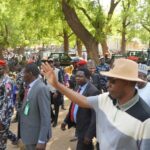
Borno State Governor, Professor Babagana Zulum, has commenced the construction of two large-scale educational institutions in Hawul Local Government Area, reinforcing his administration’s commitment to expanding access to quality education across the state.
On Wednesday, the governor laid the foundation for a High Islamic College in Shafa, a 48-classroom facility to operate under the curriculum of the National Board for Arabic and Islamic Studies (NBAIS). The institution is designed to combine Islamic education with formal learning, including digital skills, literacy, numeracy and vocational training.
Governor Zulum said the project aligns with his campaign pledge to promote a balanced education system that integrates religious instruction with modern academic and technical competencies.
In Marama town, the governor also flagged off the construction of another mega school to strengthen educational infrastructure in the area. He disclosed that the project would comprise a two-storey building with 36 classrooms and supporting facilities to enhance teaching and learning.
Addressing residents during the ceremonies, Zulum acknowledged the shortage of teachers in the locality and announced plans to recruit qualified educators, with priority given to indigenes of Marama, to ensure effective operation of the new school.
The Commissioner for Education, Science, Technology and Innovation, Engr. Lawan Abba Wakilbe, accompanied the governor during the foundation-laying exercises.
During the visit, Governor Zulum also inspected the National Orthopaedic Hospital in Azare, recently rehabilitated and donated by the state government to enable the commencement of medical services. He further commissioned projects executed by the Hawul Local Government Council, including a shopping complex and market stalls, aimed at stimulating local economic activities.
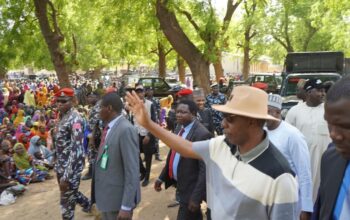
The governor was accompanied by Senator Mohammed Ali Ndume (Borno South), former deputy governors Usman Mamman Durkwa and Ali Abubakar Jatau, members of the National Assembly and Borno State House of Assembly, commissioners, local government chairmen and other stakeholders from Southern Borno.