The Federal Capital Territory (FCT) Commandant of the Nigeria Security and Civil Defence Corps (NSCDC), Dr. Olusola Odumosu, has warned that interagency rivalry and poor collaboration among security institutions are weakening Nigeria’s efforts to address growing security challenges.
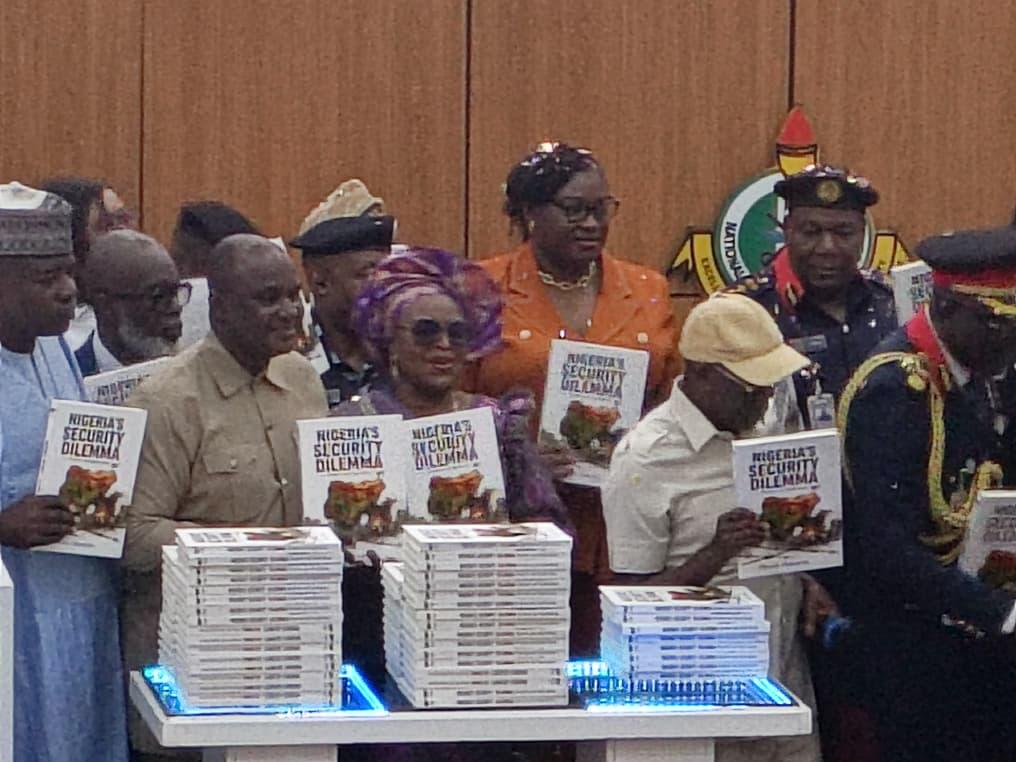
Odumosu made the assertion on Friday in Abuja during the launch of his book, Nigeria’s Security Dilemma: Rivalries and Implications, Vol. 1, where security experts and government officials advocated stronger cooperation among security agencies as a key strategy for tackling insecurity.
Speaking at the event, the NSCDC commandant said no single security agency possesses the resources, expertise or capacity to effectively confront the complex and evolving threats facing the country.
“No one agency has it all. There is a need for a united front because security is not what one agency can do. No one has a monopoly of wisdom,” he said.
Odumosu identified institutional rivalries, competition for relevance and inadequate coordination among agencies as major obstacles to building an effective national security framework, warning that such divisions have created opportunities for criminal elements to thrive.
Also speaking, Senator Adams Oshiomhole, Chairman of the Senate Committee on Interior, stressed that national security should transcend political affiliations and institutional interests.
“When it comes to security, there is no PDP, no APC. We need to understand that,” he said.

The former Edo State governor advocated mandatory intelligence sharing among security agencies, arguing that intelligence gathering achieves little value unless it is supported by coordinated operational action.
He called for stronger collaboration among the Department of State Services (DSS), the Nigeria Police Force and the military, noting that integrated intelligence and joint operations are essential for dismantling criminal networks.
Drawing from his experience in government, Oshiomhole recounted how intelligence-driven operations supported by military intervention had led to the arrest of numerous kidnappers and criminal suspects.
However, he expressed concern that some successful operations were undermined when suspects were subsequently released or granted bail, despite the efforts and resources invested in their apprehension.
Representing the Minister of Defence at the event, Rear Admiral Olusanya Bankole (retd.) acknowledged the challenges posed by interagency competition and disclosed that measures were being implemented to strengthen cooperation among Nigeria’s security institutions.
“The stability of Nigeria is more important than the ego of any agency,” he stated.

In his remarks, Deputy Commandant General of NSCDC in charge of Technical Services, Zakari Ibrahim Ningi, who represented the Commandant General of the Corps, Prof. Ahmed Audi, described insecurity as a global challenge affecting all sectors of society.
He noted that the book’s focus on interagency cooperation and security coordination was both timely and relevant, given the current security realities confronting the country.
The event attracted senior security officials, policymakers and stakeholders, including the Inspector-General of Police, Mr. Olatunji Disu, who was represented by the FCT Commissioner of Police.
The book was formally launched by Hon. Tayo Odumuyiwa, who donated N20 million in support of the publication, highlighting growing interest in innovative approaches and enhanced collaboration to address Nigeria’s security challenges.