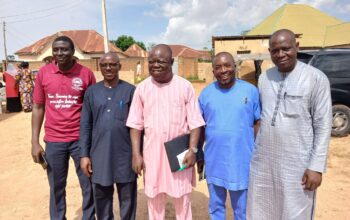
There is an enduring fixation in our public life—an almost religious reverence for titles. Professor. Chief. Apostle. Reverend. Doctor. Distinguished. Capacity. The prefixes grow longer, the introductions more elaborate, the regalia more ornate. Yet, beyond the pageantry, the evidence of development remains stubbornly thin.
Titles, in their proper place, are meant to signify achievement, responsibility and service. They are earned markers of contribution. But in our context, they have increasingly become substitutes for performance—badges worn not to reflect work done, but to command deference. The result is a culture where appearance often outweighs substance.
Nowhere is this contradiction more apparent than in Cross River State. It is a place richly endowed with intellectual capital—home to scholars, professionals and leaders whose credentials can stand alongside the best globally. By sheer academic pedigree and rhetorical prowess, Cross River ought to be a model of progress.
Across many communities, the realities tell a different story. Entire areas remain separated by rivers without bridges, as though modern infrastructure never arrived. In rural settlements, accessing basic healthcare can become a perilous journey, especially for vulnerable groups. Key road networks—critical to trade, mobility and economic activity—are in conditions that undermine both safety and growth.
In parts of northern Cross River, communities such as those in Boki experience near isolation. Routes connecting major areas, including corridors between Obudu and Ikom, are often difficult to navigate. In Bekwarra and beyond, the presence of government is, at best, intermittent—more spoken of than seen.
These are not merely infrastructural gaps; they are development failures with real human consequences. A bad road is not just an inconvenience—it is delayed emergency care, lost agricultural produce, reduced school attendance and constrained economic opportunity. A missing bridge is not just a structural absence—it is isolation, vulnerability and stagnation.
The deeper issue is not the existence of titles or education. Both are valuable. Education remains one of the most powerful tools for societal transformation. Titles, when properly earned and responsibly worn, can inspire confidence and signal competence. The problem arises when they are mistaken for substitutes for measurable performance—when designation replaces delivery, and when identity is presented as achievement.
There was a period when leadership left visible imprints—projects that could be seen, used and evaluated. Roads constructed, schools built, markets established, water systems installed. Governance was tangible. It had physical expression. Citizens did not need to be told who was performing; they could see it.
Today, there is a growing perception of a disconnect. Public office holders are often defined more by their appellations than by verifiable outcomes. Ask for accomplishments, and the response may come in the form of speeches rather than structures. Press statements replace project sites. Ceremonies replace completion.
This shift reflects a broader cultural challenge: the elevation of symbolism over substance. Publicity over productivity. Narrative over results.
Part of the problem lies in accountability—or the lack of it. When systems do not consistently demand results, it becomes easier for individuals to rely on optics. When citizens celebrate titles without interrogating performance, leaders adapt accordingly. Over time, a cycle emerges: titles command respect, respect reduces scrutiny, and reduced scrutiny enables underperformance.
For leaders, the message is straightforward: legitimacy must be earned through impact. Titles may open doors, but only results sustain credibility. Governance must return to its core function—delivering measurable improvements in the lives of people. This means prioritising infrastructure, investing in healthcare and education, supporting local economies, and ensuring that public resources translate into public goods.
For citizens, the responsibility is equally critical. Civic expectations must evolve beyond admiration for titles to demand for outcomes. Elections, community engagements and public discourse must be anchored on performance metrics, not personal branding. The question should no longer be, “Who holds the title?” but “Who has delivered results?”
There is also a need to institutionalise transparency. Budgets should be accessible and understandable. Projects should be tracked from approval to completion. Performance indicators should be clear and regularly communicated. When governance becomes measurable, it becomes harder to hide behind titles.
Importantly, development is not abstract. It is empirical. It is visible in roads that connect communities, in healthcare systems that save lives, in schools that educate, and in markets that enable livelihoods. It is measured not in speeches, but in outcomes.
Titles, in themselves, are not the problem. But when they exist without corresponding impact, they risk becoming hollow symbols—detached from the realities they are meant to influence. At that point, they no longer inspire respect; they invite scepticism.
A state cannot thrive on nomenclature. Communities cannot advance on credentials alone. Progress demands more than recognition; it demands results.
Until that shift occurs, the contrast will remain stark: prominent titles, but limited development. And for a people as capable and resourceful as those of Cross River State, that contrast is not just unfortunate—it is unacceptable.
Mike Udam, PhD The Village Preacher, Ogoja, Nigeria