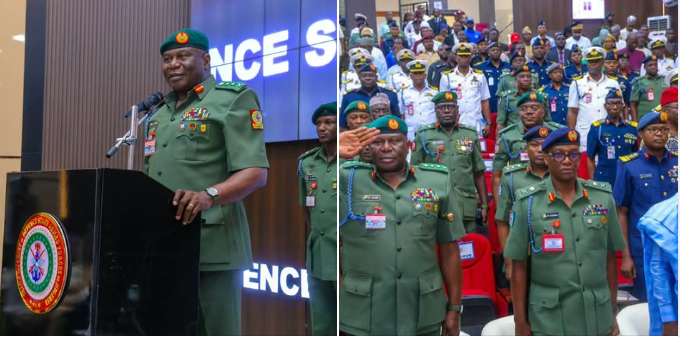
Chief of Defence Staff (CDS), General Olufemi Oluyede, has directed the Defence Space Administration (DSA) to extend its space-based intelligence, surveillance and communications support to military operations in the North-West and North-Central regions to strengthen operational effectiveness and troops’ situational awareness.
In a statement, Public Relations Officer Defence Space Administration Major Fumilayo Bukola Bamisaye said the directive will extend the support currently provided to Operation Hadin Kai in the North-East to Operation Fansan Yamma in the North-West and Operation Savannah Shield in the North-Central.
Oluyede gave the directive on Friday in Abuja during the DSA’s 12th anniversary celebration, where he commended the agency for deploying space-based capabilities to support military operations.
“As we speak now, they are supporting Operation Hadin Kai, and I have given instructions that they should extend that to Operation Fansan Yamma in the North-West and Operation Savannah Shield in the North-Central,” he said.
The CDS urged the DSA to consolidate its achievements through sustained investment in indigenous research, technological innovation and human capital development.
He also called for stronger partnerships with academic institutions, industries and relevant government agencies to develop resilient, home-grown space capabilities for national security.
Oluyede emphasised the importance of continuous research and development, noting that technological systems must be developed, field-tested and refined to meet operational demands while remaining compatible with existing military structures and equipment.
He highlighted the DSA’s achievements, including the launch of DELSAT-1, the establishment of the Special Intelligence Infrastructure and the Modular Earth Observation Outpost at the headquarters of the Joint Task Force North-East, Operation Hadin Kai.
According to him, these initiatives have strengthened Nigeria’s defence space architecture and brought specialised intelligence support closer to operational commanders.
The CDS also welcomed the commencement of academic activities at the Defence Space School in Delta State, describing indigenous expertise and technological development as critical to enhancing Nigeria’s capacity to harness space for national security and development.
Earlier, the Chief of Defence Space Administration, Major General Philip Okechukwu Ilodibia, said modern warfare increasingly relied on timely intelligence, situational awareness, secure communications and effective coordination across multiple operational domains.
Ilodibia, who reflected on the agency’s development since its establishment on October 9, 2014, said the DSA had progressively built capabilities to support the operational requirements of the Armed Forces and other security agencies.
He stressed that the agency’s performance should be assessed by the operational challenges it resolved, the decisions it enabled and the strategic advantages it delivered to the military.
The DSA chief called for stronger synergy among the Nigerian Army, Nigerian Navy and Nigerian Air Force, noting that space-enabled intelligence, surveillance, communications and geospatial capabilities could significantly improve joint situational awareness, interoperability and mission effectiveness.
He also advocated sustained collaboration between the National Space Research and Development Agency (NASRDA) and the Nigerian Communications Satellite Limited (NigComSat) to accelerate the development of indigenous space capabilities.
According to him, the anniversary theme, “Space Power and National Security,” underscored the need to harness Nigeria’s space potential to strengthen national security, improve operational effectiveness and advance strategic autonomy.
In his remarks, former Chief of Defence Staff, General Gabriel Olonisakin (retd.), described space and cyberspace as critical domains of modern warfare that require sustained investment.
Olonisakin recalled that the DSA initially operated from facilities provided by NASRDA before developing its headquarters and Cyber Centre project.
Citing the Russia-Ukraine war, he highlighted the growing importance of space technology in contemporary conflicts, particularly cyberattacks targeting satellite communications infrastructure and the use of satellite imagery to monitor troop movements.
He urged the agency to leverage strategic partnerships to develop sovereign space capabilities and strengthen Nigeria’s national security architecture.
Other dignitaries at the anniversary celebration included the Chairman of the Senate Committee on Defence, Senator Ahmed Ibrahim Lawan, and the Chairman of the House of Representatives Committee on Defence, Honourable Babajimi Benson.
A posthumous award was also presented to Mrs Badeh, wife of the late former Chief of Defence Staff, in recognition of her husband’s contributions to the establishment of the DSA.
The anniversary reaffirmed the agency’s commitment to advancing Nigeria’s defence space capabilities, strengthening joint military operations and providing timely, reliable and actionable intelligence in support of national security.