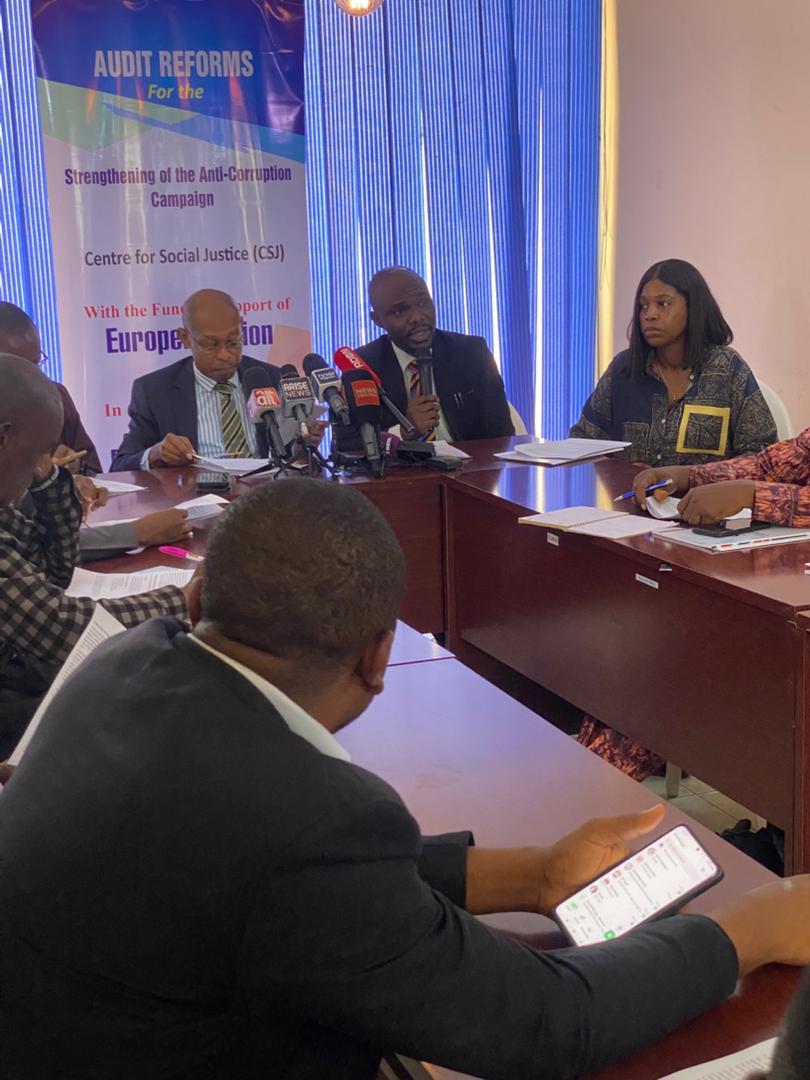
A coalition of civil society organisations has urged President Bola Ahmed Tinubu to urgently assent to the Federal Audit Service Bill, warning that further delay could weaken Nigeria’s anti-corruption campaign, fiscal transparency reforms, and public finance management system.
The coalition, which includes the Centre for Social Justice, ActionAid Nigeria, Paradigm Leadership Support Initiative, Accountability Lab, Africa Network for Environment and Economic Justice and BudgIT, said presidential assent to the bill would represent a significant milestone in efforts to strengthen accountability and curb corruption in public institutions.
In a joint statement issued on Monday, the groups described the proposed legislation as a critical governance reform aimed at modernising Nigeria’s audit framework, improving oversight of public expenditure, and addressing longstanding legal gaps in the country’s financial accountability system.
According to the coalition, the bill, which has already been passed by the National Assembly and transmitted to President Bola Ahmed Tinubu for assent, seeks to repeal the outdated Audit Ordinance of 1956 and establish a new Federal Audit Service with broader powers and greater institutional independence.
The organisations noted that Nigeria has operated for decades without a comprehensive modern audit law despite constitutional provisions establishing the Office of the Auditor-General for the Federation.
They argued that the 1956 Audit Ordinance frequently referenced in federal audit processes is no longer part of Nigeria’s extant laws, having not been reproduced in the Laws of the Federation in either 1990 or 2004.
“There is a lacuna in that area of the law,” the statement noted, adding that even if the ordinance were considered valid, it had become obsolete and incapable of addressing contemporary governance and accountability challenges.
The coalition stated that the proposed legislation would strengthen public finance management by granting wider operational and investigative powers to the Auditor-General for the Federation.
Among the key provisions highlighted are the establishment of an autonomous Federal Audit Service and Federal Audit Board, transparent procedures for appointing the Auditor-General, fair hearing safeguards before removal from office, and expanded audit responsibilities.
The bill also broadens the scope of auditing beyond routine financial reviews to include forensic audits, performance and value-for-money audits, as well as investigations into public-private partnerships, subsidies, grants, loans, disaster funds, and classified expenditures.
Under the proposed law, the Auditor-General would be empowered to summon individuals, compel the production of documents, investigate fraud, impose surcharges for unaccounted public funds, and collaborate with anti-corruption agencies such as the Economic and Financial Crimes Commission and the Independent Corrupt Practices and Other Related Offences Commission.
The coalition described as transformative the provision requiring audit reports to become public documents accessible online after submission to the National Assembly.
According to the organisations, the measure would enhance transparency, support investigative journalism, and empower citizens and civil society groups to monitor government spending more effectively.
The statement also noted that the bill introduces strict timelines for the submission and review of audit reports by ministries, departments and agencies, the Accountant-General, and the National Assembly.
The groups argued that the absence of such timelines under the current system had contributed to delayed audits, weak enforcement, and the repeated recurrence of financial infractions across government institutions.
They further identified the creation of offences and penalties for audit violations as a major innovation capable of ending what they described as a cycle of impunity in the management of public funds.
“Available evidence shows that audit recommendations are treated with levity by MDAs,” the statement said.
“Despite the provisions of the Financial Regulations, there is hardly a follow-up on the recommendations. This sets the stage for the year-after-year recurrence of the same set of financial felonies and misdemeanours by MDAs.”
The coalition maintained that signing the bill into law would deliver major economic and governance benefits, including reducing revenue leakages, improving value-for-money in public spending, strengthening investor confidence, enhancing debt management, and aligning Nigeria with international standards in public financial management.
The statement referenced the International Organisation of Supreme Audit Institutions and its Lima Declaration of Guidelines on Auditing Precepts, which emphasises the importance of independent audit systems in safeguarding public resources and detecting financial misconduct.
The organisations warned that continued delay or refusal to assent to the bill could undermine Nigeria’s anti-corruption efforts, weaken fiscal discipline, and affect the country’s ability to meet international accountability benchmarks.
They also cautioned that the existing legal vacuum in federal auditing would persist if the legislation is not signed into law.
As part of their recommendations, the coalition urged President Tinubu to immediately assent to the bill and ensure rapid implementation through the constitution of the Federal Audit Board within 90 days.
The groups also called on the Attorney-General of the Federation to publish a simplified public summary of the law to improve public understanding and confidence.

They further urged the Federal Government to communicate the reform to international development partners, including the International Monetary Fund, World Bank and AFROSAI-E, as evidence of Nigeria’s commitment to governance reforms under the Renewed Hope Agenda.
The renewed advocacy for the audit bill comes amid growing concerns over revenue leakages, rising public debt, weak institutional accountability, and persistent allegations of financial mismanagement in government agencies.
Analysts say the proposed legislation could become one of Nigeria’s most significant public finance reforms in decades if fully implemented.