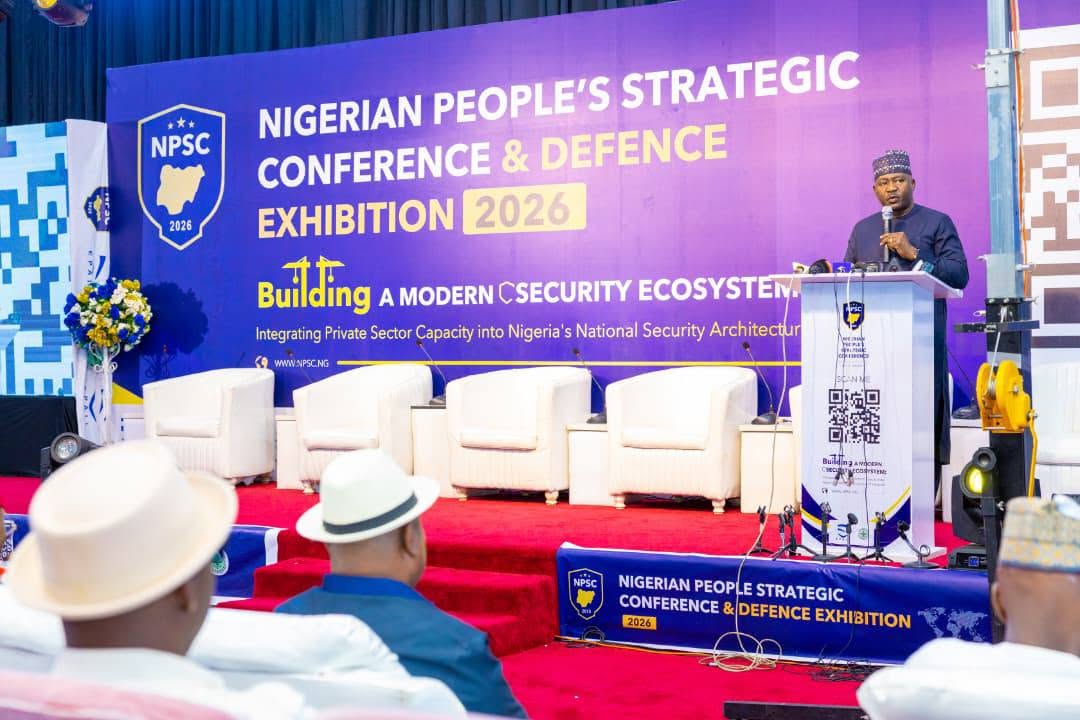
The Minister of Defence, General Christopher Gwabin Musa (Rtd), has called for a comprehensive whole-of-society approach to addressing Nigeria’s increasingly complex security challenges, stressing that military operations alone are insufficient to guarantee lasting peace and stability.
Speaking at the Nigerian People’s Strategic Conference and Defence Exhibition 2026 held at the NAF Conference Centre in Abuja on Saturday, General Musa said the evolving nature of security threats requires stronger collaboration among government institutions, the private sector and local communities.
The minister noted that contemporary security threats, including terrorism, banditry, cybercrime and infrastructure vandalism, have become more sophisticated, technology-driven and often supported by local networks. He stressed that citizens have a critical role to play in supporting security efforts through the provision of timely and credible intelligence and by denying criminal elements safe havens within their communities.
According to him, building a modern and resilient security ecosystem must rest on three key pillars: effective government leadership and coordination, sustained investment in indigenous defence innovation and industrial capacity, and stronger community partnerships founded on trust, accountability and shared responsibility.
General Musa also advocated structured and regulated public-private partnerships to strengthen intelligence gathering, protect critical national infrastructure and improve rapid response capabilities, while ensuring strict compliance with national laws and regulatory standards.
To further strengthen the country’s security architecture, the minister identified five priority areas requiring urgent attention. These include enhancing legal and policy frameworks, developing secure information-sharing platforms, promoting local defence manufacturing, investing in training and professional development, and deepening community engagement in security matters.
Also addressing participants at the conference, the Deputy Speaker of the House of Representatives, Rt. Hon. Benjamin Okezie Kalu, underscored the need for a balanced security strategy that combines kinetic and non-kinetic measures. He advocated greater emphasis on dialogue, inclusive governance and public-private collaboration as essential tools for addressing the root causes of insecurity.
Kalu described the recent passage of the State Police Bill by the House of Representatives as a significant step towards decentralising Nigeria’s security framework and improving local security management.
Similarly, Senator Osita Izunaso called for a holistic and technology-driven security strategy, arguing that military force alone cannot deliver sustainable peace. He stressed the need to tackle underlying drivers of insecurity, including poverty, unemployment and weak governance structures.
The senator also highlighted the importance of reliable data systems, effective grassroots governance and the development of indigenous technological and security capabilities to strengthen national resilience.
Reaffirming the commitment of the Armed Forces of Nigeria and other security agencies to protecting the nation, General Musa emphasised that security remains a collective responsibility that requires the active participation of all segments of society.
He urged stakeholders across the public and private sectors to work together in building a safer, more secure and prosperous Nigeria capable of addressing emerging security threats and safeguarding national development.