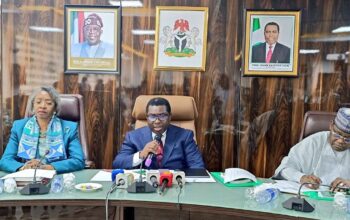
The inaugural meeting of Competent National Authorities (CNA) responsible for enforcing the judgments of the ECOWAS Community Court of Justice has commenced in Lagos, Nigeria, with a focus on strengthening cooperation and improving enforcement across member states.
The two-day workshop, holding from June 23 to 24, 2025, is themed “Enhancing the Role, Relevance, and Effectiveness of the ECOWAS Court of Justice: Strengthening Synergies Between the Court and Competent National Authorities.”
In his keynote address, President of the ECOWAS Court, Justice Ricardo Cláudio Monteiro Gonçalves, stressed that judgments of the Court are legally binding and must be executed by member states. He underscored the importance of enforcement in safeguarding the rule of law, advancing justice, and promoting regional human rights.
Quoting Article 24(2) of the Court’s Protocol, Justice Gonçalves explained that enforcement should proceed through writs issued to designated national authorities, to be executed in line with domestic civil procedures. He also cited Article 24(4), which mandates all member states to officially notify the Court of their designated competent authorities. Ten of the twelve member states have fulfilled this obligation.

Representing Nigeria’s Attorney-General and Minister of Justice, Lateef Fagbemi SAN, Mr. Nnanna Ibom, Director of International and Compliance Law at the Ministry, commended the initiative. He described the meeting as essential to advancing regional integration, access to justice, and the rule of law.
“It is imperative that we harmonise enforcement protocols and strengthen collaboration between the Court and national justice systems,” he said.
In his welcome remarks, Dr. Yaouza Ouro-Sama, Chief Registrar of the ECOWAS Court, explained that the workshop aims to bolster cooperation between the Court and national authorities to improve compliance. He acknowledged enforcement challenges common to many international courts, particularly those reliant on domestic legal systems and political will.
Dr. Ouro-Sama also referenced Article 15(4) of the Revised ECOWAS Treaty, affirming the binding nature of ECOWAS Court judgments on states, institutions, individuals, and entities. He identified obstacles such as the lack of legal domestication, weak political commitment, and absence of implementing laws as persistent barriers to enforcement.
The meeting aims to facilitate information sharing, build sustainable enforcement mechanisms, and ultimately enhance access to justice and rule of law across the ECOWAS region.