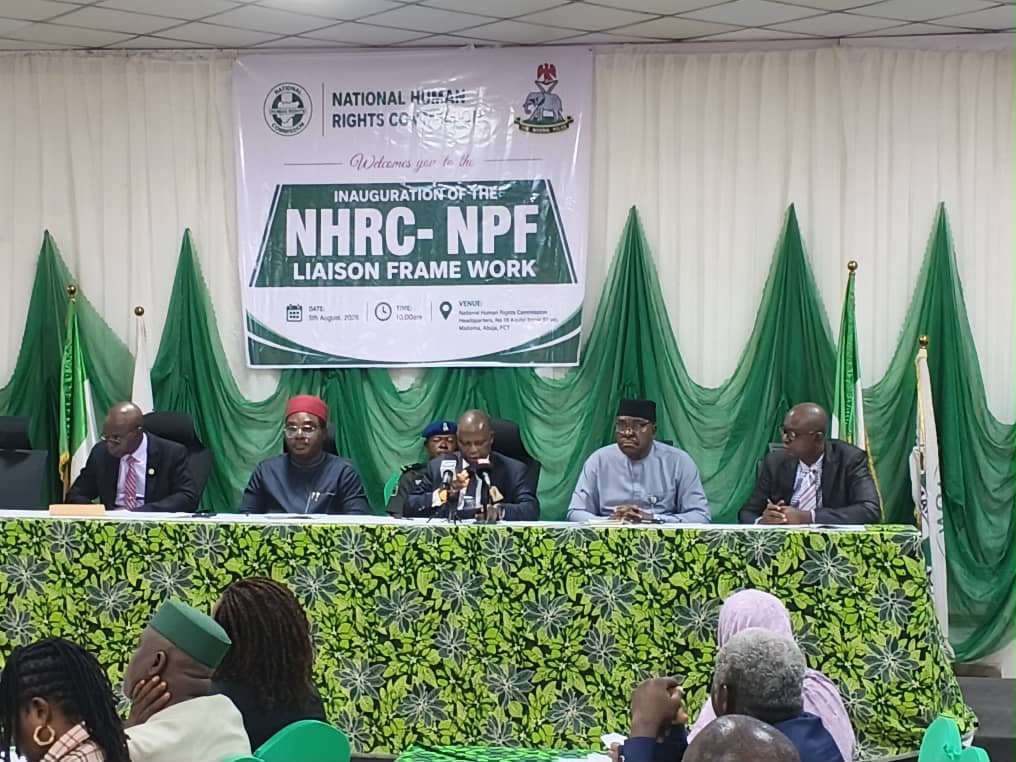
The Federal Government has launched a new institutional framework to strengthen collaboration between the National Human Rights Commission (NHRC) and the Nigeria Police Force (NPF), in a move aimed at tackling human rights violations, enhancing police accountability and restoring public confidence in law enforcement.
Attorney-General of the Federation and Minister of Justice, Lateef Fagbemi, inaugurated the NHRC–NPF Liaison Framework on Wednesday at the headquarters of the National Human Rights Commission in Abuja, describing it as a landmark initiative that would institutionalise cooperation between the two agencies to improve the protection of citizens’ rights and strengthen the administration of justice.
Fagbemi acknowledged that while both the police and the NHRC were established to safeguard the rights of Nigerians, a significant proportion of complaints received by the Commission still stem from alleged abuses by law enforcement officers.
He said the Federal Government has both constitutional and international obligations, particularly under the International Covenant on Civil and Political Rights (ICCPR), to provide effective remedies for victims of human rights violations, making closer collaboration between the two institutions imperative.
“Effective policing and respect for human rights are mutually reinforcing objectives that strengthen public confidence, improve cooperation between law enforcement agencies and the communities they serve, and contribute to the overall effectiveness of the criminal justice system,” the Attorney-General said.
According to him, the liaison framework provides a structured mechanism for improved communication, prompt resolution of complaints, enhanced oversight of police detention facilities, greater compliance with human rights standards and coordinated efforts to address systemic challenges within Nigeria’s criminal justice system.
He stressed that lasting reforms in the justice sector could only be achieved through sustained institutional partnerships rather than isolated interventions.
Fagbemi explained that the framework introduces designated focal officers at both national and operational levels, transforming what had previously been informal engagements into a permanent institutional arrangement.
He added that the initiative prioritises the prevention of human rights abuses through continuous dialogue, capacity building, institutional cooperation and proactive oversight instead of merely responding after violations have occurred.
Highlighting ongoing justice sector reforms, the Attorney-General cited the Administration of Criminal Justice Act, 2015, the Anti-Torture Act, 2017, and the Police Act, 2020 as key legislative milestones designed to strengthen accountability and guarantee respect for constitutional rights.
He also noted that the administration of President Bola Ahmed Tinubu has intensified efforts to modernise the justice system through improved judicial infrastructure, the appointment of judges to fill vacancies and enhanced welfare packages for judicial officers.
Fagbemi linked broader security sector reforms to improved human rights protection, revealing that President Tinubu recently approved salary increases of between 30 and 80 per cent for members of the Nigerian Armed Forces to boost professionalism, morale and operational efficiency.
He maintained that improved welfare for security personnel complements efforts to build institutions anchored on accountability, human dignity and the rule of law.
The Attorney-General assured stakeholders that the Federal Ministry of Justice would continue supporting collaboration among law enforcement agencies, oversight institutions, prosecutors, the judiciary, legal aid organisations and civil society groups.
He, however, cautioned that the framework’s success would ultimately depend on its effective implementation, urging designated officers and participating institutions to maintain regular communication, diligent monitoring and sustained cooperation.
Earlier, Executive Secretary of the National Human Rights Commission, Chief Tony Ojukwu, described the inauguration as the beginning of a new era of institutional partnership between two critical national institutions charged with protecting the rights, dignity and security of Nigerians.
Ojukwu said the framework emerged from sustained engagement between the Commission and the Nigeria Police Force, tracing its foundation to a high-level working visit convened by the Administration of Criminal Justice Monitoring Committee on June 16, 2025, and strengthened through subsequent consultations with the police leadership.
He said both institutions had consistently recognised that protecting human rights and maintaining public safety are complementary responsibilities that require close institutional collaboration.
The NHRC boss commended the Inspector-General of Police for approving the reactivation of the NHRC–NPF Liaison Framework and supporting the establishment of national coordination structures to deepen cooperation between both organisations.
He also praised the Deputy Inspector-General of Police and other senior police officers for working closely with the Commission to transform the initiative into an operational framework.
According to Ojukwu, the partnership is designed to move beyond dialogue by strengthening institutional accountability, promoting respect for human rights, ensuring compliance with constitutional and criminal justice laws, improving professionalism in policing, enhancing public trust and fostering strategic collaboration.
He said the framework would establish structured communication channels, improve complaint resolution mechanisms, strengthen detention monitoring, build the capacity of police officers and develop coordinated responses to emerging human rights challenges across the country.
“Our shared objective is to ensure that policing activities across Nigeria consistently uphold the rule of law, professionalism and respect for the dignity of every person,” Ojukwu stated.
He reaffirmed the Commission’s commitment to working closely with the Nigeria Police Force and other justice sector institutions to ensure the effective implementation of the framework, expressing confidence that the initiative would significantly improve accountability, human rights compliance and public trust in law enforcement.
Fagbemi expressed optimism that the NHRC–NPF Liaison Framework would promote human rights-compliant policing, strengthen detention oversight, improve accountability, expand access to justice and reinforce public confidence in Nigeria’s criminal justice system.
He congratulated the leadership of both the National Human Rights Commission and the Nigeria Police Force for initiating what he described as a landmark partnership, urging all participating institutions to remain committed to its successful implementation in the interest of justice, the rule of law and the protection of the rights and freedoms of all Nigerians.