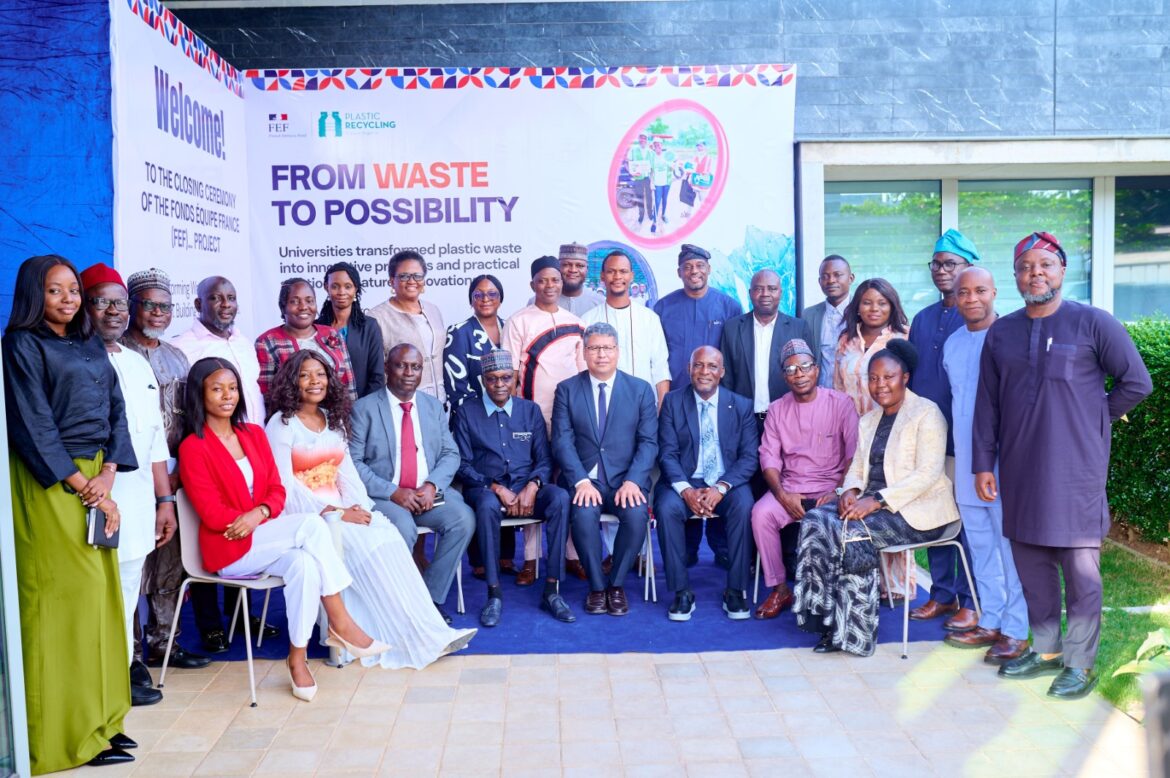
A two-year partnership between the Embassy of France in Nigeria and 13 Nigerian universities has demonstrated how plastic waste can be transformed into a thriving circular economy capable of generating an estimated ₦949.3 million annually, marking a significant milestone in Nigeria’s fight against plastic pollution.
The €753,000 (about ₦1.3 billion) initiative, which concluded on June 30 in Abuja, has converted university campuses into hubs for recycling, innovation and green entrepreneurship while proving that higher education institutions can play a pivotal role in driving the country’s environmental sustainability and economic development.
An independent evaluation presented at the project’s closeout ceremony by BluerAfrica–Africa Blue and Coastal Community Development Initiative described the programme as one of Nigeria’s most impactful university-led circular economy initiatives, while urging stronger institutional frameworks to sustain and expand its achievements.
Presenting the evaluation, Executive Director of BluerAfrica, Priscilla Ibadin, commended the programme for demonstrating that Nigerian universities possess the technical expertise and innovation capacity to lead practical environmental solutions.
She, however, stressed that long-term success would depend on improved operational management, stronger occupational health and safety standards, enhanced environmental monitoring and more efficient utilisation of recycling infrastructure.
Funded under the French Government’s Fonds Équipe France (FEF 209), the project was designed to address Nigeria’s growing plastic waste challenge by equipping universities with recycling facilities, promoting research and innovation, and creating opportunities for students to convert plastic waste into commercially viable products.
The independent assessment revealed that the participating institutions now possess the capacity to recycle 3.17 metric tonnes of plastic waste daily.
Over the two-year period, they diverted 145.2 metric tonnes of plastic waste from landfills and waterways and converted 79.3 metric tonnes into marketable products, including eco-bricks, paving stones, construction materials, plastic flakes, consumer products and filament for 3D printing.
The programme also built human capacity, with more than 1,500 students trained in recycling technologies, digital fabrication and circular economy innovation, while 275 informal waste pickers were integrated into structured recycling value chains, creating new income opportunities and strengthening community participation.
According to the evaluation, if the participating universities operate their recycling facilities at full capacity, they could collectively generate about ₦949.3 million annually, underscoring the enormous economic potential of Nigeria’s emerging green economy.
Speaking at the event, the French Ambassador to Nigeria, Marc Fonbaustier, said environmental sustainability and economic growth should be pursued together rather than viewed as competing priorities.
He noted that recycling and responsible waste management have become important economic opportunities capable of creating jobs, stimulating innovation and supporting local manufacturing.
Fonbaustier reaffirmed France’s commitment to expanding scientific collaboration with Nigerian universities through continued research partnerships, technical cooperation and knowledge exchange beyond the lifespan of the project.
Also speaking, the Deputy Head of Cooperation at the French Embassy, Pierre Andriamampianina, said the programme’s greatest achievement was the human capacity it had developed.
According to him, while the recycling infrastructure remains valuable, the project’s lasting legacy lies in the students, researchers and institutions now equipped with the knowledge and skills needed to drive Nigeria’s transition to a circular economy.
Participating universities also showcased innovations developed under the initiative.
The University of Lagos disclosed that its recycling micro-plant has already diverted about five tonnes of plastic waste from surrounding communities while producing furniture from recycled plastics and creating new business opportunities for waste collectors.
The University of Calabar projected that large-scale recycling could become a significant revenue stream for Nigerian universities if similar initiatives are expanded nationwide.
Speaking on behalf of the participating institutions, university representatives stressed that the foundation for a sustainable recycling economy has already been established.
“The infrastructure is real. The products are real. The students are ready,” one representative said.
“What remains is our collective commitment to ensure these systems operate consistently, safely and sustainably beyond the life of this grant.”
The ceremony ended with renewed commitments by the French Government, participating universities and development partners to deepen collaboration and scale up university-led recycling initiatives as Nigeria grapples with rising plastic pollution, rapid urbanisation and increasing climate-related challenges.
Participants said the project has demonstrated that plastic waste, once regarded as an environmental burden, can become a valuable economic resource capable of creating jobs, supporting industries and advancing Nigeria’s transition to a cleaner, more sustainable future.