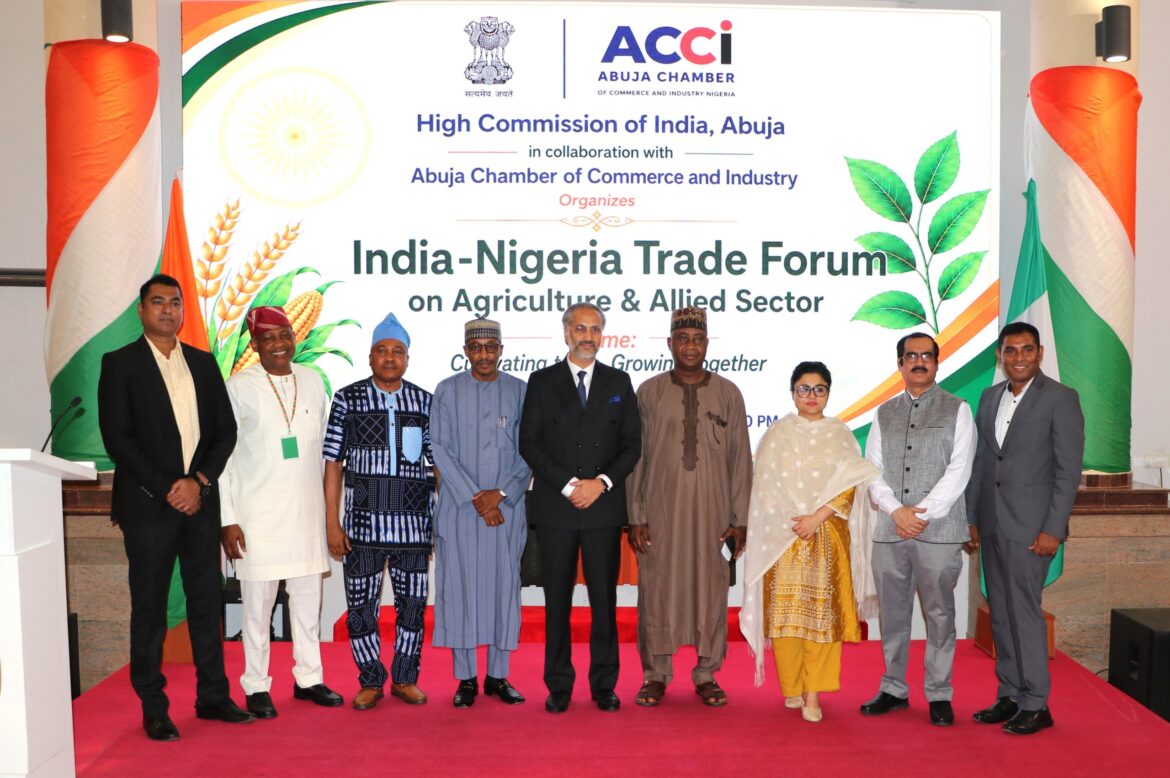
India has unveiled plans to support Nigeria’s agricultural transformation by helping the country reduce post-harvest losses, modernise livestock production and expand food processing as part of efforts to strengthen food security and deepen bilateral economic cooperation.
The initiative will focus on technology transfer, climate-smart agriculture, mechanisation, financing, capacity building and improved value chains, coming at a time when Nigeria is grappling with rising food prices, low agricultural productivity and worsening food insecurity.
Indian High Commissioner to Nigeria, Ambassador Abishek Singh, disclosed the plans on Thursday at the India-Nigeria Trade Forum on Agriculture and Allied Sector in Abuja, organised by the Indian High Commission in collaboration with the Abuja Chamber of Commerce and Industry (ACCI).
Speaking on the theme, “Cultivating Trade, Growing Together,” Singh said Nigeria had enormous agricultural potential but continued to lose a significant proportion of its farm output due to inadequate storage, limited processing capacity, poor logistics and inefficient value chains.
He said India, which had transformed from a food-deficit country into one of the world’s major agricultural producers through technology and innovation, was ready to share its expertise with Nigeria. “Nigeria’s agriculture contributes significantly to its GDP, and India is ready to invest in livestock, fisheries and food processing to enhance food security,” Singh said.
The envoy said India would also support the adoption of climate-resilient farming techniques to help Nigerian farmers cope with the growing effects of climate change on agricultural production.
According to him, India’s expertise in drip irrigation, high-yield oil palm seedlings and fertiliser production could improve farm productivity while reducing production costs.
He added that India’s capabilities in tomato processing, cold-chain logistics, food preservation and modern packaging were particularly relevant to Nigeria’s urgent need to curb losses between harvest and consumption.
Singh further disclosed that Indian technology companies and agritech startups were prepared to partner with Nigerian institutions by providing digital agricultural solutions, technical training and investment support.
He said financing for prospective partnerships could be facilitated through institutions such as the Nigerian Export-Import Bank (NEXIM), the Bank of Industry and private-sector investors.
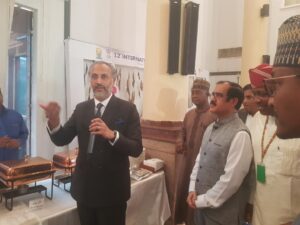
The High Commissioner said the proposed cooperation would extend to livestock development, with India providing technical expertise in dairy farming, artificial insemination, improved breeding techniques and cooperative models aimed at increasing milk and meat production.
He disclosed that India was already working with Jigawa State to modernise livestock production through improved breeding programmes and the organisation of farmers into dairy cooperatives.
Singh also revealed that India had submitted a proposed Memorandum of Understanding on agriculture and allied sectors to the Federal Government, urging the Nigerian authorities to accelerate its approval to facilitate broader cooperation.
Minister of Agriculture and Food Security, Senator Abubakar Kyari, welcomed the initiative and reaffirmed the Federal Government’s commitment to strategic international partnerships under President Bola Tinubu’s Renewed Hope Agenda.
Represented by the ministry’s Director of Agribusiness and Marketing Development, Olawumi Olajide, the minister said collaboration with India would promote job creation, value addition and technology transfer while advancing Nigeria’s drive for food self-sufficiency.
Also speaking, the First Deputy President of ACCI, Prof. Adesoji Adesugba, described the forum as an important platform for strengthening economic relations between Nigeria and India through agriculture.
Adesugba, who is also National Vice President (India) of the Nigerian Association of Chambers of Commerce, Industry, Mines and Agriculture (NACCIMA), said stronger cooperation could unlock opportunities in mechanisation, agricultural research, innovation, agro-processing and technology transfer.
He said deeper agricultural ties with India could accelerate economic diversification while improving food production and rural livelihoods.
Nigeria’s agricultural sector continues to face significant structural challenges despite its vast arable land resources. Poor storage facilities, inadequate mechanisation, insecurity in farming communities, weak transportation networks and limited agro-processing capacity have continued to constrain productivity and raise food costs.
Agricultural experts estimate that between 30 and 50 per cent of fruits, vegetables, grains and other farm produce may be lost annually before reaching consumers, largely because of inadequate storage, transportation and processing infrastructure.
The losses represent billions of naira in foregone income, reducing farmers’ earnings, discouraging investment and aggravating food shortages.
The proposed India-Nigeria agricultural partnership therefore has the potential to address critical gaps across the entire value chain, from production and livestock development to storage, processing, logistics and market access.
India is already one of Nigeria’s major trading partners, with bilateral commerce covering pharmaceuticals, energy, information technology, manufacturing and agriculture.
If successfully implemented, the proposed agricultural cooperation could help Nigeria reduce post-harvest losses, expand agro-industrial processing, increase dairy and livestock output, create employment and strengthen the country’s long-term food security strategy.