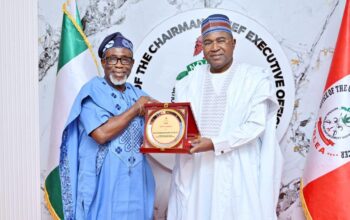
The Institute for Peace and Conflict Resolution (IPCR) has officially launched Nigeria’s 2024 Strategic Conflict Assessment (SCA), offering an extensive analysis of the nation’s conflict dynamics across all 774 local government areas.
Unveiling the 859-page report at the IPCR headquarters in Abuja on Thursday, the Director-General, Dr. Joseph Ochogwu, described it as a landmark, homegrown research product developed entirely by the Institute’s in-house experts—without the involvement of external consultants or donor funding.
“This document is a product of rigorous, evidence-based research,” he said. “It captures conflict trends, dynamics, triggers, actors, and interventions across every state, geopolitical zone, and local government area.”
The SCA, last conducted over six years ago, is one of IPCR’s flagship research initiatives, first launched in 2003. Dr. Ochogwu emphasized that the 2024 edition reflects local realities and nuances, offering deep insights into the varied nature of conflicts—such as identity-based disputes, communal violence, and farmer-herder clashes—across different regions.
“Conflict in one area often differs significantly from that in another,” he noted. “Understanding these distinctions is key to developing effective responses.”
He said the report will be instrumental for government institutions, civil society, international development partners, and peacebuilding practitioners. “This document provides the credible, data-rich foundation needed to design targeted and impactful interventions.”
Dr. Ochogwu warned against the dangers of relying on outdated or generalized assumptions, urging all stakeholders to make use of the SCA findings. “Too often, interventions misalign with local realities due to weak evidence. This report fills that gap.”
According to him, the report will inform a forthcoming National Action Plan on Conflict Prevention and Management to be presented to the federal government, aimed at promoting coordinated, multi-sectoral responses to the country’s complex conflict landscape.
He further noted that Nigeria’s insecurity is fueled by multiple factors—including youth unemployment, social exclusion, and the waning interest of young people in agriculture—adding that “not all conflicts require kinetic responses; some demand socio-economic solutions.”
A summary version of the SCA will be distributed digitally to universities, research institutions, and stakeholders nationwide to encourage widespread use.
Dr. Ochogwu commended the report’s lead coordinator, Dr. Bosede Awodola, and the research team for their commitment and intellectual rigor. He also thanked the media for their consistent support, urging them to help amplify the findings.
“This report is a must-read for all peacebuilders, policymakers, and conflict resolution professionals. It is a powerful tool to reshape our understanding and strategies for peace in Nigeria,” he concluded.