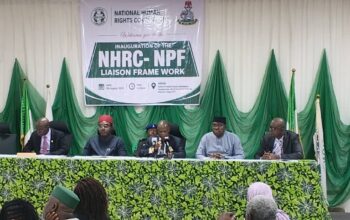
The National Human Rights Commission (NHRC), in partnership with the United Nations Human Rights Office (OHCHR), has urged Nigerian border officials to uphold the human rights and dignity of migrants, emphasizing that they remain among the most vulnerable groups and deserve compassion and fairness.
This call was made during a High-Level Briefing with Border Officials held in Abuja to share findings from recent human rights monitoring missions at the Seme Border in Lagos State and the Idiroko Border in Ogun State. The event brought together representatives of key border agencies, development partners, and human rights experts to strengthen Nigeria’s border governance through a human rights-based approach.
Executive Secretary of the NHRC, Dr. Tony Ojukwu (SAN), noted that migration is a complex global phenomenon driven by economic, social, and environmental factors, stressing that every migrant, irrespective of their status, is entitled to full protection under international and national law.
“While motivations for migration may differ, one principle remains constant — every migrant deserves dignity and respect,” Ojukwu said. He reiterated the Commission’s statutory mandate to monitor, investigate, and report on human rights conditions, including those at Nigeria’s borders, in partnership with OHCHR and the International Organization for Migration (IOM).
He explained that the Commission’s assessment focused on entry and exit procedures, referral mechanisms, and safeguards for vulnerable persons such as women and persons with disabilities. Ojukwu added that the objective was to move beyond identifying challenges to developing practical, time-bound solutions that foster accountability and inter-agency collaboration.
Representing the United Nations Human Rights Office, Mrs. Esther Michael Sawa, speaking on behalf of Ms. Adowa Kufuor, Senior Human Rights Adviser at the Office of the UN Resident Coordinator, highlighted the Promise Project — a joint initiative between OHCHR and the UN Office on Drugs and Crime (UNODC) — which supports West African countries in developing human rights-based responses to irregular migration.
Sawa emphasized that migrants often face violence and discrimination and must be treated with empathy and respect. “The protection of migrants and strengthening our borders is not the task of one agency alone. It requires joint efforts and shared accountability,” she said.
She added that the meeting was not intended to apportion blame but to identify good practices and address gaps through collective solutions.
Presenting the findings of the border monitoring missions, Ms. Jennifer S. Aga of the NHRC and Mrs. Sawa reported several systemic human rights and operational challenges at both Seme and Idiroko borders. These included the absence of standardized procedures for identifying trafficking victims, weak referral mechanisms to NAPTIP, inadequate infrastructure, and a lack of interpreters for non-English speakers.
The assessment also identified over 130 unofficial border routes at Idiroko used for trafficking and smuggling, with security agencies struggling with severe resource shortages. Communities near border areas reported instances of harassment, sexual violence, and exploitation.
The NHRC and its partners recommended developing standardized victim identification tools, improving infrastructure and living conditions, providing emergency assistance funds, deploying interpreters, and enhancing training and collaboration among agencies.
The Commission reaffirmed that protecting migrants’ rights is integral to Nigeria’s commitment to human rights, the rule of law, and human dignity, calling for sustained partnership among all stakeholders to implement the findings and recommendations from the border assessments.