The National Human Rights Commission (NHRC) has called on the Federal Government to increase funding for mental healthcare, expand health insurance coverage and strengthen safeguards against discrimination and abuse of persons living with mental health conditions.
The commission warned that existing laws and policies would have little impact unless they translated into accessible healthcare services, adequate professional support and effective protection of the fundamental rights of affected persons.
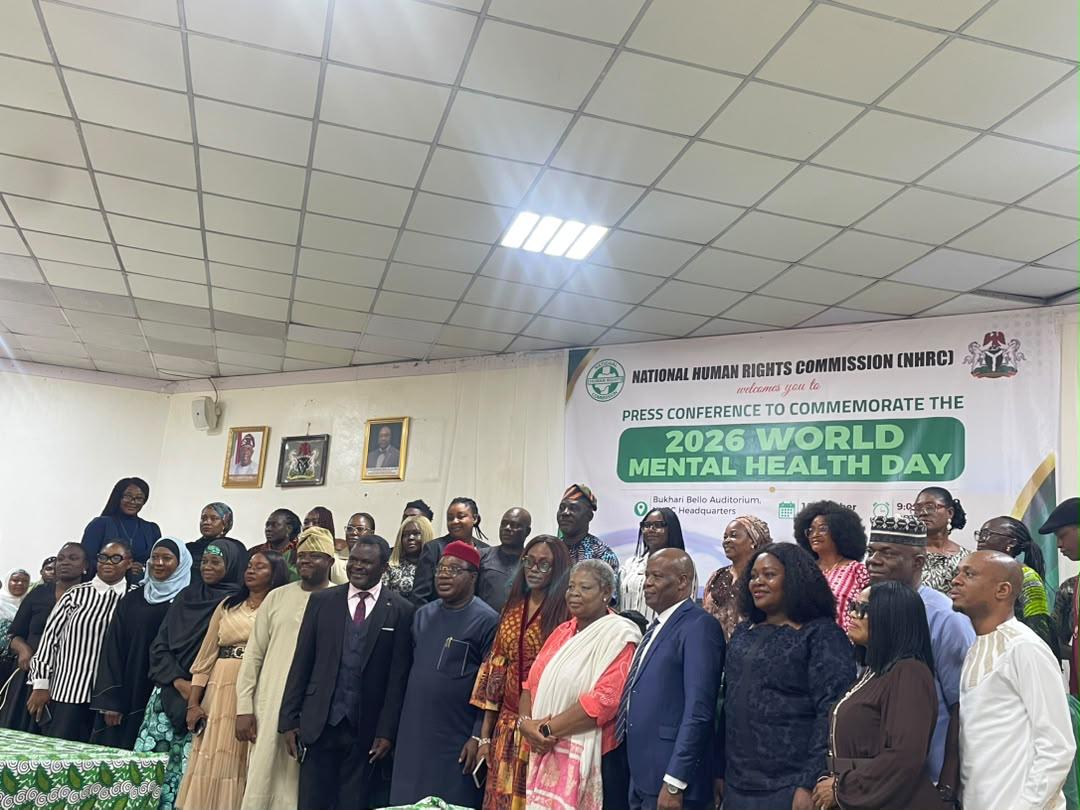
The Executive Secretary of the NHRC, Chief Tony Ojukwu, made the call in Abuja on Monday in a statement commemorating the 2026 World Mental Health Day. He stressed that mental healthcare should be treated not merely as a medical concern but as a fundamental human rights obligation requiring coordinated action by government agencies, healthcare providers, civil society organisations and other stakeholders.
Ojukwu also expressed concern over the growing mental health needs of Nigerians affected by terrorism, abductions, displacement, gender-based violence and other humanitarian emergencies, insisting that psychological trauma must be integrated into the country’s broader human rights response.
Citing Article 16 of the African Charter on Human and Peoples’ Rights, which guarantees every individual the right to enjoy the best attainable state of physical and mental health, he said the government had a responsibility to ensure that Nigerians could access appropriate and affordable mental healthcare without discrimination.
He acknowledged Nigeria’s legislative and policy efforts, including the National Mental Health Act and the National Mental Health Policy, but maintained that effective implementation remained essential to protecting affected persons from neglect, exclusion and degrading treatment.
The National Mental Health Act, enacted in 2021 and assented to by the President in December 2022, provides a legal framework for mental health services and the protection of the rights of people living with mental health conditions.
However, the NHRC chief argued that legislation alone could not resolve the country’s mental health challenges without sustained investment in healthcare infrastructure, trained personnel, community-based services and accountability mechanisms.
He cited World Health Organisation estimates that nearly one in seven people globally lives with a mental disorder, noting that poverty, inequality, violence and disability could further aggravate the burden and restrict access to treatment.
Of particular concern, Ojukwu said, was the limited health insurance coverage for mental healthcare in Nigeria, with fewer than three per cent of people with mental health conditions reportedly covered by health insurance.
He warned that the situation placed an excessive financial burden on affected individuals and their families, many of whom already struggled to meet basic needs while seeking treatment and related support services.
The NHRC executive secretary further condemned the stigma, discrimination, violence and social exclusion faced by people experiencing mental health conditions, noting that some were denied opportunities in education, employment, housing and community life.
He said others were deprived of the opportunity to make decisions about their own lives or subjected to treatment that undermined their dignity and fundamental rights.
“A mental-health condition does not reduce a person’s worth, dignity or human rights,” Ojukwu said, advocating a rights-based approach that recognises affected persons as individuals entitled to equality, respect and appropriate care.
He urged the Federal Government to expand affordable and accessible mental health services, particularly by integrating them into primary healthcare centres across the country.
He also called for broader health insurance coverage and the recruitment, training and deployment of more psychiatrists, psychologists, counsellors, psychiatric nurses and social workers to address the shortage of qualified professionals.
Ojukwu further urged the government to fully implement the National Mental Health Act and Policy while strengthening mechanisms for investigating and preventing human rights abuses in mental healthcare facilities.
NHRC expands psychosocial support
The commission’s chief said the need for comprehensive mental health interventions was particularly urgent in communities affected by conflict, terrorism, abductions and displacement, where survivors of violence and serious human rights violations frequently experienced psychological distress.
He stressed that mental health and psychosocial support should form an integral part of interventions for survivors of conflict, torture, human trafficking, gender-based violence and other forms of abuse.
As part of its response, Ojukwu disclosed that the NHRC had established a Counselling Unit at its headquarters to provide emotional support to individuals affected by human rights violations and traumatic experiences.
The unit, staffed by qualified counsellors, also provides support to commission personnel dealing with distressing cases involving violence, abuse, loss and human suffering.
He said the commission had also organised mental health and human rights training through its Human Rights Institute, particularly for investigation officers, to equip them with the skills to identify psychosocial concerns, respond appropriately to vulnerable complainants and recognise cases requiring professional intervention.
According to him, the establishment of the commission’s Vulnerable Group Department had further strengthened its capacity to address the rights and needs of vulnerable populations, including people experiencing mental health challenges.
Ojukwu also disclosed that the NHRC was collaborating with the Federal Ministry of Health and Social Welfare and other stakeholders to integrate human rights considerations into the proposed National Mental Health Strategic Plan for 2027–2032.
He described the proposed five-year plan as an important step towards establishing a coordinated national framework for mental health interventions.
The commission, he added, had participated in training organised by the United Nations Office on Drugs and Crime on drug prevention, treatment and care, with particular attention to the relationship between substance use, mental health and human rights.
He said drug-related challenges should be addressed through appropriate treatment, rehabilitation and psychosocial support rather than approaches that expose affected persons to further abuse.
The NHRC executive secretary further disclosed that the commission had partnered with the Taipei Trade Office and civil society organisations to provide grants and free mental health sessions to some indigent women who were victims of human rights violations.
Commission recounts interventions
Ojukwu recounted interventions in Kano State involving children and adults with psychosocial and psychological disabilities who had allegedly been subjected to solitary confinement before being moved to a welfare facility following the commission’s intervention.
He also cited a case in the Federal Capital Territory in which the commission rescued a child from a woman living in what he described as an extremely distressing and inhuman condition linked to her mental state.
He said the cases demonstrated the need for responses based on professional care, family support, protection and respect for human dignity, rather than punishment, abandonment or abuse.
The interventions, he maintained, reinforced the need for government institutions and communities to protect vulnerable individuals while ensuring that mental health conditions were not used as grounds for denying people their fundamental rights.
Stakeholders demand stronger implementation
In a goodwill message, the Founder of the Mandate Health Empowerment Initiative, Ameh Zion, called for stronger implementation of Nigeria’s mental health legislation and closer collaboration among government agencies, civil society organisations and development partners.
Zion described mental health as a human rights imperative, arguing that people experiencing depression, psychosis, trauma and psychosocial disabilities should not be deprived of their fundamental rights because of their conditions.
He expressed concern over the shortage of trained professionals, inadequate healthcare services and persistent stigma, which he said continued to prevent many Nigerians from accessing appropriate treatment.
According to him, the psychological consequences of terrorism, violence, displacement and abuse often leave survivors with invisible wounds, while families and caregivers struggle with emotional and financial pressures without sufficient institutional support.
Zion urged stakeholders to move beyond public awareness campaigns and ensure that existing laws and policies were implemented nationwide through clearly defined responsibilities, measurable targets and accessible services.
He also expressed his organisation’s readiness to collaborate with the NHRC and African mental health reform stakeholders on public awareness, institutional capacity building, psychosocial support for survivors, referral pathways and policy advocacy.
Both Ojukwu and Zion called on schools, workplaces, families and communities to create supportive environments where people could discuss mental health concerns and seek help without fear of rejection or discrimination.
Ojukwu urged religious and traditional leaders to complement professional mental healthcare rather than substitute it for clinical treatment where necessary. He also called on the media to promote accurate and sensitive reporting of mental health issues, warning against narratives that reinforce stereotypes and stigmatise affected persons.
The NHRC executive secretary reaffirmed the commission’s commitment to investigating human rights violations, protecting vulnerable persons and advocating policies that uphold the rights and dignity of all Nigerians.
He maintained that the country could not effectively protect human dignity while people continued to suffer in silence or face discrimination because they needed mental healthcare.