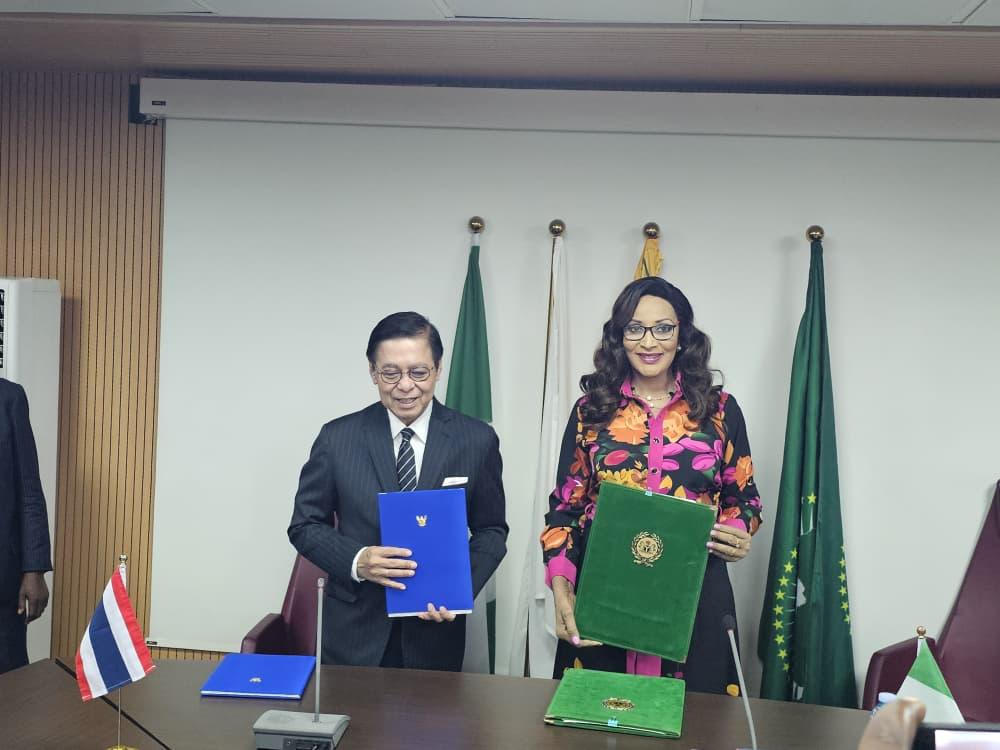
Nigeria and Thailand have moved to strengthen bilateral economic relations with the signing of a Memorandum of Understanding (MoU) on technical cooperation, alongside renewed commitments to expand trade, investment, technology transfer and development partnerships.
The agreement, signed in Abuja on Tuesday, provides a framework for cooperation in skills development, agriculture, technology, innovation and other sectors considered critical to the economic growth of both countries.
Nigeria’s Minister of Foreign Affairs, Ambassador Bianca Odumegwu-Ojukwu, signed the agreement on behalf of the Federal Government, while Thailand’s Deputy Prime Minister and Minister of Foreign Affairs, Sihasak Phuangketkeow, signed for Thailand.
Speaking at the ceremony, Odumegwu-Ojukwu said Nigeria was determined to move its relationship with Thailand beyond traditional diplomatic engagement towards a comprehensive economic partnership capable of delivering measurable benefits to citizens of both countries.
She welcomed Thailand’s Thailand-Africa Initiative and advocated stronger collaboration between the Nigerian Technical Aid Corps (NTAC) and the Thailand International Cooperation Agency (TICA), particularly in skills acquisition, technology transfer and sustainable development.
The minister also called for the expansion of the Thailand-Nigeria Sustainable Agricultural Technology Development Project to more parts of Nigeria, stressing that deeper cooperation in agricultural research, technology and innovation could improve productivity, enhance food security and create opportunities for farmers and businesses.
Odumegwu-Ojukwu said Nigeria was prepared to elevate its relationship with Thailand to a strategic partnership, with economic cooperation as a major pillar.
She urged Thai investors to take advantage of Nigeria’s large consumer market and investment opportunities, while calling for greater diversification of bilateral trade beyond crude oil, rice and agricultural machinery.
According to her, agro-processing, manufacturing, energy, information and communications technology, mining and renewable energy offer significant opportunities for increased Thai investment and joint ventures.
The minister also proposed the establishment of a Joint or Bi-National Commission to provide an institutional mechanism for sustained economic dialogue, monitor the implementation of bilateral agreements and accelerate negotiations on outstanding agreements.
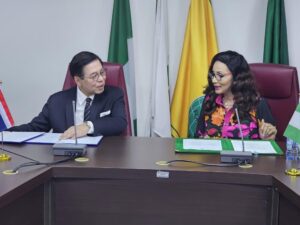
Pending instruments include the Investment Promotion and Protection Agreement, Trade Agreement, and Agreement on Economic, Scientific, Technical and Cultural Cooperation.
She further advocated stronger engagement between the Association of Southeast Asian Nations (ASEAN) and the Economic Community of West African States (ECOWAS), saying closer ties between the two regional blocs could unlock new opportunities for trade, investment and development.
For Thailand, Phuangketkeow described Nigeria as a key African economy, saying a strategic economic partnership would help expand investment and trade while delivering positive outcomes for the populations of both countries.
The latest agreement comes as Nigeria intensifies efforts to attract foreign investment, diversify its economy and build stronger international economic partnerships as part of its drive to reduce dependence on crude oil revenues.
Thailand, in turn, stands to gain greater access to one of Africa’s largest consumer markets and a strategic gateway to West Africa, while Nigeria could benefit from Thailand’s expertise in manufacturing, agriculture, technology and industrial development.
The technical cooperation framework is therefore expected to provide a foundation for broader economic engagement, with its success likely to depend on the translation of the commitments into concrete projects, investment agreements and sustained private-sector partnerships.
Both countries reaffirmed their commitment to regular high-level engagements and expanded cooperation, signalling a renewed effort to transform Nigeria-Thailand relations from diplomatic goodwill into a more substantive and mutually beneficial economic partnership.