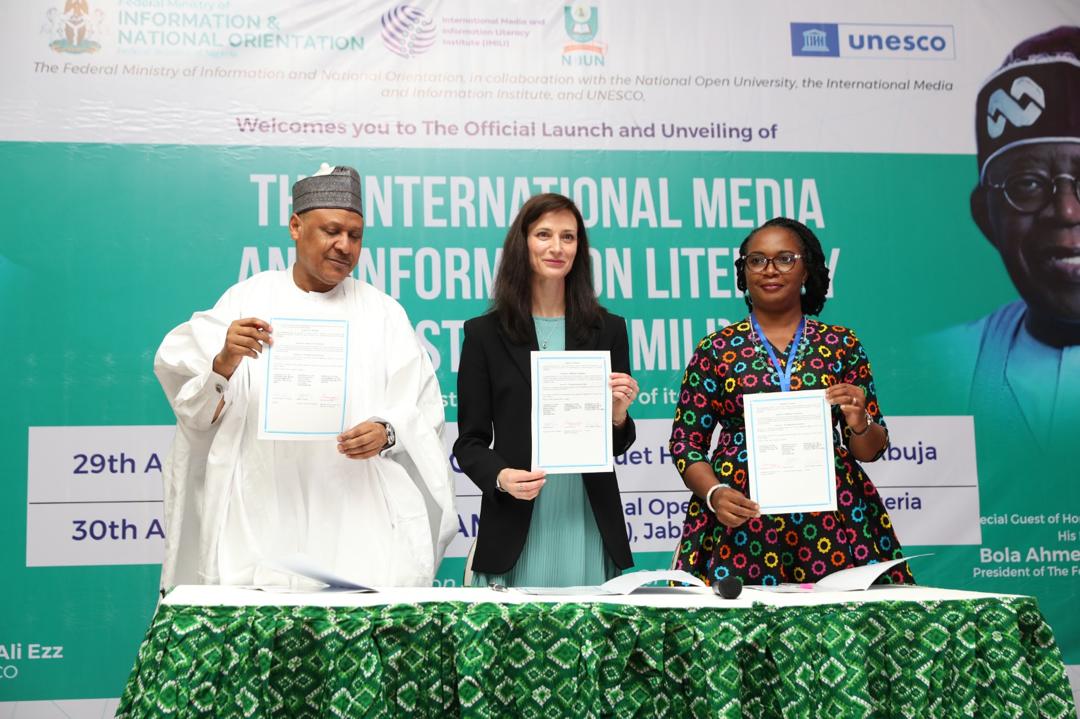
Nigeria has partnered with the United Nations Educational, Scientific and Cultural Organization to establish the world’s first International Media and Information Literacy Institute (IMILI), marking a major milestone in global efforts to tackle misinformation and promote critical thinking.
The institute was officially inaugurated on Wednesday in Abuja by the Federal Ministry of Information and National Orientation, positioning Nigeria as a leading force in advancing media literacy in the digital era.
IMILI is the first UNESCO Category 2 Institute dedicated exclusively to Media and Information Literacy (MIL), underscoring its global significance for Africa and the wider international community.
Speaking at the launch, UNESCO Assistant Director-General for Communication and Information, Mariya Gabriel, described the initiative as a timely response to the growing complexity of the global information landscape.
She noted that as the volume of information continues to expand rapidly, the ability to distinguish credible content from misinformation has become essential for informed citizenship.
The institute is expected to function as a global hub for research, innovation, and capacity building in media literacy. It will offer training programmes for educators, policymakers, media practitioners, and young people, equipping them with skills to critically assess information and participate effectively in democratic processes.
In addition, IMILI will support curriculum development, strengthen international collaboration, and connect Nigeria to a global network of expertise, reinforcing media and information literacy as a public good.
UNESCO commended President Bola Ahmed Tinubu for his role in supporting the initiative, while also acknowledging the contributions of the Minister of Information and National Orientation, Mohammed Idris Malagi, whose leadership was described as pivotal to its realization.
The organisation further recognised the efforts of key stakeholders, including the Nigerian National Commission for UNESCO, the UNESCO Abuja Office, and Nigeria’s Permanent Delegation to UNESCO.
By hosting the institute, Nigeria signals its intention to play a central role in shaping global responses to challenges in the digital information space, leveraging its dynamic media environment and growing digital population.
Observers say the launch reflects a broader commitment to empowering citizens not only to access information but to analyse and use it responsibly, with IMILI expected to strengthen public trust, support informed decision-making, and advance democratic values globally.