The Philippines has urged Nigeria to move beyond policy declarations on gender equality by strengthening legislation, institutions and accountability mechanisms that make women’s inclusion enforceable across government.
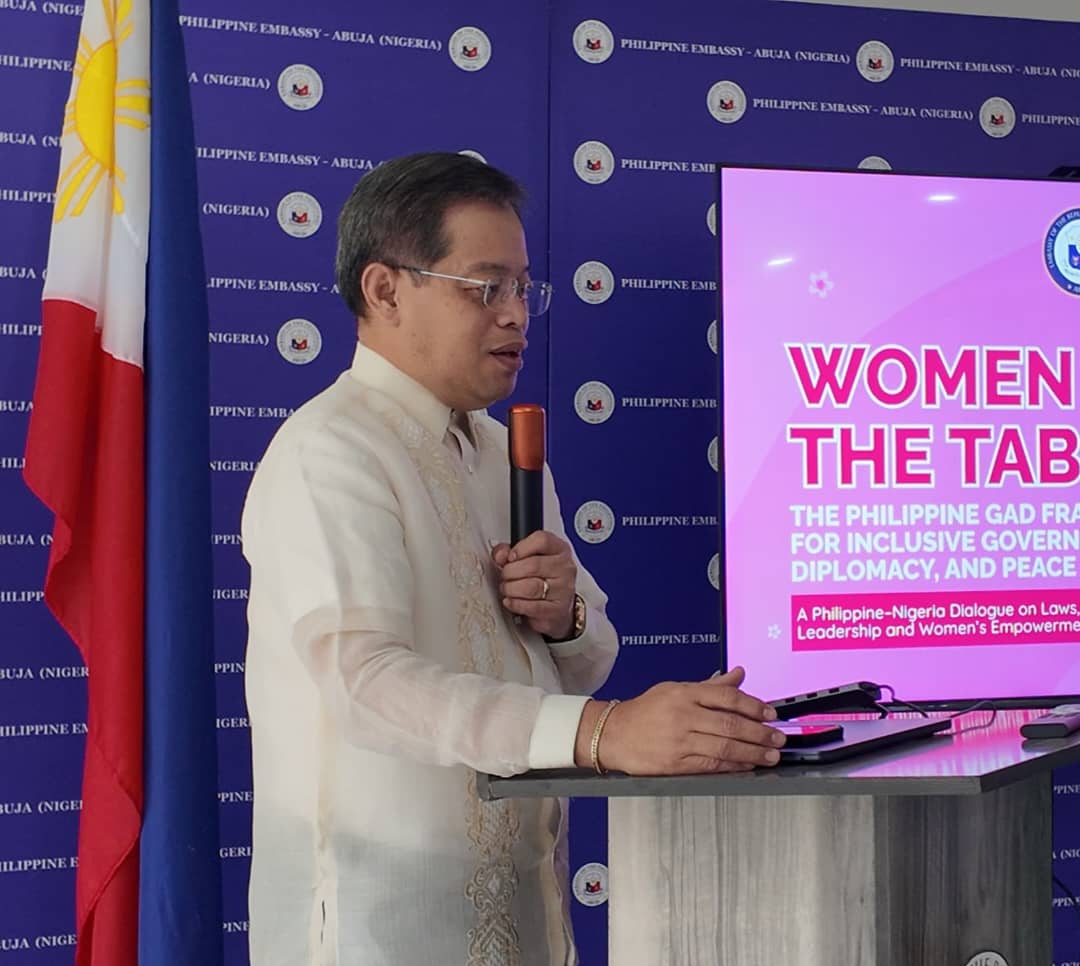
Philippine Ambassador to Nigeria, Mersole Mellejor, made the call in Abuja during a high-level dialogue organised under the Female Legislative Mentorship Initiative on Parliamentary Affairs and Diplomacy at the Philippine Embassy.
Mellejor said Nigeria could draw lessons from the Philippine experience, particularly its system of linking gender-responsive governance to government funding.
He explained that the Philippines had established parameters under which government agencies that failed to implement gender-mainstreaming policies could face consequences in their budgetary allocations.
“In the Philippines, we have parameters in place that carry direct budget implications for government agencies. Failure to implement gender mainstreaming directly impacts an agency’s budgetary allocation, serving as a firm measure to force compliance,” he said.
The envoy said such mechanisms had transformed gender mainstreaming from a voluntary policy commitment into an institutional obligation with measurable consequences.
He also highlighted the Philippines’ Safe Spaces Act, which provides legal protection against gender-based harassment and abuse in public places and workplaces, describing it as an example of how gender policies could be translated into enforceable legal protections.
Mellejor spoke during a session themed, “Women at the Table: The Philippine Gender and Development (GAD) Framework for Inclusive Governance, Diplomacy, and Peace.”
The dialogue brought together officials from the Directorate of Parliamentary Affairs, the Ministry of Foreign Affairs, members of the diplomatic community and legislative mentees to examine women’s participation in leadership, gender-responsive legislation and peacebuilding.
The ambassador commended Nigeria for the progress it had made on gender inclusion, noting that the country’s size, diversity and social complexity should not become barriers to achieving greater equality.
“As an outsider, I am very encouraged by where Nigeria is in terms of gender initiatives,” he said.
He argued that Nigeria’s diversity could become an asset for national development if its different social groups were effectively integrated into governance and decision-making.
Mellejor also identified Nigeria’s youthful population and growing digital, creative and technology sectors as major opportunities for economic transformation and stronger cooperation between Nigeria and the Philippines.
Participants examined ways to strengthen institutional support for women seeking leadership positions and improve the implementation of gender-responsive policies.
Members of the Philippine diplomatic mission, including Vice-Consuls Norman and Yate, shared experiences from the embassy’s Gender and Development programmes and their application in domestic and international engagements.
Mellejor expressed optimism that the dialogue would deepen collaboration between the Philippine Embassy, the National Assembly and civil society organisations in using legislation and public policy to advance gender equality.
The engagement underscored a central policy challenge for Nigeria: closing the gap between gender commitments and actual implementation.
For Nigeria, the Philippine experience offers a clear lesson that gender equality may require more than legislation and policy statements. It may also demand measurable institutional obligations, budgetary incentives and sanctions capable of compelling public institutions to deliver on their commitments.