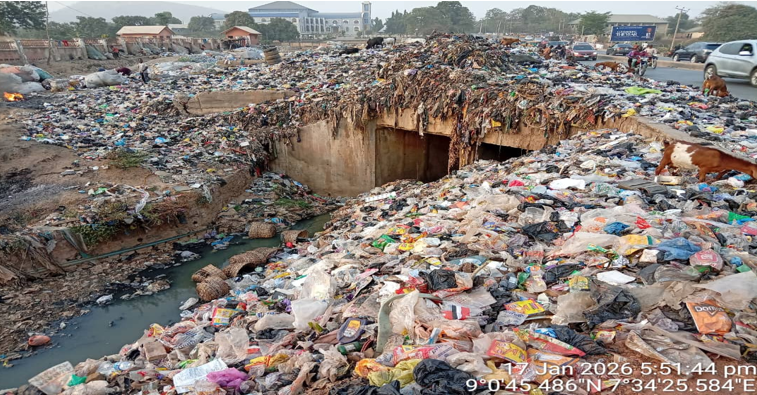
Speak Out for Justice Advocacy Ltd./GTE. (SOJA) has raised the alarm over mounting refuse at strategic locations in Dutse and Zuba, Abuja, warning that prolonged waste accumulation could create environmental and public-health risks if urgent action is not taken.
The human rights, anti-corruption and justice advocacy organisation, in a statement signed by its Founder and Executive Director, Hameed Jimoh, on Sunday, called on the Federal Capital Territory Administration (FCTA), Abuja Environmental Protection Board (AEPB), relevant Area Councils and other responsible authorities to urgently address the situation.
SOJA identified a stretch of the Dutse–Bwari Road, between the Police Sign Board and Tipper Garage Junction in Dutse, Bwari, as one of the affected locations. It also reported significant refuse accumulation around Zuba Garage Bridge, particularly at points visible to motorists and other road users approaching or descending from the bridge.
The organisation said the presence of substantial waste at multiple strategic locations warranted a broader environmental assessment rather than isolated clean-up exercises.
According to SOJA, the refuse at the Dutse location is accompanied by a strong and offensive odour, creating a nuisance for motorists, pedestrians, residents, traders and other members of the public who use the route.
It warned that prolonged waste accumulation could attract flies, rodents and other disease vectors, obstruct drainage systems and contribute to broader environmental degradation and sanitation problems.
However, SOJA stressed that it was not attributing any specific disease or contamination to the refuse without the findings of appropriate environmental or public-health assessments.
Rather, it said the continued accumulation of waste and the associated nuisance constituted foreseeable environmental risks that authorities should address before they escalated.
The organisation maintained that the issue was not merely about aesthetics, stressing that environmental sanitation was directly connected to public welfare, dignity, safety and quality of life.
It cited Section 14(2)(b) of the 1999 Constitution, as amended, which provides that “the security and welfare of the people shall be the primary purpose of government,” arguing that effective sanitation and responsible waste management were integral to safeguarding community welfare.
SOJA also warned against an approach that merely evacuates existing refuse without tackling the causes of recurring dumping.
It urged the authorities to investigate whether adequate waste-collection arrangements are available in the affected communities, identify individuals or businesses routinely dumping refuse at the locations and determine whether residents have sufficient waste-disposal facilities.
The organisation further called for regular monitoring of the affected areas and stronger enforcement of existing environmental sanitation regulations.
Among its immediate demands, SOJA urged the FCTA, AEPB and relevant Area Councils to inspect the identified locations, evacuate and properly dispose of the accumulated waste, assess surrounding environmental conditions and, where possible, identify those responsible for indiscriminate dumping.
It also advocated stronger waste-collection systems, public enlightenment, community engagement and periodic post-clean-up inspections to prevent the affected areas from becoming permanent dumping sites.
SOJA called for a wider sanitation assessment covering major roads, bridges, junctions, markets and other public spaces in the affected areas to determine whether similar refuse accumulation exists elsewhere.
The organisation stressed that environmental sanitation remained a shared responsibility between government and citizens.
While government agencies must provide effective waste-management systems, enforce relevant regulations and maintain monitoring mechanisms, it said residents, traders, businesses and other members of the public must equally dispose of waste responsibly.
“No government can maintain a clean environment if citizens deliberately turn public roads, drainage channels, bridges and open spaces into unauthorized dumping grounds,” SOJA said.
It, however, noted that citizens could not reasonably be expected to comply with waste-management requirements where adequate collection systems and disposal facilities were unavailable.
The organisation therefore called for stronger coordination among the FCT Administration, AEPB, Area Council authorities, community leaders, businesses and residents.
It also urged authorities to consider improved waste-collection systems, strategically located disposal facilities, recycling initiatives, community sanitation programmes, stronger enforcement and technology-based monitoring of persistent dumping hotspots.
SOJA said its intervention was intended as constructive civic engagement rather than criticism of government institutions, urging the authorities to regard the situation as an opportunity to establish a sustainable waste-management solution.
“The removal of waste should not be the end of the intervention. It should be the beginning of a sustainable solution,” the organisation said.
SOJA urged the relevant authorities to act promptly, investigate the underlying causes of the refuse accumulation and implement measures to prevent a recurrence.
It reaffirmed its commitment to human rights, environmental responsibility, accountability, good governance, public welfare, access to justice and the rule of law.