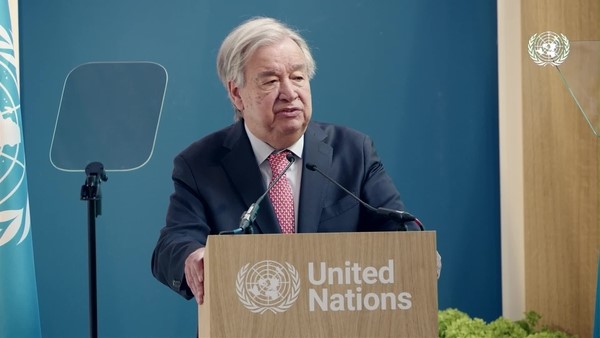
The United Nations Secretary-General, António Guterres, has warned that the world is facing a “tale of two crises” — an accelerating climate emergency and a deepening global energy insecurity — both driven by continued dependence on fossil fuels.
Delivering a special address at the Local Climate Action Summit in London, Guterres said the climate crisis and the energy crisis share a common origin in hydrocarbons and require a unified response anchored on a rapid, fair and large-scale transition to renewable energy.
He noted that recent years have recorded unprecedented global heat levels and rising climate-related disasters, warning that the world is approaching dangerous tipping points that could trigger irreversible environmental damage, including sea level rise, ecosystem collapse and disruption of global weather systems.
At the same time, he said geopolitical conflicts and fossil fuel market volatility have exposed the fragility of the global energy system, particularly for developing economies facing rising costs of energy, food insecurity and debt pressures.
“The model that powered the past is no longer fit for purpose,” Guterres said, adding that the international community must urgently accelerate implementation of the Sustainable Development Goals and transition away from fossil fuel dependence.
He highlighted the rapid decline in the cost of renewable energy technologies, noting that solar and wind power are now among the cheapest sources of electricity globally and are increasingly outcompeting fossil fuels in new installations. He added that clean energy investment is outpacing fossil fuel investment, signalling a structural shift in global energy markets.
Guterres said energy security can no longer be achieved through fossil fuel reliance, stressing that renewables offer greater stability, affordability and independence. “There are no embargoes on sunlight and no blockades on the wind,” he said.
Outlining a seven-point action framework, the UN chief called for immediate emissions reductions aligned with net-zero pathways, stronger methane mitigation across energy, waste and agriculture sectors, and an end to fossil fuel expansion that risks locking economies into stranded assets.
He also urged governments to address rising energy demand from emerging technologies such as artificial intelligence, proposing greater transparency from technology firms on the environmental impact of data centres and a shift toward renewable-powered digital infrastructure.
On climate finance, Guterres said the global financial system remains skewed against developing countries, which face disproportionately high borrowing costs despite vast renewable energy potential. He called for urgent reforms to mobilise scaled-up funding, including fulfilment of pledged climate finance commitments and stronger lending capacity from multilateral development banks.
Africa, he noted, holds major solar and mineral resources but continues to receive a small share of global clean energy investment, a disparity he described as both unjust and economically inefficient.
Guterres further emphasised the importance of a “just transition” that protects workers and communities dependent on fossil fuel industries, while ensuring that the benefits of clean energy development are widely shared, particularly in resource-rich developing nations.
He also warned against the growing threat of climate misinformation, urging stronger protection of science, journalists and institutions that uphold evidence-based climate policy. The UN, he said, is advancing initiatives to strengthen information integrity on climate change.
Concluding his address, Guterres described the current moment as both a crisis and an opportunity, stressing that the global shift to renewable energy is already underway but must be accelerated.
“This is our moment of choice,” he said, urging world leaders to turn the climate challenge into a “story of resolve, fairness and shared progress” by decisively moving away from fossil fuels toward a sustainable, renewable-powered future.