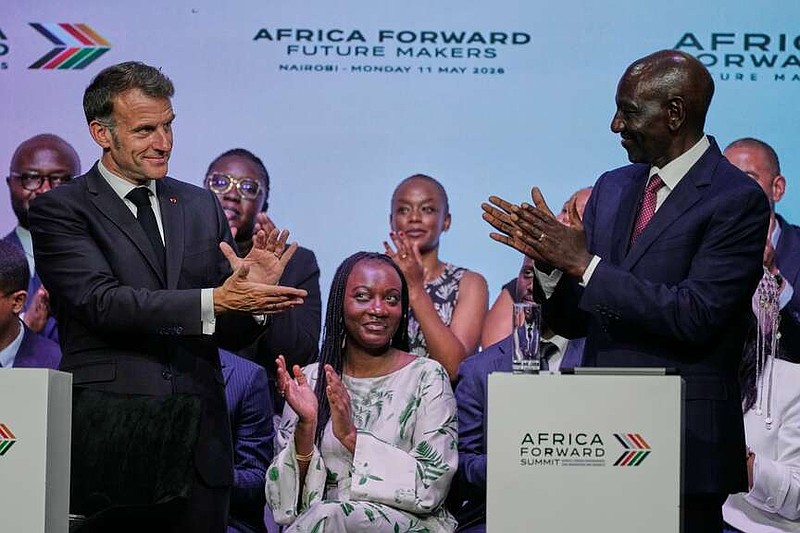
French Emmanuel Macron and Kenyan William Ruto, recently cohosted the Africa Forward Summit in Nairobi, with the intention of rebuilding relations between France and African countries. Present were many African leaders, Michael Olukayode in this report tries to place what the meeting means to France and Africa, now and in the future
For more than six decades after formal decolonisation, relations between France and Africa have remained among the most complex, controversial and strategically important international relationships in the world. What began as a colonial enterprise evolved into political alliances, military partnerships, economic dependence, cultural exchanges and, increasingly in recent years, bitter disputes over sovereignty and influence.
Today, however, that relationship appears to be entering another turning point.
At the Africa Forward Summit in Nairobi, Kenya, co-hosted by Emmanuel Macron and William Ruto, African and European leaders attempted to redefine the future of Africa-France relations around the language of equality, co-investment, sovereignty and shared prosperity.
The summit was historically symbolic. For the first time, the traditional Africa-France summit was held in a major Anglophone African country rather than a Francophone former French colony. That alone reflected a deliberate shift in France’s African policy.
But beneath the optimistic language of partnership lies a deeper historical question: can France truly build a new relationship with Africa without confronting the enduring legacies of “Françafrique”?
The Burden of History
France’s relationship with Africa cannot be understood without examining colonialism and the post-independence system that followed it.
Following the independence movements of the 1950s and 1960s, France retained enormous political, military and economic influence over many of its former colonies in West and Central Africa. Through military agreements, monetary arrangements such as the CFA franc, strategic resource control, and elite political networks, Paris maintained what became known as “Françafrique” — an informal system of influence that critics described as neo-colonial.
For decades, France intervened militarily in African states, supported friendly governments, influenced political transitions and protected economic interests. French companies dominated sectors ranging from oil and mining to telecommunications and infrastructure.
To many Africans, particularly younger generations, the relationship increasingly appeared unequal. France was often seen not as a partner but as a guardian of old structures that preserved dependency.
Anti-French sentiment grew sharply across parts of West Africa in recent years, particularly in Mali, Burkina Faso and Niger, where military juntas expelled French troops and questioned France’s long-standing role in regional security.
This changing political mood explains why the Nairobi summit represented more than diplomacy; it was an attempt at political reinvention.
Macron’s Attempt to Redefine France-Africa Relations
President Macron openly acknowledged during the summit that France’s traditional approach to Africa had become unsustainable.
“For too long,” he admitted, “too many people… saw Africa as their back yard. That is over.”
That statement was perhaps one of the most candid acknowledgements ever made by a French president regarding France’s historical posture toward Africa.
Macron’s speeches in Nairobi repeatedly emphasized that Africa no longer wants charity, paternalism or lectures from Europe.
“The African continent does not want us to come along with aid,” he declared. “People in Africa want us to come and invest.”
Throughout the summit, Macron framed the future relationship around four key concepts:
* equality;
* co-investment;
* sovereignty;
* and mutual strategic interest.
He argued that Europe’s own future prosperity and strategic autonomy are increasingly tied to Africa’s success.
“Supporting your success is a condition of our success,” he said.
This language marked a sharp departure from older diplomatic frameworks in which Africa was often treated primarily as a recipient of aid, humanitarian assistance or security intervention.
Instead, Macron repeatedly described Africa as:
* “the continent of the present,”
* a hub of innovation,
* and a critical partner in technology, energy, industrialisation and artificial intelligence.
The summit also produced concrete economic announcements, including €23 billion in investment pledges for Africa — €14 billion from French firms and €9 billion from African investors.
Why Africa Is No Longer Waiting for Europe
France’s changing tone is not occurring in a vacuum. Africa itself has changed dramatically.
The continent is now the youngest in the world, increasingly urbanised and technologically connected. African governments are diversifying partnerships with China, Turkey, India, Gulf states and Russia. No single external power dominates Africa today.
China’s rise, especially, transformed Africa’s diplomatic landscape. Chinese investment in infrastructure, mining, manufacturing and telecommunications altered the balance of influence that France and other European powers once enjoyed.
Macron himself acknowledged this shift in Nairobi, noting that China, Turkey and the United States had become stronger competitors in Africa because they were often perceived as more commercially aggressive and competitive.
At the same time, African leaders are becoming more assertive in demanding reforms in global governance, financing and trade systems.
This was strongly reflected in the intervention of Bola Tinubu at the summit.
Tinubu’s Intervention: Africa Wants Fairness, Not Charity
President Tinubu’s contribution in Nairobi reflected a broader African frustration with the global economic system.
He argued that Africa’s industrialisation and development are being constrained by unfair financial structures, punitive borrowing costs and weak investment mechanisms.
Tinubu warned that African countries are treated as permanently “high risk” economies, making access to affordable finance extremely difficult.
According to Reuters, Tinubu noted that Nigeria alone is projected to spend $11.6 billion on debt servicing in 2026 — almost half of government revenue.
His intervention aligned closely with the themes raised by Macron and Ruto:
* reform of the global financial architecture;
* support for industrialisation;
* and stronger African economic integration.
Tinubu stressed that Africa must move beyond exporting raw materials toward value-added manufacturing and regional industrialisation.
That position echoed Macron’s own argument that Africa should no longer merely export raw minerals and commodities while industrial processing happens elsewhere.
Tinubu also highlighted Nigeria’s maritime ambitions and offered the country’s Deep Blue maritime security project as a regional platform for Gulf of Guinea cooperation.
His broader message was significant: Africa is not asking for sympathy; it is demanding fair participation in the global economy.
That marks a major philosophical shift in Africa’s international diplomacy.
The Central Contradiction: Trust
Despite the optimistic rhetoric in Nairobi, the future of France-Africa relations still faces a fundamental challenge: trust.
Many Africans remain skeptical of France’s intentions.
Online discussions during the summit revealed continuing suspicion about whether France’s new strategy is genuinely different from older patterns of influence. Some commentators accused France of merely shifting its focus from hostile Francophone countries toward more receptive Anglophone states such as Kenya.
Others questioned whether investment-led engagement could simply become a new form of economic dependency rather than genuine partnership.
These concerns are not baseless.
True partnership requires more than speeches and investment announcements. It requires structural change.
Africa’s future relationship with France — and indeed with Europe generally — must therefore be built on several principles.
What the Future Relationship Should Look Like
1. From Extraction to Industrialisation
Africa can no longer remain primarily an exporter of raw materials.
The continent possesses critical minerals essential for global energy transition, digital technology and manufacturing. Yet much of the value addition still occurs outside Africa.
Future France-Africa relations should focus on:
* local manufacturing;
* industrial parks;
* technology transfer;
* and African ownership within supply chains.
Macron acknowledged this reality directly when he said Africa should not merely be “where raw materials… are extracted but also where processing occurs.”
That is perhaps the most important economic issue of the next generation.
2. Financial Justice and Investment Reform
African countries continue to face disproportionately high borrowing costs despite their enormous growth potential.
Tinubu’s call for financial reform highlighted the urgency of this issue.
If France truly wants a new partnership with Africa, it must support:
* fairer sovereign risk assessments;
* lower financing barriers;
* stronger development banks;
* and African-led financial institutions.
Macron’s support for strengthening the Nairobi-based ATIDI guarantee mechanism may represent one step in that direction.
3. Respect for Sovereignty
Military interventions and political interference severely damaged France’s image in Africa.
Future relations must be grounded in non-interference, mutual respect and African leadership in security matters.
The Nairobi Declaration strongly emphasized that Africans must remain the principal actors in resolving African conflicts.
That principle is critical.
4. Youth, Technology and Human Capital
Africa’s greatest resource is not oil, gold or lithium — it is its people.
The summit repeatedly focused on youth, innovation, digital technology, AI, sports and creative industries because both African and European leaders recognize that the continent’s demographic strength could become a global economic engine.
France’s future role should therefore prioritize:
* education partnerships;
* research collaboration;
* digital infrastructure;
* entrepreneurship financing;
* and mobility for African students and professionals.
5. A Relationship Beyond Colonial Memory
History cannot be erased, but it does not have to permanently imprison the future.
France must continue confronting difficult aspects of colonial history honestly, while African governments must also engage pragmatically with new opportunities.
The future cannot be built entirely on resentment, nor can it be built on denial.
What Africa increasingly demands is dignity, reciprocity and respect.
A Defining Transition
The Africa Forward Summit may ultimately be remembered as the moment when France publicly accepted that the old order in Africa had ended.
Macron himself acknowledged this transformation:
“That is over.”
But declarations alone will not redefine the relationship.
The real test will lie in whether:
* investments become genuine partnerships;
* financing becomes fairer;
* African industries become stronger;
* and sovereignty becomes respected in practice rather than rhetoric.
Africa today is no longer a passive actor in global affairs. It is increasingly confident, assertive and strategic.
France can either adapt to this new Africa as an equal partner — or continue losing influence to countries that understand the changing realities more quickly.
The future of France-Africa relations will therefore not be determined in Paris alone.
It will increasingly be shaped in Nairobi, Abuja, Kigali, Lagos, Dakar, Johannesburg and across a continent that is no longer waiting to be spoken for.