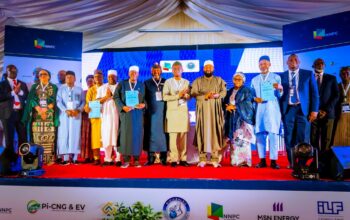
Renowned environmental activist, Nnimmo Bassey, has called for urgent and decisive climate action in Nigeria, warning that continued dependence on fossil fuels and environmental degradation could deepen the country’s ecological and economic challenges.
Bassey made the call while delivering the keynote address at the 2026 World Environment Day celebration hosted by Igbinedion University, where he urged universities to take the lead in advancing climate action, environmental justice and sustainable development.
Speaking on the theme, “Now for Climate: Nigeria’s Moment, Edo’s Opportunity – Universities at the Vanguard of the Climate Transition,” the environmental advocate said climate change is no longer a distant threat but a present reality already impacting livelihoods, food security, public health and national security.
“The future has already arrived,” Bassey said. “Climate action is no longer something that can be postponed. ‘Now for Climate’ leaves no room for procrastination or the propagation of false solutions.”
He described climate change as the “epicentre of a global polycrisis,” linking it to biodiversity loss, pollution, food insecurity, economic instability, displacement and widening social inequality.
According to him, despite international commitments under the Paris Agreement to limit global warming to 1.5 degrees Celsius above pre-industrial levels, inadequate global action has placed those targets increasingly out of reach.
Bassey cited recurring floods, coastal erosion, desertification, declining agricultural productivity and rising heat stress across Nigeria as evidence that the country is already experiencing severe consequences of climate change.
He noted that although Africa contributes only a small fraction of global greenhouse gas emissions, the continent bears a disproportionate share of climate impacts, describing the situation as a profound environmental injustice.
“The communities most exposed to climate impacts are often those with the fewest resources to adapt,” he said, stressing that climate policy discussions must remain grounded in climate justice and the principle of Common But Differentiated Responsibilities.
The environmentalist also renewed criticism of decades of oil and gas exploitation in the Niger Delta, arguing that oil spills, gas flaring, polluted water sources and degraded farmlands have inflicted significant environmental damage on host communities.
While acknowledging the need for a transition to renewable energy, he cautioned against replacing one form of exploitation with another.
“The transition away from fossil fuels is necessary, but it must be just,” Bassey said. “It must not simply replace fossil fuel colonialism with green colonialism.”
Highlighting opportunities for sustainable development in Edo State, he said the state’s forests, biodiversity and fertile lands remain valuable ecological assets that require stronger protection. He, however, expressed concern over forest degradation, illegal logging and other extractive activities threatening the environment.
Bassey called for enhanced conservation and restoration of forest reserves, describing healthy forests as vital carbon sinks that support climate regulation and local livelihoods.
He further challenged higher institutions to move beyond their traditional academic roles and become centres of innovation, policy development, research and community engagement capable of driving a just climate transition.
“Every student graduating today will enter a world shaped by climate realities,” he said. “The question is not whether universities have a role to play. The question is whether our universities are prepared to lead.”
The activist advocated the integration of climate literacy across all academic disciplines, arguing that professionals in fields such as law, medicine, engineering, journalism and economics must understand the environmental implications of their work.
He also urged universities to align research priorities with community needs, particularly in agroecology, renewable energy, biodiversity conservation, water management and climate adaptation.
According to him, campuses should serve as practical models of sustainability through the adoption of renewable energy systems, waste reduction initiatives, water conservation measures and ecosystem restoration programmes.
Bassey further called for stronger collaboration between academic institutions and local communities, emphasising the importance of indigenous knowledge systems in developing effective climate solutions.
He urged universities to critically examine projects promoted as environmentally friendly and expose initiatives that merely repackage exploitative practices under the guise of sustainability.
As Nigeria confronts the growing challenges posed by climate change, Bassey said institutions of higher learning have a unique responsibility to help redefine development and shape a more sustainable future.
“The future will not simply happen to us. It is something we collectively create,” he said. “Nigeria has a moment before it. Edo State has an opportunity before it. Igbinedion University has a responsibility before her.
“The question is whether we will act with the courage, wisdom and commitment that this moment demands.”