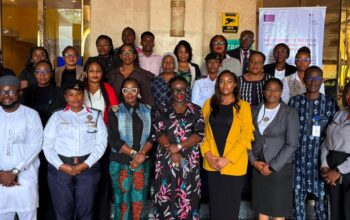
At the National Justice Summit 2024, hosted over two days, the Federal Ministry of Justice, International Institute for Democracy and Electoral Assistance (International IDEA), and other key stakeholders in Nigeria’s judiciary collectively proposed significant reforms to address systemic challenges in judicial appointments, funding, and the elimination of delays in the administration of justice.
Co-organized by the Federal Government in partnership with the European Union-funded RoLAC II Programme of International IDEA, the summit culminated in a communique unveiling the National Policy on Justice 2024 to 2028. This policy aims to serve as a guiding framework, ushering in a more effective, equitable, and responsive justice system across Nigeria.
Dr. Babatunde Ajibade, SAN, Chairman of the Joint Planning Committee, highlighted that the summit deliberated across three technical sessions, with a central focus on reforming the role of the National Judicial Council (NJC) in the judicial appointment process.
A consensus emerged regarding concerns over the concentration of power within the Chief Justice of Nigeria (CJN), who chairs both the NJC and the Federal Judicial Service Commission (FJSC). The summit underscored the need to review this dual role, given potential conflicts of interest in the appointment process.
Further, stakeholders emphasized the imperative to diversify the State Judicial Service Commissions (SJSC) to better represent the spectrum of justice sector stakeholders. Concerns were raised about the current NJC guidelines, which may limit the autonomy of the SJSCs in shortlisting judicial candidates, prompting a call for amendments to ensure collective decision-making within the commissions.
In advocating for greater transparency and meritocracy in judicial appointments, the summit endorsed exploring models akin to those in Kenya, emphasizing the codification of appointment processes to minimize discretion.
Regarding funding and administration, the summit decried the disparity between federal and state-level judiciary funding. Recommendations were made to enforce constitutional provisions mandating joint executive-judiciary funding for state courts and to professionalize court administration, separating it from the dispensation of justice.
Efforts to streamline case management and curb delays in justice administration included proposals to restrict the Supreme Court’s jurisdiction to matters of national significance, limiting automatic appeals to specific high-profile cases.
The National Justice Summit 2024 represents a pivotal step towards institutionalizing reforms that prioritize transparency, equity, and efficiency within Nigeria’s judicial system, reflecting a collective commitment to advancing the rule of law and ensuring equal access to justice for all citizens.