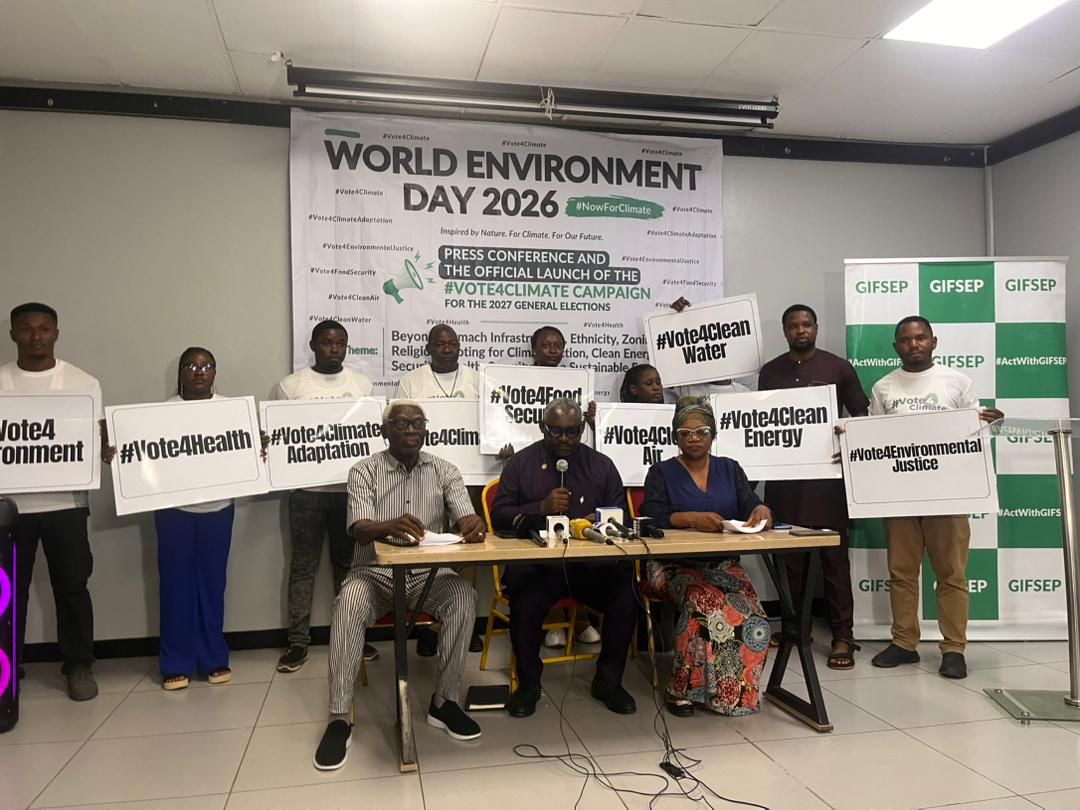
As Nigeria joined the global community to mark World Environment Day 2026, the Global Initiative for Food Security and Ecosystem Preservation (GIFSEP) has launched a nationwide campaign aimed at making climate action a central issue in the 2027 general elections.
The organisation unveiled its #Vote4Climate 2027 Campaign in Abuja on Friday, urging Nigerians to hold political leaders accountable by demanding clear commitments on environmental protection, renewable energy, food security and climate resilience.
Speaking at a press conference attended by environmental experts, development partners and civil society organisations, GIFSEP Executive Director, Dr. Michael David, said climate change has evolved from a projected threat into a present-day crisis with far-reaching economic and social consequences for Nigeria.
Commemorating this year’s World Environment Day under the theme, “Inspired by Nature. For Climate. For Our Future. #NowForClimate,” David noted that Nigerians are already grappling with the impacts of environmental degradation, including flooding, desertification, food insecurity and displacement.
He expressed concern over the shrinking of Lake Chad, which he said has lost more than 90 per cent of its size since the 1960s, undermining livelihoods across the region. He also warned that advancing desertification in northern Nigeria is reducing arable land, worsening poverty and contributing to resource-related conflicts.
David further highlighted the growing threat of coastal erosion and rising sea levels to communities in Lagos, Bayelsa, Delta and Cross River states, while noting that extreme weather events are becoming increasingly frequent and destructive.
Referencing the devastating floods of 2022, which displaced more than 1.4 million Nigerians, he described the disaster as a stark reminder of the country’s vulnerability to climate-related shocks.
According to him, air pollution from gas flaring, open waste burning and vehicle emissions continues to pose serious public health risks, contributing to thousands of premature deaths annually. He added that land degradation is costing the nation billions of naira each year through declining agricultural productivity and the loss of livelihoods.
David warned that more than 35 million Nigerians are currently facing acute food insecurity and cautioned that climate-related disruptions could further reduce agricultural output if urgent interventions are not implemented. He also identified energy poverty as a major challenge, arguing that Nigeria’s dependence on fossil fuels threatens long-term economic growth and environmental sustainability.
“Climate change is no longer a future threat. It is a present crisis affecting our economy, security, health and food systems,” he said.
At the heart of GIFSEP’s initiative is the #Vote4Climate 2027 campaign, which seeks to elevate climate issues within national political discourse ahead of the next election cycle.
David criticised the dominance of ethnic, regional and patronage considerations in electoral debates, insisting that environmental sustainability should become a key benchmark for assessing political candidates.
He urged citizens to question aspirants on their plans for climate adaptation, renewable energy development, pollution control, green job creation and environmental justice.
“Every Nigerian is a green voter because every Nigerian depends on a stable environment for survival and prosperity,” he stated.
The campaign also aims to mobilise voters to reject leaders who ignore climate risks or support policies that encourage the unsustainable exploitation of natural resources.
Also speaking at the event, Richard Nzekwu, a consultant with the United Nations Convention to Combat Desertification (UNCCD), warned that land degradation is accelerating across Nigeria and poses a significant threat to national stability.
He called for increased investment in nature-based solutions and youth-led environmental restoration initiatives, stressing that millions of Nigerians rely directly on land resources for their livelihoods.
Nzekwu cautioned that continued environmental decline could trigger large-scale migration from affected communities, placing additional pressure on urban centres and heightening the risk of social unrest.
In her remarks, GIFSEP Board Member Gloria Agema advocated greater participation of women in climate governance and decision-making processes.
She observed that women often bear the brunt of climate-related challenges, including food shortages, health risks, insecurity and displacement, yet remain underrepresented in the formulation of climate policies.
Agema urged governments and development partners to strengthen support for women-led climate initiatives, describing inclusive approaches as essential to building resilient communities.
The event concluded with a call on journalists, civil society organisations, youth groups and citizens to demand greater environmental accountability from public office holders.
As preparations for the 2027 elections gather momentum, GIFSEP maintained that climate change can no longer be treated as a peripheral issue, warning that the nation’s future prosperity and security will depend significantly on the decisions made at the ballot box.