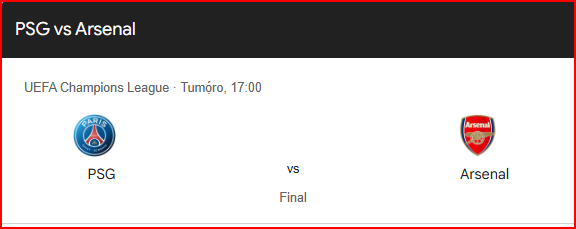
Saturday’s UEFA Champions League final at the Puskás Aréna presents a compelling tactical contradiction: a historically dominant defensive structure confronting one of the most prolific attacking units in modern European competition. Defending champions Paris Saint-Germain stand 90 minutes from becoming only the second club in the rebranded Champions League era—after Real Madrid—to successfully retain Europe’s premier club trophy. Opposing them is Mikel Arteta’s Arsenal, a side that has recently shed a long-standing domestic burden and now seeks its first continental crown.
Both teams arrive in Budapest as domestic champions, though their respective league triumphs reflect markedly different competitive contexts. Luis Enrique’s PSG secured a fifth consecutive Ligue 1 title with relative control, reinforcing their domestic dominance. In contrast, Arsenal ended a 22-year Premier League title drought, a breakthrough achievement that symbolized both sporting progression and psychological release.
Much of the pre-match narrative will inevitably reference last season’s semifinal, in which PSG eliminated Arsenal across two legs. However, a deeper analytical reading suggests the outcome was heavily influenced by contextual constraints rather than a definitive tactical mismatch.
Arsenal entered that tie significantly weakened by injuries across key defensive and attacking positions, limiting both structural stability and offensive variance. Despite these constraints, Mikel Arteta’s framework consistently generated higher-quality chance creation phases over the 180 minutes, indicating competitive underlying performance despite the aggregate result.
When combined with Arsenal’s league-phase victory over PSG earlier in the campaign, the broader data profile suggests that a fully available Arsenal squad presents a substantially more complex tactical problem than the semifinal scoreline alone implies.
The defining narrative of this final is the stark statistical divergence between two optimized footballing models—one built on suppression and control, the other on volume and vertical aggression.
Under Mikel Arteta, Arsenal have developed into Europe’s most cohesive defensive unit. Built around the central pairing of William Saliba and Gabriel Magalhães, and reinforced by David Raya’s proactive command of aerial and distribution phases, the team has allowed just six goals across 14 Champions League fixtures.
Their knockout-phase record is even more striking, conceding only twice in the most high-pressure segment of the competition. The accumulation of nine clean sheets places them on the cusp of a historic defensive milestone, underlining a model grounded in spatial compression, rest-defense discipline, and controlled pressing triggers.
Luis Enrique’s PSG, by contrast, represent the most productive attacking unit in the competition. Their 44-goal tally places them within touching distance of the Champions League scoring record, previously set by elite historical sides.
The system is defined by rotational fluidity and high-tempo isolation mechanics. Ousmane Dembélé operates as a destabilizing central reference point, while Désiré Doué and Khvicha Kvaratskhelia provide high-frequency wide progression through sustained one-v-one engagement. Collectively, the front line is engineered to stretch defensive structures laterally before exploiting transitional fractures at speed.
Beyond the headline contrast of attack versus defense, the decisive factors may emerge in less visible structural layers.
While primarily recognized for offensive output, PSG’s semifinal performance against Bayern Munich highlighted a significant evolution in game-state management. Luis Enrique’s side demonstrated improved low-block discipline and an increased capacity to absorb pressure without structural collapse—an attribute that may prove decisive in phases of sustained Arsenal possession.
With a comparatively stable squad, Arsenal’s ability to neutralize PSG’s transition phases becomes central. Arteta’s rest-defense organization will be tasked with preventing isolation scenarios for PSG’s wide attackers, particularly limiting space for Dembélé and Kvaratskhelia to engage fullbacks in open-field duels.
On paper, this final presents a near-perfect tactical equilibrium defined by opposing footballing philosophies. PSG bring elite attacking volume, historical scoring capacity, and positional unpredictability. Arsenal counter with structural discipline, defensive efficiency, and controlled game management.
In a single-match final, however, equilibrium is fragile. The outcome in Budapest will likely hinge on a narrow margin: PSG’s ability to convert transitional moments into decisive attacking events versus Arsenal’s capacity to sustain structural integrity under sustained offensive pressure.