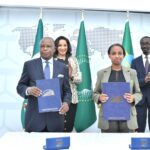
The Federal Government has unveiled a comprehensive Net Zero Investment Plan (NZIP) aimed at mobilising climate finance, accelerating green economic growth, and advancing Nigeria’s target of achieving net zero emissions by 2060.
The framework, launched in Abuja by the National Council on Climate Change, is expected to serve as a strategic roadmap for implementing the country’s long-term climate commitments by identifying priority investment sectors, financing requirements, and mechanisms for bridging climate finance gaps.
Officials said the initiative marks a significant step toward translating Nigeria’s climate pledges into practical and bankable investment opportunities capable of attracting domestic and international funding.
The NZIP was developed under the NDC Partnership’s “Global Call for NDCs 3.0 and LT-LEDS” initiative with technical support from Deutsche Gesellschaft für Internationale Zusammenarbeit and funding from the German Federal Ministry for the Environment, Climate Action, Nature Conservation and Nuclear Safety through the International Climate Initiative.
According to government officials, the investment framework aligns with Nigeria’s broader economic transformation agenda and supports the country’s ambition to emerge as a leading climate-responsive economy in Africa in line with the African Union Agenda 2063.
The framework also builds on existing national policies, including the Nigeria Agenda 2050, the Nationally Determined Contributions (NDCs), and the Long-Term Low-Emission Development Strategy (LT-LEDS), which collectively provide the policy foundation for Nigeria’s transition to sustainable and climate-resilient development.
Under the LT-LEDS framework, Nigeria aims to attain net zero greenhouse gas emissions by 2060, while the NDCs outline the country’s short- and medium-term obligations under the Paris Agreement.
Speaking at the launch, Country Director of GIZ, Markus Wagner, described the NZIP as a critical instrument for converting climate ambitions into viable projects capable of attracting large-scale investment.
Wagner said the framework provides a structured mechanism for mobilising both public and private capital toward climate resilience, low-carbon industrialisation, and sustainable economic development.
He noted that achieving net zero emissions would require close collaboration among government institutions, development partners, financial organisations, and the private sector.
According to him, the plan demonstrates Nigeria’s commitment to aligning climate action with economic development priorities while creating opportunities for innovation, green jobs, and sustainable growth across key sectors of the economy.
Analysts say the launch of the NZIP could strengthen investor confidence in Nigeria’s green economy agenda and position the country to benefit from growing global climate finance targeted at low-carbon and climate-resilient development initiatives.